
Research suggests that the challenges often seen alongside autism may not be separate conditions, but connected patterns in how children experience and respond to the world
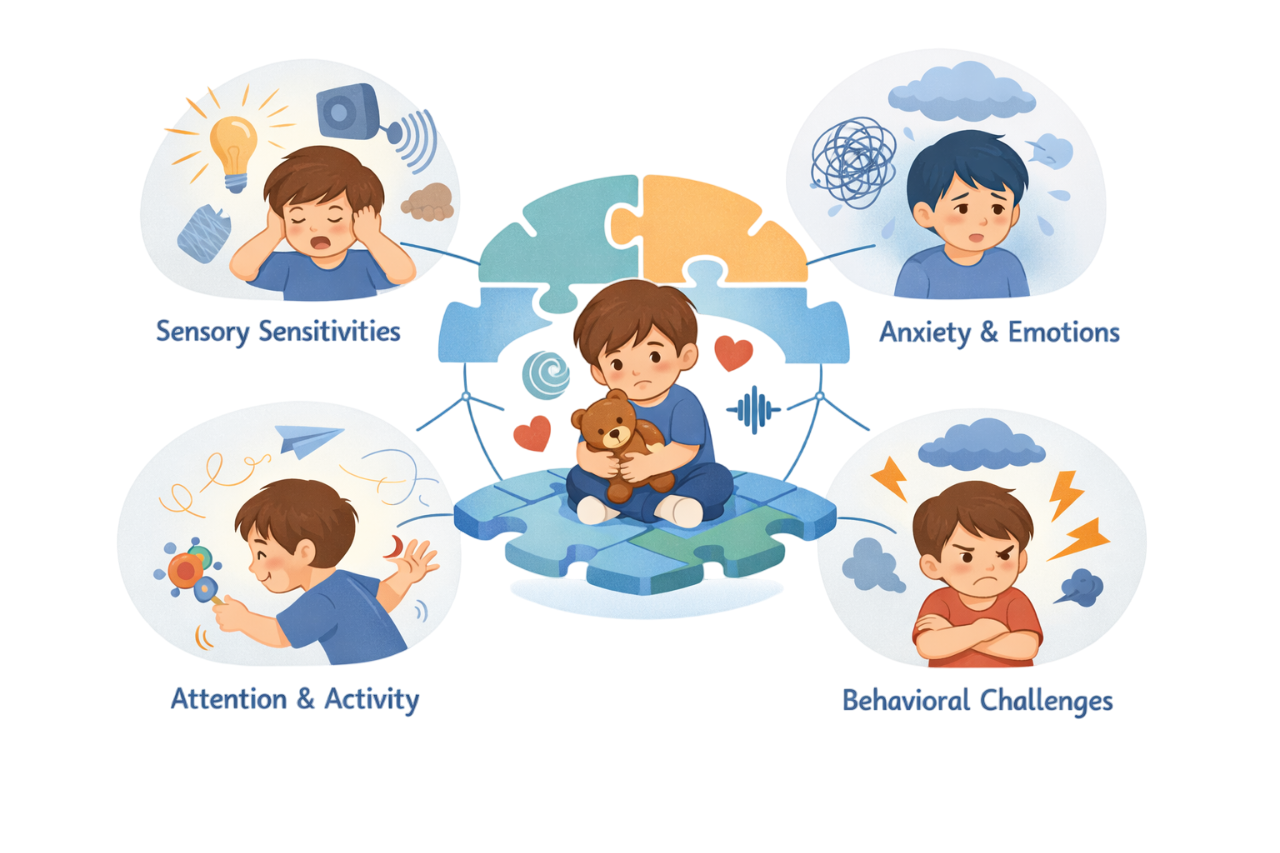
When a child is diagnosed with autism, many parents begin to notice other challenges alongside it, things like anxiety, attention difficulties, mood changes, or behavioural concerns.
This is not uncommon. In fact, research shows that around 70% of autistic children experience at least one additional condition, such as anxiety, ADHD, or depression.
But a recent study brings a new way of understanding this. Instead of seeing these as separate conditions happening together, researchers suggest that many of these challenges may actually be deeply connected through how a child experiences and responds to the world.
A different way to understand autism
Traditionally, autism and other conditions are treated as separate diagnoses:
But this study suggests that these may not be completely independent. Instead, they may be linked through something called “approach and withdrawal behaviours.” In simple terms, this means:
These patterns are shaped by how children experience emotions, sensory input, and their environment.
How these patterns show up in everyday life
Researchers found that certain behaviours in autism are closely linked to other challenges:
These are not random overlaps. They are part of a connected system of behaviours, where one pattern can influence another.
With FAIRY, you'll get your child assessed as per DSM-5, powered by WHO's ICF framework, and enriched by domain level behavioural patterns to better support your little one.
Why this matters for parents
This changes an important assumption. Instead of thinking:
“My child has autism and anxiety”
It may be more helpful to think:
“My child has a pattern of responses that affects multiple areas of development.”
This perspective can feel more accurate, and often more empowering. Because it shifts the focus from labels to understanding:
Why development can look so different in each child
The study also highlights something parents often experience: No two autistic children are the same. This is because each child has a unique combination of behavioural patterns, across:
These patterns interact with each other, creating very different developmental profiles.
Moving toward better support
One of the biggest takeaways from this research is this: To truly support a child, we need to understand how their behaviours are connected, not just what labels they meet. This means:
When we do this, support can become more targeted and meaningful.
The bigger picture
Autism is not just a checklist of symptoms. It is a dynamic system of behaviours, where emotional, sensory, and social experiences are deeply connected. And when we begin to see these connections clearly, we move closer to understanding what every parent really wants to know:
“What is my child experiencing, and how can I support them better?”
With FAIRY, you'll get your child assessed as per WHO's ICF framework, powered by DSM-5, and enriched by domain level behavioural patterns to better support your little one.
