
A growing body of research is shifting the focus from one-time diagnosis to understanding how children develop across time, context and domains
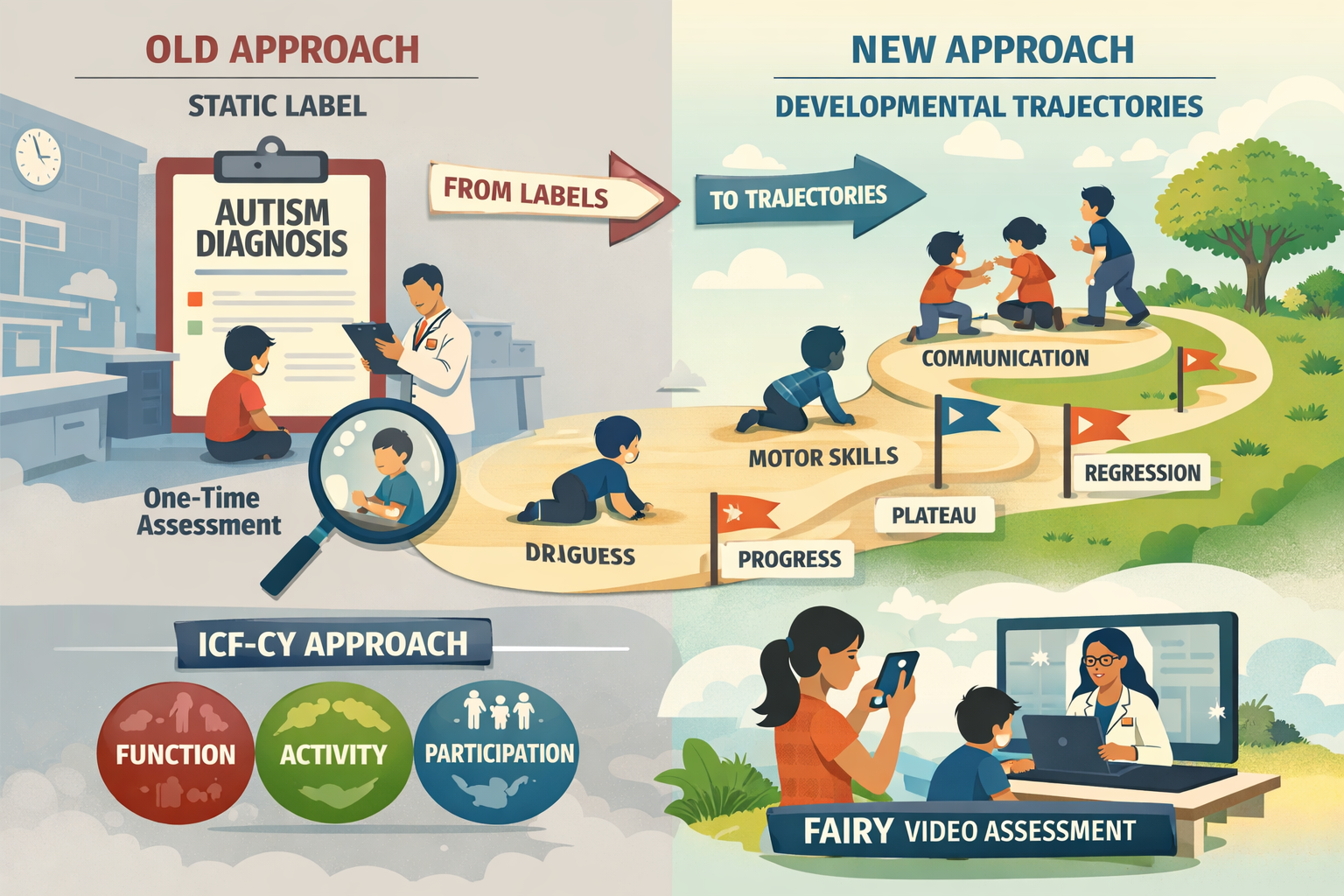
For decades, autism has been understood through labels, a child is either diagnosed or not, based on how they present at a given point in time. But research covered in the Spectrum section of The Transmitter shows that this approach is increasingly being questioned.
Scientists are now asking a different question:
Not “Does this child have autism?”
But “How is this child’s development unfolding over time?”
Development is not static
Longitudinal research, following children across months and years — shows that autism is not a fixed state. Instead, children follow distinct developmental trajectories:
Even when two children receive the same diagnosis, their developmental paths can look entirely different. This makes a single label insufficient to explain a child’s development.
The limitation of labels
A diagnosis captures a snapshot, how a child behaves in a structured setting at one moment. But as Spectrum research highlights, a snapshot cannot explain:
Two children with the same label may have very different developmental patterns, yet appear identical within a diagnostic category.
This is why researchers are moving beyond labels toward trajectory-based understanding.
What trajectories reveal
When development is tracked over time, patterns begin to emerge that labels cannot capture:
For instance, early motor differences may influence later social engagement, or communication delays may emerge after otherwise typical early development. These insights are only visible when development is viewed as a dynamic process, not a fixed outcome.
With FAIRY, you'll get your child assessed as per WHO's ICF framework, powered by DSM-5, and enriched by domain level behavioural patterns to better support your little one.
The framework that supports this shift: ICF-CY
This move toward trajectories is closely aligned with frameworks like the International Classification of Functioning, Disability and Health for Children and Youth (ICF-CY). ICF-CY does not focus on diagnosis alone. Instead, it looks at:
Importantly, it treats development as multidimensional and evolving, rather than reducing a child to a single label. This makes it particularly relevant to autism, where development often varies across domains and over time.
From diagnosis to developmental understanding
The shift in research reflects a deeper change: Autism is not just something to identify, it is something to understand across time.
What matters is not only whether a child meets criteria, but:
Where FAIRY (Family Assisted Integrated Review Yardstick) fits into this shift
This is where approaches like FAIRY’s video-based developmental assessment, built on ICF-CY principles, become meaningful. FAIRY allows parents to capture short, structured videos of their child in natural home environments, across multiple activities and time points. These observations are then interpreted at a domain level, aligned with how development is understood within ICF-CY, not just as a diagnosis, but as functioning across areas like movement, communication and interaction.
By combining:
FAIRY enables a view of development that is closer to what research now emphasizes: understanding patterns and trajectories, not just assigning labels.
The bigger shift
The move from labels to trajectories is not about removing diagnosis. It is about making developmental understanding more accurate and meaningful. Because when we shift from asking:
“What diagnosis does this child have?”
to
“How is this child developing?”
we move closer to:
And that is the direction autism research, and increasingly, practice is moving toward.
With FAIRY, you'll get your child assessed as per WHO's ICF framework, powered by DSM-5, and enriched by domain level behavioural patterns to better support your little one.
