
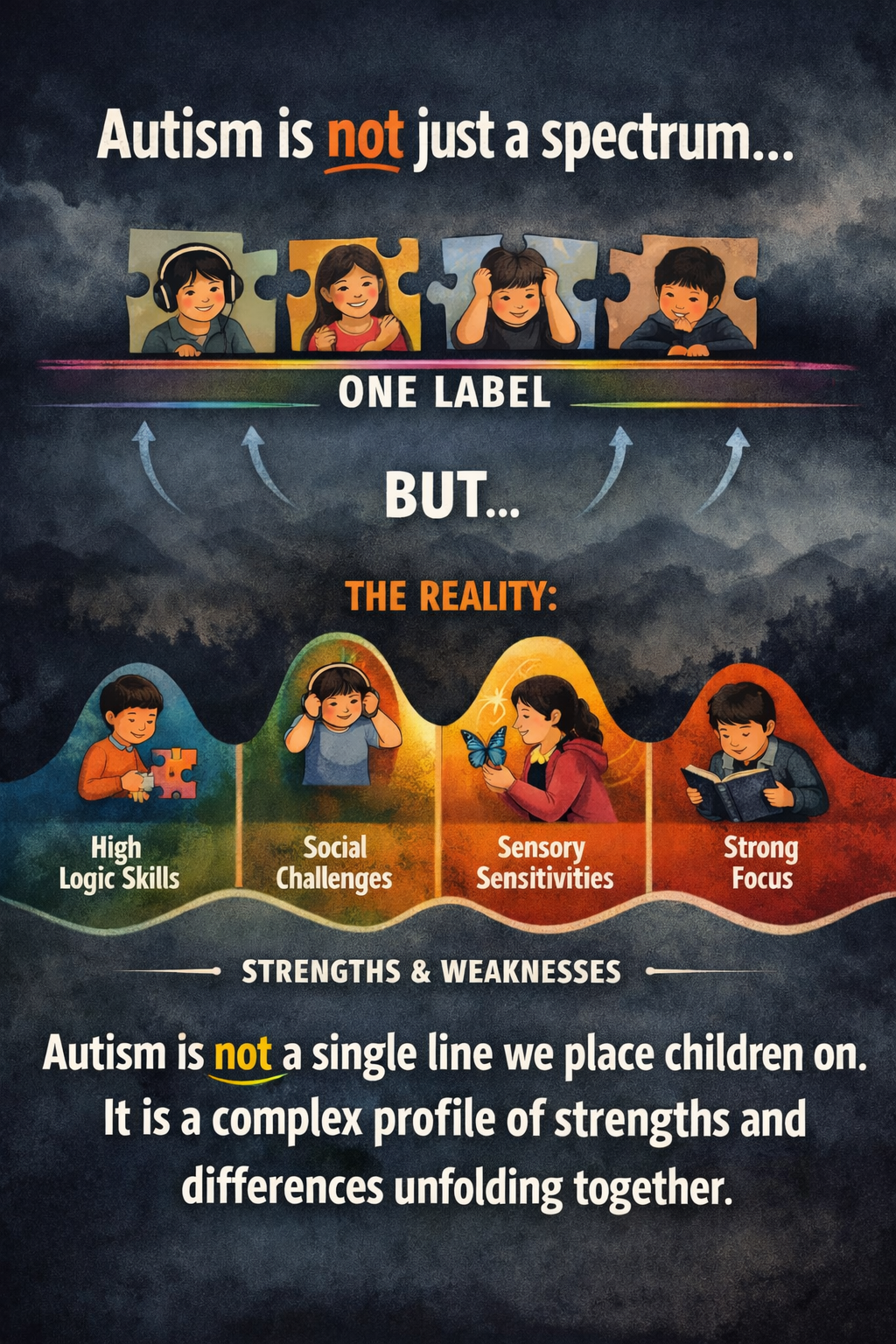
What looks like one condition often hides very different abilities. Understanding a child means seeing how those abilities come together.
In her recent interview, Uta Frith raises an uncomfortable point:
Autism may not just be a spectrum, it may be something we’ve oversimplified to the point of losing meaning.
Because what we call “autism” today includes children who are:
Completely different profiles. Yet, one label.
But Frith points to something more important: Autism isn’t just variation in severity. It’s uneven development across different abilities.
A child may:
Not a linear condition. But a spiky, uneven developmental profile. And this is where we miss something critical. When we look at children through a single label, we flatten that unevenness.
We stop asking:
Because behaviour is where these uneven abilities interact. Not in isolation. But in everyday situations.
Where this breaks down
Most assessments are built to conclude:
But what often gets lost is resolution.
The child’s:
Which is exactly what Frith is pointing toward: We need to understand autism not just as a category, but as a detailed profile of abilities.
With FAIRY, you'll get your child assessed as per WHO's ICF framework, powered by DSM-5, and enriched by domain level behavioural patterns to better support your little one.
Where FAIRY fits
This is where FAIRY aligns directly with this shift. Instead of relying on one-time, clinic-based observation,
FAIRY builds understanding through:
What this allows is something traditional assessments struggle with: Seeing how a child actually functions across domains:
Not as isolated checkpoints. But as a connected profile. And importantly, these observations are not taken once. They are layered, extended, and reviewed to build depth, not just conclusions.
Which means the output is no longer just:
“Does this child meet criteria?”
But:
“How is this child developing across domains — and where exactly do they need support?”
The real shift: Frith’s point is not to discard autism. It’s to stop flattening it into a single dimension. Because when complexity is reduced to a label,
we lose the detail required to understand it. And without that detail, support becomes generic.
The takeaway
👉 Autism is not a single spectrum to place a child on — it is a multi-dimensional profile that needs to be understood in detail.
With FAIRY, you'll get your child assessed as per WHO's ICF framework, powered by DSM-5, and enriched by domain level behavioural patterns to better support your little one.
