
What science says about the milestone most parents celebrate but few truly understand, and why recording your baby's development from day one changes everything.
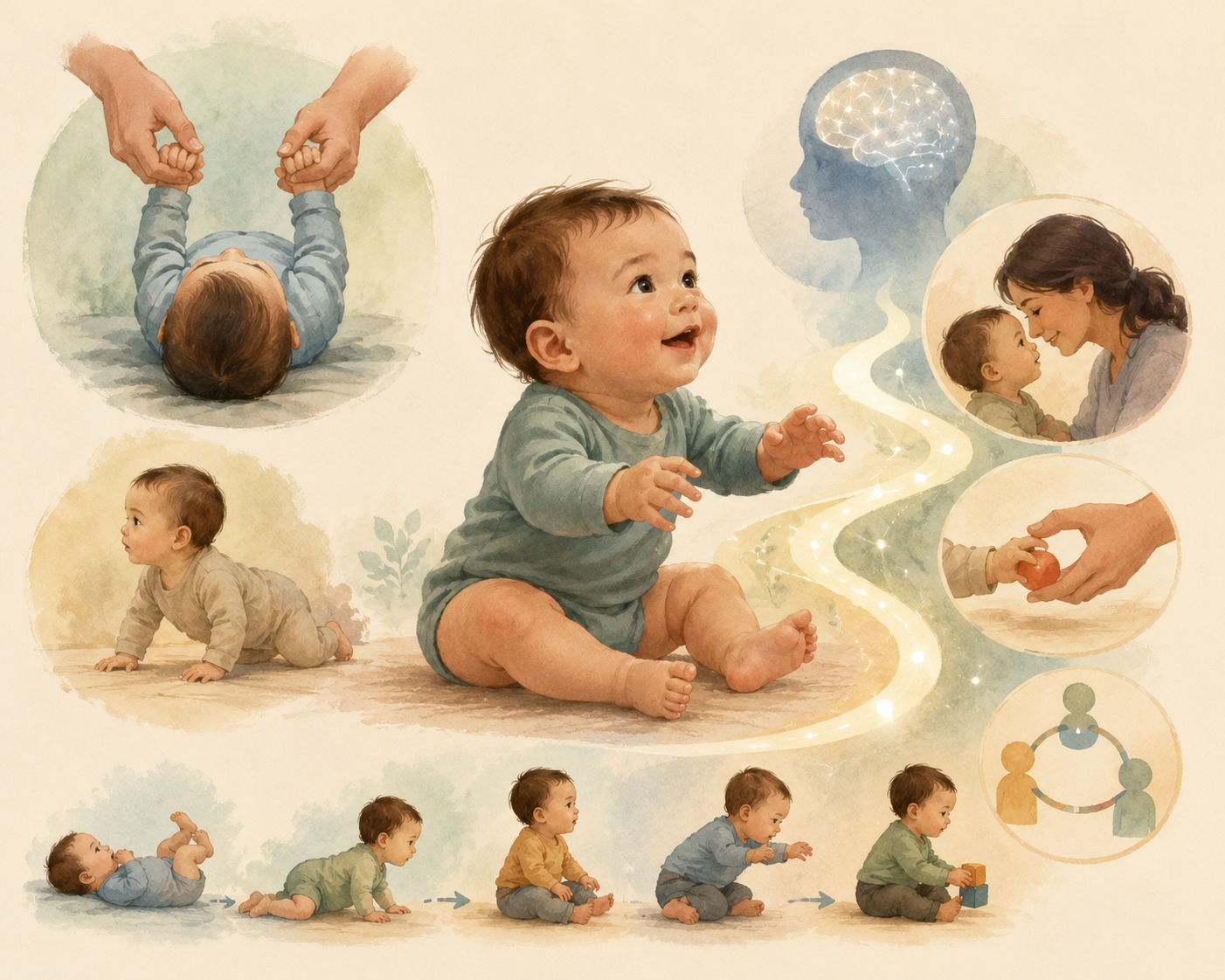
There's a moment most parents remember vividly, the day their baby, after weeks of wobbling, just sits there. Hands off the floor. Back straight. Eyes bright. It feels like a graduation. You grab your phone, film it, send it to the grandparents. Milestone unlocked.
But here's what the research quietly tells us: the when of sitting is only half the story. The how, the quality, the variety, the ease, is the part that really matters, and most parents never hear about it.
When developmental researchers observe infants in their first year, they don't just note whether a baby can sit without support. They watch what happens around that milestone. How freely does the baby move into sitting from lying down? How long do they stay there without leaning on their arms? Do they shift into side-sitting, kneeling, or squatting and back again, or do they stay locked in one position?
A landmark study followed 22 high-risk infants (younger siblings of developmentally challenged children) and 18 low-risk infants across floor-play sessions at 6, 9, 12, and 14 months. Researchers filmed them playing and coded every distinct posture each baby adopted.
The finding was striking: infants who were later diagnosed with developmental challenges used only about half as many distinct postures as their typically developing peers at 6, 9, and 12 months. These babies preferred more supported postures, leaning on their hands or staying on all fours, rather than freely sitting upright.
By 14 months, most of the gap had closed. But those early months, when a child is just learning to sit and play simultaneously, are a critical window. The baby who sits freely and shifts postures constantly is doing something far more than strengthening their core, they're opening themselves up to the world.
Monitor your little one’s development with Hidden Hum, so you can move forward with clarity today, instead of looking back with guilt later.
Think about what independent sitting actually enables. When a baby no longer needs both hands to prop themselves up, those hands become free to pick up a toy, pass it between palms, bang it on the floor, offer it to a parent. When the trunk is stable, the head and face are free too, free to look up, make eye contact, follow a gaze, respond to a smile.
Research emphasises precisely this cascade effect. Postural delays don't stay contained in the motor domain. They ripple outward into opportunities for communication, shared attention, and exploration, all foundational for language and social development. A baby spending more time in supported positions has fewer moments of that rich, hands-free, face-to-face interaction that wires the developing brain.
The Pull-to-Sit Test: A Small Gesture, a Big Signal
One of the most research-backed early checks: the pull-to-sit manoeuvre. The baby lies on their back. You gently pull them upward by the wrists. By around 4 months, a typically developing baby will begin to lift their head in line with the body as they're pulled up, what researchers call reduction of head lag.
A study followed high-risk baby siblings and found that 9 out of 10 infants who later received an assessment of developmental challenge, showed persistent head lag at 6 months, compared with 7 out of 30 high-risk infants who did not develop any challenge. The same study found that low motor scores at 3 and 6 months were linked to poorer communication skills at 18 months. Motor delays and communication delays share roots, and those roots run directly through the body's ability to hold itself upright and stable.
It's Not About Labelling — It's About Acting Early
None of this means that a baby who sits late is destined for a diagnosis. Large studies also show that most children with developmental challenges walk on time or even earlier than children with other developmental conditions of similar cognitive profiles. A "normal" milestone age doesn't close the conversation, and neither does a delay open a verdict.
What matters more is the texture of how a child moves through these milestones. Does your 9-month-old sit freely during play, or immediately reach for something to lean on? Does your 12-month-old transition from sitting to all fours and back again, or stay fixed in one position? These aren't alarming questions, they're useful ones.
You don't need specialised equipment or a clinical eye. Here are three things to observe during everyday floor time:
If something seems off, consulting a developmental paediatrician is a non-negotiable.
The Hidden Hum Beneath Every Milestone
There's something almost musical about how development works. Each milestone — rolling, sitting, standing, walking, is less a single note and more a chord, built from dozens of smaller skills vibrating together. Posture. Strength. Balance. Attention. The readiness to look up and meet the world.
Most of that richness goes unrecorded. A paediatrician's visit captures a snapshot; everyday life holds the full film. That's exactly the gap Hidden Hum was built to close. A one-of-a-kind growth vitals monitor, Hidden Hum combines a carefully designed developmental questionnaire with a meticulously analysed gaze pattern of your child's focus, delivering a detailed well-being report in under 5 minutes, aligned with RBSK guidelines from the Ministry of Health and Family Welfare alongside globally recognised early development bio-markers.
When your baby finally sits without support, reaches out for a toy, and turns to find your face that is their nervous system finding its frequency. Their inner hum, taking shape.
Hidden Hum listens for it, at every stage, across the first five years, so nothing in that frequency ever goes unheard.
Monitor your little one’s development with Hidden Hum, so you can move forward with clarity today, instead of looking back with guilt later.
