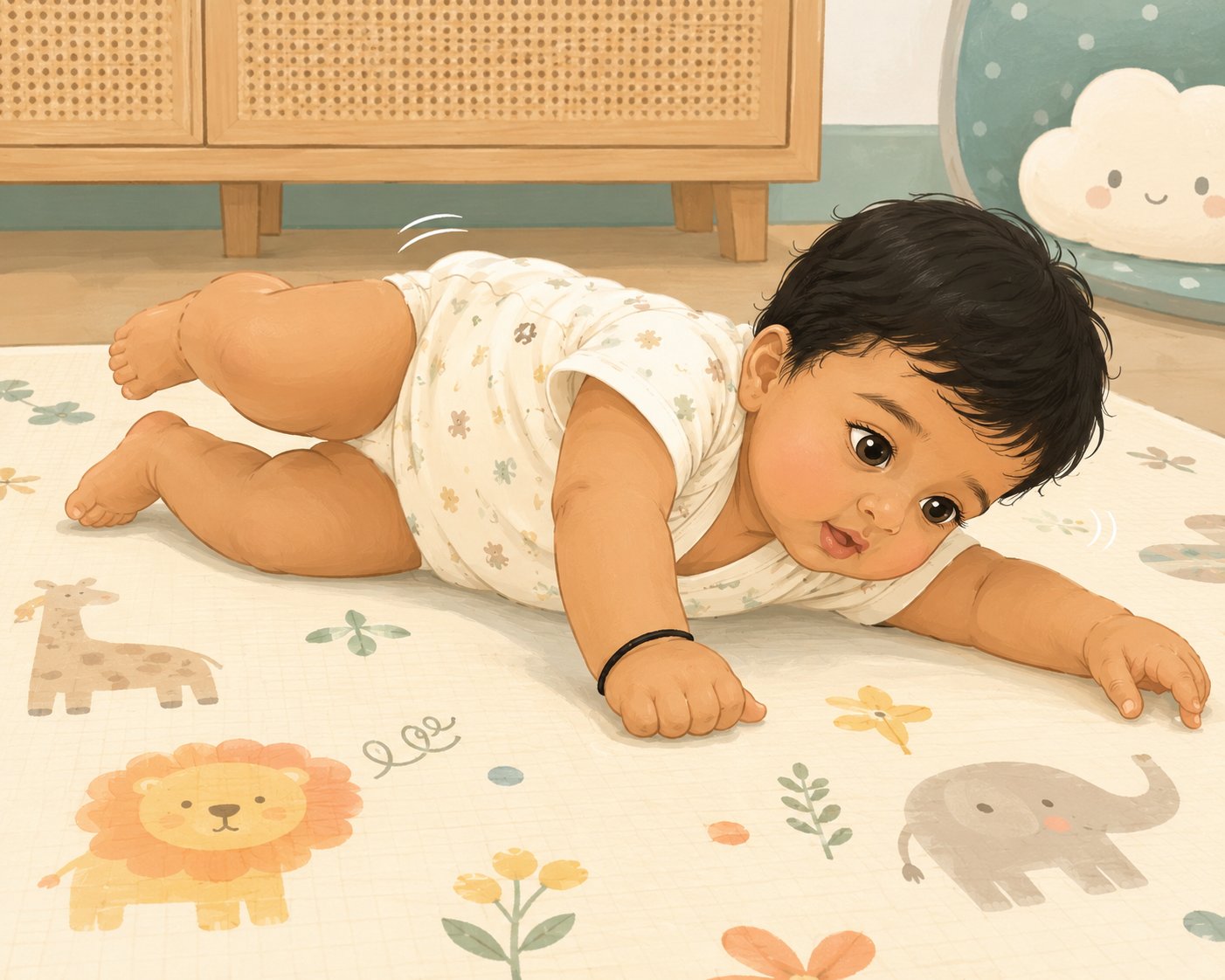
Most developmental milestone charts in wide circulation were built on data from Western, predominantly white infant populations. These charts set rolling norms that many Indian and Asian babies simply don't match — not because they are delayed, but because Asian infants roll later on average, and that is normal for them.
A landmark study from the Chinese University of Hong Kong followed a cohort of Chinese infants and compared them against Western milestone norms derived from the Alberta Infant Motor Scale (AIMS). The findings were clear and directly relevant to Indian parents using the same Western-derived charts.
Western AIMS norms place rolling milestones roughly a month earlier. When Indian parents use these charts, babies who are developing entirely typically get flagged as "behind" — creating unnecessary anxiety and, sometimes, unnecessary intervention.
Why do Asian babies roll later — and why does it matter?
The difference is largely cultural and positional. Studies across South and East Asian populations consistently show that babies spend less time in tummy time (prone position) compared to Western infants. This isn't neglect — it reflects different carrying practices, different sleeping surfaces, and different cultural norms around floor play.
Tummy time directly builds the shoulder, neck and core strength needed for rolling. Less tummy time means these muscles develop on a slightly different timeline. The motor outcome is the same — babies roll — but the clock runs a few weeks behind Western norms.
If your baby isn't rolling yet, the single most evidence-backed thing you can do is increase supervised tummy time — starting from the first weeks of life, building to 30 minutes spread across the day by 3 months.
"Asian infant motor norms differ from Western charts by 3–5 weeks for rolling milestones. Most 'delays' flagged in Indian babies are not delays at all — they are normal variation within the Asian range."
The rolling milestone window — what's typical for Indian babies
Based on Asian cohort data, the table below gives a more accurate reference range for Indian parents than most Western-derived charts.
| Rolling milestone | Typical age range (Asian norms) | Western chart age | When to consult |
|---|---|---|---|
| Prone to supine (front to back) | 3.5 – 5.5 months | 3 – 4.5 months | Not rolling by 6 months |
| Supine to prone (back to front) | 4.5 – 6.5 months | 4 – 5.5 months | Not rolling by 7 months |
| Rolling both directions fluidly | 5 – 7 months | 4.5 – 6 months | Not rolling both ways by 8 months |
| Using rolling to move toward objects | 6 – 8 months | 5.5 – 7 months | No purposeful movement by 9 months |
These ranges are guides, not verdicts. A baby at the later end of a range who is meeting other milestones — head control, visual tracking, social smiling, reaching — is almost certainly developing typically. The concern is not one milestone in isolation, but a pattern across multiple domains.
What rolling tells us beyond the motor domain
Rolling is more than a physical achievement. A baby who rolls freely has solved a complex sensorimotor problem — coordinating vision, vestibular input, muscle activation across the full body, and motivation (there is usually something they want to reach). The moment a baby starts rolling purposefully, their world expands dramatically.
Research on motor development consistently finds that rolling and floor mobility open up opportunities for exploration, object manipulation, and spatial learning that feed directly into cognitive and language development. A baby who can't yet move toward things is a baby waiting for the world to come to them.
This is why rolling delay, when it is genuine, is worth tracking not in isolation but as part of a broader developmental picture. Is the baby showing interest in objects? Are they tracking faces? Are they vocalising and responding to sound? These questions together paint a more useful picture than the rolling milestone alone.
Be in Charge
Early motor differences can be quiet — often hidden in everyday moments. Knowing how your child is developing early gives you more opportunity to support them.
Know today, through your child's RBSK developmental markers. Objective, from home, in 6 minutes.
What you can do right now
Tummy time, daily. Place your baby on their tummy on a firm surface while awake and supervised. Start with short bursts from birth, building to several sessions of 5–10 minutes each day. Use a rolled towel under the chest if needed for support in early weeks.
Motivate with eye contact and toys. Get down to floor level. Place a high-contrast toy or your face just out of reach. Motivation drives movement — babies roll toward things and people they want.
Reduce time in bouncers and swings. Babies learn to roll through floor time, not time in supportive devices. These have their place, but a baby spending most of their waking hours in a bouncer has fewer opportunities to develop the muscle strength and movement patterns needed for rolling.
Don't compare to Western charts. If your baby is 4 months old and not yet rolling, and you are Indian, you are almost certainly looking at a normal variation. Use the Asian-range reference above, not a chart built on a Dutch or American infant cohort.
Consult if the whole picture concerns you. If your baby is past 6–7 months and not rolling in either direction, and you're also noticing limited head control, reduced interest in faces, or little babbling, a developmental assessment is the right next step.
Based on: Nelson EAS et al. Developmental assessment of motor milestones in Chinese infants: a population-based study. BMC Pediatrics. | Alberta Infant Motor Scale (AIMS) normative data. | WHO Multicentre Growth Reference Study Group. WHO Motor Development Study. Acta Paediatrica. 2006;Suppl 450.