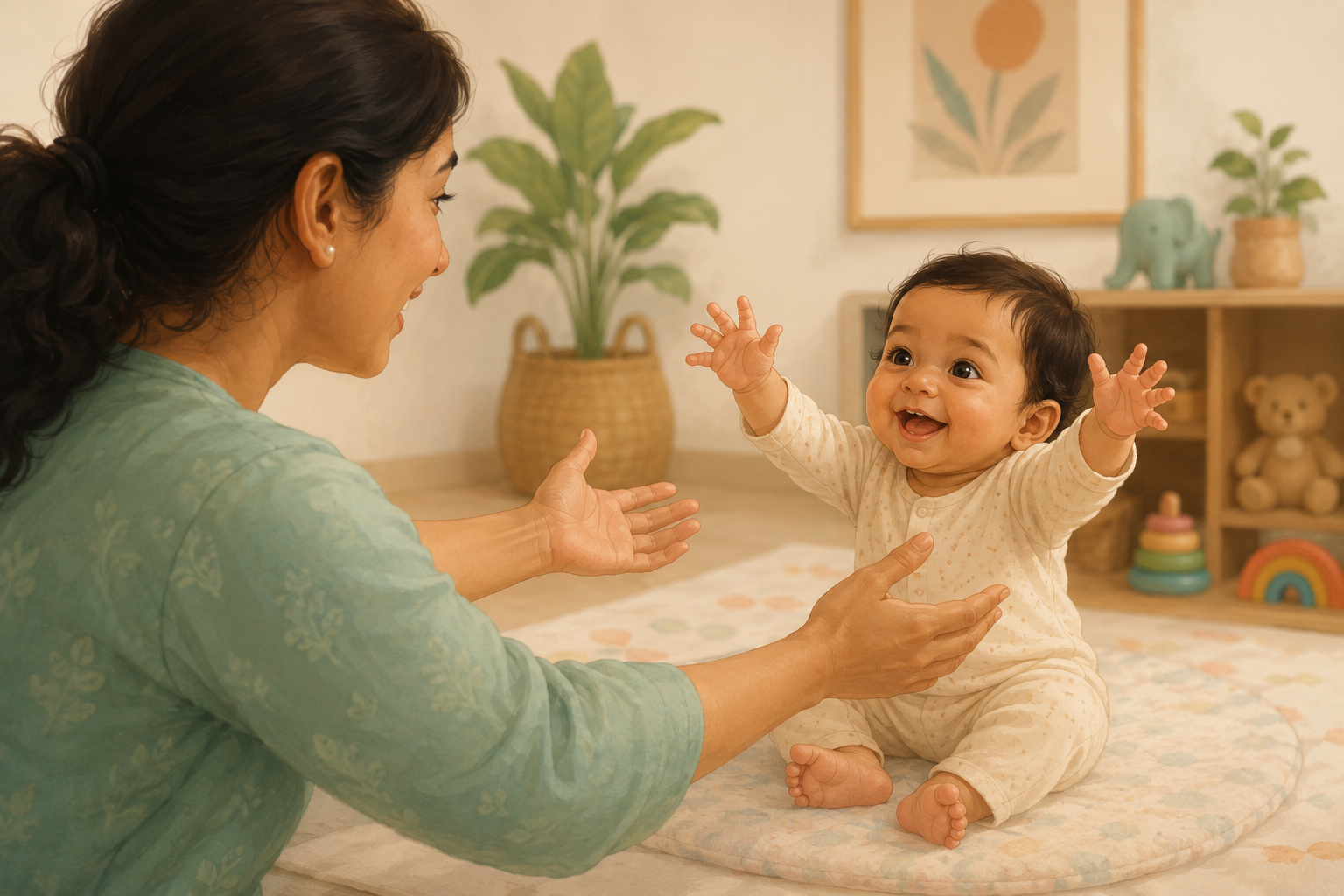
There's a moment most parents remember clearly: you walk towards your baby, open your arms, and they stretch their tiny arms up towards you — eager, certain, and completely irresistible.
It feels like pure love. And it is. But it's also one of the most meaningful developmental milestones of your baby's first year.
That small gesture — arms up, body leaning forward, eyes locked on yours — is your baby telling you something in the only language they have right now. And what it reveals about their growing brain is remarkable.
Worried about how your little one is developing? Hidden Hum is a free, 6-minute, RBSK-aligned check you can do from home — clarity today, not guilt later.
What is really happening when your baby raises their arms?
On the surface, "arms up to be picked up" looks like a simple, instinctive response. Under the surface, it's anything but.
For your baby to raise their arms when you approach, several sophisticated things must happen simultaneously:
- They must recognise you as a familiar, trusted person — not just a face in the room
- They must predict what's about to happen, based on hundreds of repeated experiences of being lifted by you
- They must use a deliberate body gesture — arms up, body leaning forward — to communicate: "Yes. You. Now. Pick me up."
"Researchers found that babies begin making anticipatory adjustments — shifting arms, stiffening bodies — even before a caregiver's hands make contact. By 6–9 months, this matures into something unmistakably intentional."
This is early social intelligence. Early body control. And early communication — all bundled into one small, outstretched pair of arms.
When should you expect to see this milestone?
Most typically developing babies show a reliable "raise arms to be picked up" response somewhere in the 6–9 month window. Indian paediatric training materials — used in DNB and MD programmes — specifically list this behaviour at 7 months, making it a well-established clinical expectation in our own medical system, not just a borrowed Western benchmark.
Here's roughly what the progression looks like:
- Around 4–6 months: Your baby begins to show subtle postural changes when you approach to lift them — body stiffening slightly, arms beginning to shift. The response is there, but it's quiet and easy to miss
- Around 6–7 months: The gesture becomes more obvious. Your baby recognises familiar adults, shows a clear preference for being held by you, and begins to lean or reach upward when you come close
- Around 7–9 months: "Arms up" is now a consistent, intentional part of your daily interactions — especially when your baby is tired, unsettled, or wanting comfort. They may also pair it with vocalisations, eye contact, or an expectant expression
Different milestone frameworks place the exact timing slightly differently, but the consensus is consistent: by 9 months, most babies do this reliably with their primary caregivers.
What does Indian research tell us about early gestures?
One of the most important questions for Indian parents is whether global research actually applies to their children. For this milestone, the evidence is locally grounded and reassuring.
Studies following Indian infants from 8 to 18 months have found that babies use a growing range of communicative gestures — reaching, showing, giving, indicating — to express needs and desires well before they have words for them. Research on Tamil-speaking infants at 10–12 months confirms that gesture use is already rich at this stage, while meaningful spoken words are still rare.
Critically, richer gesture use in the first year and a half is strongly linked to better language outcomes later.
"Raising arms to be picked up" fits squarely within this — what researchers call an instrumental gesture, where a baby uses their body to request a specific action from a specific person.
Indian data confirms that typically developing infants in our context are doing this actively by the end of the first year, often well before they can say the words for what they want.
Why this milestone is a window into so much more
What makes "arms up to be picked up" so valuable as a developmental marker is how much it bundles together in a single moment:
- Attachment and social preference. Your baby doesn't raise their arms for just anyone. They raise them for you — the person they know, trust, and want to be close to. That selectivity matters
- Understanding of cause and effect. They recognise what your approaching posture means and respond before you've lifted them. That's prediction, not just reaction
- Intentional communication. This isn't a random body movement. It's a consistent, goal-directed gesture aimed at a specific person to produce a specific outcome
- Motor planning and coordination. Adjusting their posture and arms in anticipation of being lifted requires real coordination — the same kind that will support more complex motor skills later
Together, these make "arms up to be picked up" an early high-value signal for how your baby's social, communicative, and physical development are progressing — not diagnostic on its own, but too important to overlook.
When should parents pay closer attention?
A delay in this milestone doesn't automatically indicate any specific concern. Development varies, and context matters. But there are moments when it's worth looking more carefully.
- Watch more closely if: By 7–8 months, your baby shows very little anticipatory response when you approach to pick them up — no arm movement, no body leaning, no change in expression — consistently, not just on an off day
- Speak to your paediatrician or developmental specialist if: By 9–10 months, your baby never seems to anticipate being picked up by familiar caregivers, and you're also noticing limited eye contact, few smiles directed at you, little or no babbling, or an overall sense that your baby isn't responding to social interaction the way you'd expect
No single milestone tells the whole story.
But when multiple signals cluster together in the same window, early attention makes a genuine difference.
Simple ways to support this milestone at home
You don't need to train your baby or run exercises. You just need to create the right conditions for this gesture to emerge naturally — and to notice when it does.
- Use a consistent pick-up cue. As you approach your baby, open your arms and use the same phrase each time — "Come here!" or "Uthao?" — before you lift them. Over time, they begin to associate your movement and words with what comes next, and start responding in advance
- Give them a moment to respond. Pause briefly before lifting. Many babies will shift their arms or lean forward in that small gap. If you always scoop them up immediately, you may not see the gesture at all
- Repeat often with familiar people. This response typically appears first — and most strongly — with primary caregivers. Let grandparents, regular household members, and other familiar adults try the same cue so you can observe how your baby responds to different people
- Notice the pattern, not the perfect moment. You're looking for a consistent behaviour across many interactions, especially when your baby is tired or wanting comfort — not a single picture-perfect "arms up" response
Why this milestone doesn't always get the attention it deserves in India
India has strong frameworks for early child health — including the Rashtriya Bal Swasthya Karyakram (RBSK), which places real emphasis on early identification of developmental risk. But in daily practice, most parents receive structured guidance on physical growth (weight, height, vaccinations) and far less on communication and social milestones like gesture development.
The result is a common pattern: parents sense something, but aren't sure if their concern is valid. They wait. And the early window, when intervention is most effective, quietly closes.
"The gap isn't awareness. It's structure. Indian parents need the same rigour for developmental milestones that they already have for growth charts."
How Hidden Hum helps Indian parents track this milestone
Hidden Hum is an RBSK-aligned developmental monitoring tool built for Indian families — designed to bring the same structure and seriousness to communication and social milestones that growth charts bring to physical development.
For this milestone specifically, Hidden Hum:
- Prompts you at the right ages — 6, 7, and 9 months — to actively observe and record whether your baby is consistently raising their arms to be picked up by familiar caregivers
- Uses your baby's natural gaze, responses, and engagement during simple guided activities to build a clearer picture of how social connection and early communication are developing together
- Translates your observations into an RBSK-aligned view of whether your baby is broadly on track, or whether a more detailed conversation with your doctor would be worthwhile — without labelling, diagnosing, or making clinical promises
Hidden Hum doesn't replace your paediatrician.
It ensures you arrive at your next appointment with clearer observations, better questions, and the confidence to act early if it matters.
Track your baby's gesture milestones against RBSK guidelines — from 2 months — with Hidden Hum's early skills profiler.
The bottom line for parents
When your baby stretches their arms up for you, they are doing something profound: they are recognising you, predicting your actions, and asking — in the clearest way they know — to be close to you.
That's not just a sweet moment. It's a window into their social intelligence, their communication, and their developing sense of the world. It deserves the same careful attention you give to every other milestone on your child's health chart.
Enjoy it. Celebrate it. And track it.
For more on how early gestures and social development connect, see our pieces on your baby's social smile, consonant babbling milestones, and what it means when a baby doesn't respond to their name.
Hidden Hum is part of the Fairy Tales Wellbeing family, supporting Indian parents with evidence-based, locally relevant developmental monitoring from birth to 6 years.