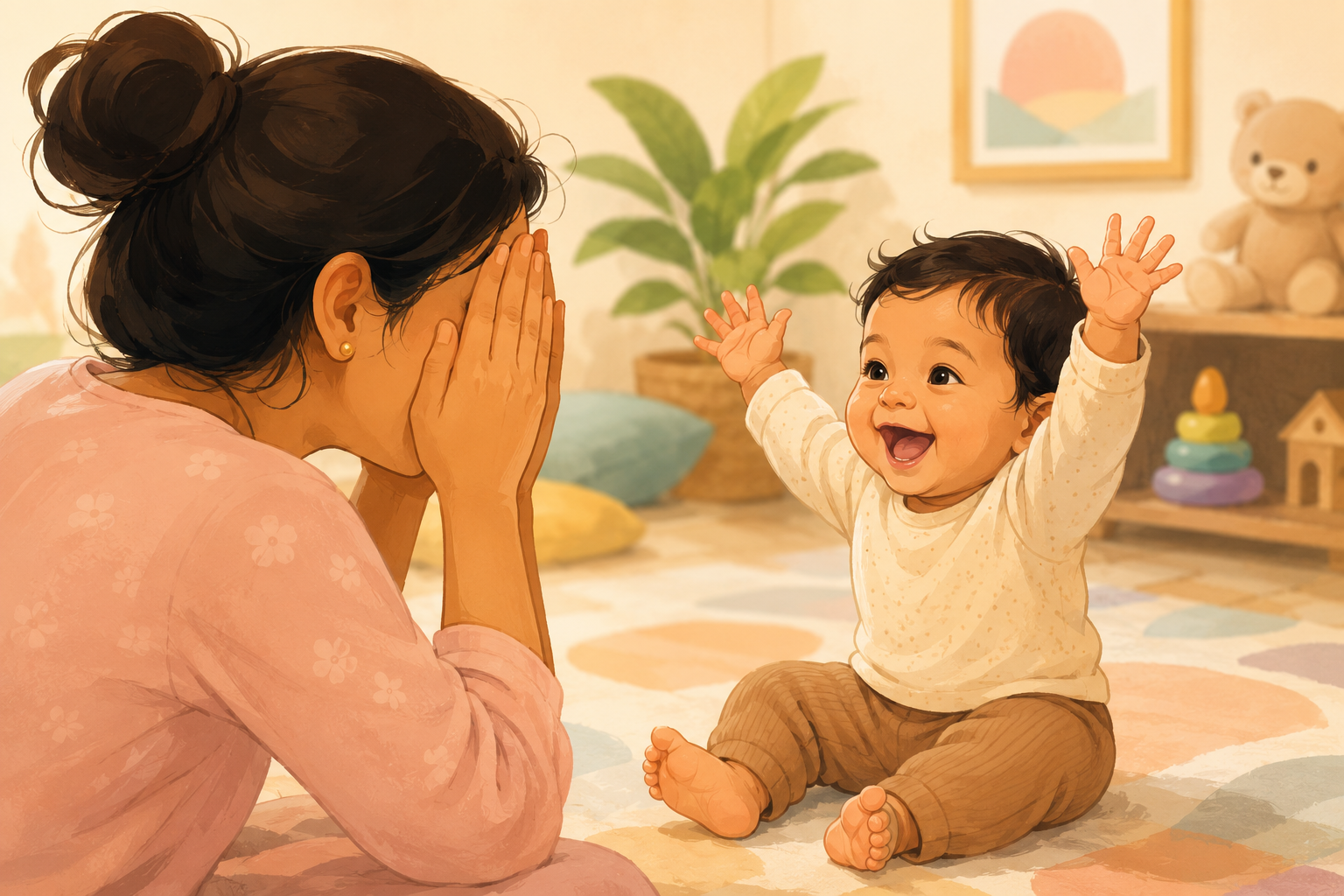
You cover your face. Pause. Reveal yourself. And your baby erupts — every single time, like it's the best surprise they've ever had.
Parents play peekaboo because it's fun. What most don't realise is that this simple game sits at the intersection of some of the most important developmental science in early childhood — object permanence, social communication, and emotional understanding, all wrapped into thirty seconds of play.
Here's what the research actually says about why this game matters, and what your baby's response to it can tell you.
Be in Charge
Social and cognitive differences can be quiet — often hidden in everyday moments. Knowing how your child is developing early gives you more opportunity to support them.
Know today, through your child's RBSK developmental markers. Objective, from home, in 6 minutes.
Why peekaboo is expected by 9-12 months
Multiple global milestone frameworks converge on the same window for this behaviour. Guidance from Together by St. Jude notes that infants in this age band find hidden things easily and actively play games such as peekaboo and pat-a-cake. UNICEF's Internet of Good Things resource specifically recommends hiding objects and observing whether an infant can find them, expecting increased curiosity and active searching during this period. The BBC's Tiny Happy People programme frames toy hide-and-seek as a 9-12 month activity that builds listening, one-to-one interaction, and the ability to follow simple instructions.
By 9 to 12 months, babies are expected not just to tolerate peekaboo, but to actively search, anticipate, and engage with it as a genuine two-way game.
The real reason peekaboo works: object permanence
Underneath the giggles, peekaboo is a live demonstration of one of the most studied concepts in infant cognition: object permanence — the understanding that people and objects continue to exist even when they can't be seen.
Foundational research by Baillargeon (1991) found that infants as young as 3.5 to 4 months already represent the existence and trajectory of hidden objects, using clever looking-time experiments where infants stared longer at physically impossible events involving hidden objects. Kaufman and colleagues (2005, PNAS) took this further, identifying oscillatory brain activity during occlusion that reflects the brain actively maintaining a mental representation of a hidden object.
A comprehensive 2015 review of object permanence research concluded that while this understanding is present quite early, it becomes progressively more flexible and integrated with real action — searching, reaching, pointing — through roughly 6 to 12 months.
"Your baby isn't just being entertained. They're actively exercising a cognitive skill that's rapidly maturing in real time."
Peekaboo teaches your baby how conversations work
Peekaboo isn't only a cognitive exercise — it's your baby's earliest lesson in social turn-taking.
A landmark study by Bornstein and colleagues (1984, Child Development) filmed 17 mother-infant pairs monthly from 8 to 16 months playing games including peekaboo. They found infants played more rounds once they could perform game-relevant behaviours, like uncovering their own face — and that mothers' "stage-setting" behaviours shaped how infants participated over time.
The psychologist Jerome Bruner described peekaboo as a structured social game with defined roles — a hider, a hiding device, an agent who reveals — with a stable, repeating sequence. This structure, Bruner argued, scaffolds the back-and-forth rhythm babies will later use in real conversation.
Research by Nomikou and colleagues (2017, Frontiers in Psychology) confirmed this directly, showing that infants shift from being passive participants in peekaboo to actively initiating and modulating the game themselves.
It's the same shift from responder to initiator that underlies all early communication.
By 10-13 months, peekaboo becomes genuinely communicative
Here's where the science becomes especially interesting. Around 10 to 13 months, peekaboo and hiding games stop being just about finding objects — they start reflecting whether your baby understands what another person knows.
A striking study by Bourdais and colleagues (2013, Infant Behavior & Development) had 10- and 13-month-olds play a hiding game with their mothers under two conditions: one where the mother watched the toy get hidden, and one where she didn't. In the first condition, 10-month-olds already gave accurate gaze and pointing cues. But in the second condition — when the mother genuinely didn't know where the toy was — only the 13-month-olds adjusted their gestures to actively inform her.
"That's a remarkable jump in just three months: from communicating out of habit, to communicating because you understand someone else doesn't know something you do."
A related study by Behne and colleagues (2005, Developmental Science) found that by around one year, infants reliably use pointing and gaze in hiding games as genuinely informative signals — not just as attention-grabbing gestures. A 2023 longitudinal study in Cognitive Science, tracking infants monthly from 10 to 13 months, found a clear, steady increase in what researchers call "cognitive reference comprehension," reaching stable, above-chance understanding by 12 months.
Your baby's laughter isn't random — it's expectation being confirmed
Even the joy of peekaboo has been studied closely. Research published in Developmental Psychology (2001) found that infants show distinct emotional and attentional responses when the "reveal" moment in peekaboo carries different expressions — showing that babies are genuinely reading and responding to what happens at the reveal.
Further research summarised by the BBC found that infants laugh more during a standard, predictable version of peekaboo than during a "trick" version where the person or location changes unexpectedly.
The joy of peekaboo comes from a baby's expectations being confirmed — not simply from surprise. Your baby isn't just being startled. They're anticipating, and delighting in being right.
What healthy peekaboo engagement looks like at 9-12 months
Based directly on the research, here's what to watch for:
- Active searching — looking for a hidden toy or person, not just staring blankly when something disappears
- Anticipation before the reveal — a baby who leans in, smiles, or shows excitement just before you reappear is demonstrating genuine expectation, not just reacting after the fact
- Taking an active role — by this age, many babies begin initiating the game themselves, covering their own eyes or hiding an object to prompt you to play
- Clear positive affect at the reveal — laughter, smiling, or vocalising when the hidden person or object reappears
- Emerging communicative gestures — around 10-13 months, watch for your baby using gaze or pointing to guide you toward a hiding spot, especially if they sense you don't already know where something is
When to talk to your paediatrician
If by 12 months your baby shows little interest in searching for hidden objects or people, doesn't seem to anticipate the reveal, or appears consistently disengaged from social games like peekaboo, it's worth raising with your paediatrician alongside other developmental observations. This isn't cause for alarm — but early, structured attention is always more useful than waiting.
For more on how early social and cognitive signs connect, see our pieces on hidden object search at 15 months and what it means when a baby doesn't respond to their name.
How Hidden Hum helps parents track this milestone
Most parents intuitively know peekaboo is good for their baby — but few have a structured way to observe what it's actually revealing about their baby's cognitive and social development.
Hidden Hum, our RBSK-aligned early skills profiler, closes that gap. At the 9 and 12-month stages, Hidden Hum prompts parents to observe and record exactly what the research identifies as meaningful — whether their baby searches actively for hidden objects, shows anticipation before a reveal, and takes an increasingly active role in initiating social games like peekaboo.
These observations build into a clear, longitudinal picture of your baby's cognitive and social development — so if a conversation with your paediatrician is ever needed, you're bringing structured, evidence-grounded observations rather than a vague feeling that something's off.
Hidden Hum doesn't diagnose any condition. It ensures a milestone as meaningful as peekaboo doesn't quietly slip past unnoticed.
Frequently asked questions
At what age is peekaboo a developmental milestone?
Peekaboo becomes a developmental milestone between 9 and 12 months of age. This is when babies grasp object permanence — the understanding that a person or object still exists even when hidden. That is why the delighted reaction to your reappearance emerges around this age: your baby now knows you were there the whole time.
When do babies start playing peekaboo?
Most babies start actively playing peekaboo between 9 and 12 months. Simpler enjoyment — smiling and reacting to the reveal — can appear as early as 6 to 8 months, but by 9 to 12 months babies anticipate the reveal, search for hidden people, and begin initiating the game themselves.
Why is peekaboo important for a baby's development?
Peekaboo reflects object permanence — the understanding that people and objects continue to exist even when hidden. Research also shows it builds early turn-taking, communicative gesture use, and by 10 to 13 months, an emerging sensitivity to what another person does or doesn't know.
Does a baby's reaction during peekaboo actually mean something?
Yes. Research shows infants display distinct emotional and attentional responses during peekaboo, and their enjoyment depends on their expectations being confirmed. Babies laugh more at standard, predictable peekaboo than an unexpected "trick" version, showing genuine anticipation.
Should I be concerned if my 9 to 12 month old doesn't engage with peekaboo or hiding games?
If your baby shows little interest in searching for a hidden toy or person, doesn't anticipate the reveal, or seems disengaged from social games by 12 months, it's worth discussing with your paediatrician alongside other developmental observations.
Sources: Baillargeon (1991), Child Development; Kaufman et al. (2005), PNAS; Bornstein et al. (1984), Child Development; Nomikou et al. (2017), Frontiers in Psychology; Bourdais et al. (2013), Infant Behavior & Development; Behne et al. (2005), Developmental Science; Cognitive Science (2023); Developmental Psychology (2001).
Hidden Hum is part of the Fairy Tales Wellbeing family — a non-diagnostic, RBSK-aligned early skills profiler helping parents track developmental milestones from birth to 6 years.