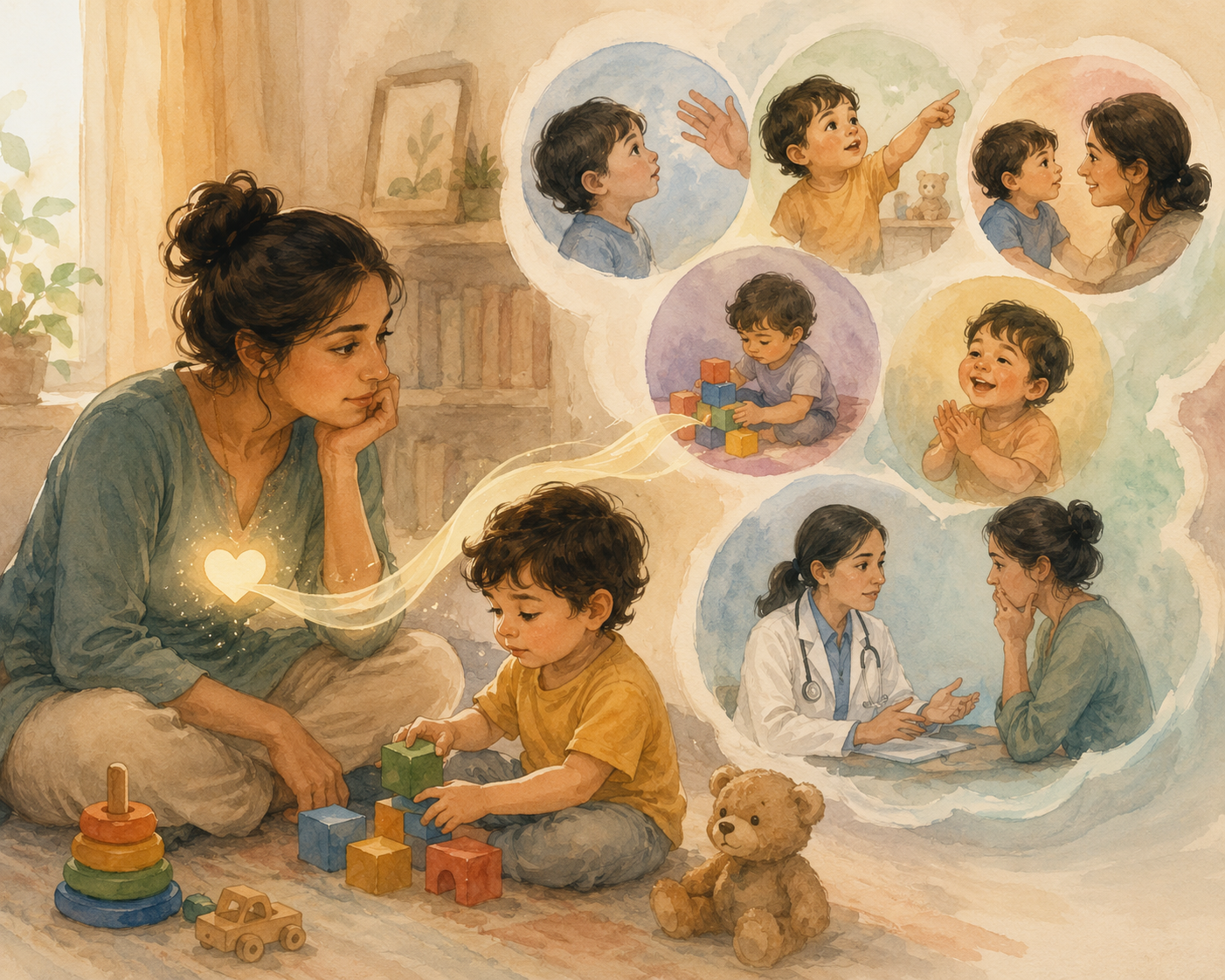
You know that feeling. It's not quite a thought yet — more of a quiet pull at the back of your mind when you watch your little one play. Everyone else says they're fine. Your mother-in-law says you're worrying too much. The paediatrician glanced at them for three minutes and said, "Come back in six months." But something in you hasn't settled. You keep watching. You keep wondering.
If this is you, we want to say something clearly, and we mean it: your instinct is not nothing. It is, in fact, one of the most clinically meaningful signals in early child development — and research has spent years trying to understand exactly why.
Your instinct is a real signal — here's what the research shows
Parental concern has measurable predictive value
When researchers looked at what parents wrote in the free-text sections of a standardised developmental questionnaire — the kinds of quiet worries a mother jots down when given the space — they found something important. Parental concern, particularly specific medical and developmental concern, predicted lower developmental scores on gold-standard assessments (Deakin-Bell, Walker & Badawi, 2013). In other words, when a parent said something feels off about how my child is developing, that concern pointed toward something real.
This finding is echoed in work focused specifically on autism. Research examining the predictive and concurrent validity of parental concern about young children at risk found that parent-reported worry carried measurable weight — it wasn't random noise, and it wasn't simply anxiety (Hess & Landa, 2011). Parents who said something felt different were, more often than not, observing something that was genuinely worth exploring.
Think about what this means for you. You are with your child every single day. You see them at breakfast, at bath time, in the middle of the night. You notice the tiny things — the way they do or don't look up when you call their name, the sounds they make or don't make, the way they respond (or don't) when you try to play together. No clinician, however skilled, has access to that depth of observation in a three-minute check-up.
But instinct alone isn't the whole picture
Here's where we want to be honest with you, because you deserve honesty more than reassurance. While parental concern is a meaningful signal, research also shows it is not, on its own, a reliable screening tool. The same study that found concern predicted lower developmental scores also found that concern alone did not meet the accepted standards for a clinical screening test — sensitivity ranged from 22% to 48% across different groups (Deakin-Bell et al., 2013). What this means in plain language: your instinct tells you something is worth looking at, but it can't tell you what or how much. That's not a failure of your instinct. That's simply what instinct is — a signal that needs a structure to become an answer.
"If your worry is focused — my child isn't responding to their name, they're not pointing at things to show me — that specificity matters. It's worth taking seriously and taking further."
The distinction matters most when it comes to the type of concern. Research found that specific medical and developmental concerns were the ones that predicted developmental outcomes — while more general or behavioural worries were less consistently linked (Deakin-Bell et al., 2013). So focused concern — such as a child not pointing to share interest — is exactly the kind of signal worth acting on.
How to tell the difference between normal development and something worth exploring
What typical development looks like — and where the edges are
Development in the first six years is not a straight line. Children move through skills at their own pace, and there is genuine, wide variation in what is typical. A child who walks at 10 months and a child who walks at 15 months are both, in most cases, developing normally. Language can surge and plateau. Social confidence can ebb and flow with temperament.
But within that variation, there are patterns that researchers and clinicians watch carefully — not because they signal a verdict, but because they signal that a child might benefit from closer attention and earlier support. These include things like: responding to their name when called, pointing to share interest in something (not just to get it), making eye contact during play, babbling and building toward words, and showing curiosity about other people. These are the kinds of behaviours that structured developmental surveillance tools are specifically designed to track.
Red flags that research shows are worth noting
A large-scale study screening over 7,000 toddlers between 14 and 22 months found that when both a parent's concern and a clinician's concern were present together, the likelihood of identifying a genuine developmental difference was highest (Wieckowski et al., 2024). But crucially, the study also found that concern from either source alone — parent or clinician — was still a meaningful signal. Children flagged by a parent's concern, even without a clinician independently raising the same concern, were still more likely to have a developmental difference than children with no concern raised at all.
If you have raised your concern and felt unheard, your concern still carries weight. It doesn't disappear because someone else didn't share it in that moment.
Why 'wait and see' can delay the clarity you need
One of the most common responses parents receive when they raise a developmental worry is "let's wait and see." Sometimes this is genuinely appropriate — development is uneven, and some children do catch up. But research on developmental surveillance suggests that waiting without any structured monitoring in place can mean that children who would benefit from early support don't receive it until much later (Barger, Salmon & Moore, 2023). The earlier a developmental difference is identified and supported, the more time a child has to build skills in the years when the brain is most responsive.
Waiting without watching — without any structured framework to tell you what you're looking for — is not the same as watchful waiting.
It's just waiting.
When your instinct isn't being heard — what you can do today
Your concern plus a clinician's concern is the strongest signal
The research is clear that the combination of parental concern and clinical concern produces the highest accuracy in early identification (Wieckowski et al., 2024). But what do you do when you have the concern and the clinician doesn't — yet? The answer is not to abandon your concern. It's to give it structure.
A structured developmental monitoring tool does something that a worried parent's instinct and a busy clinician's three-minute check-up both struggle to do alone: it asks the right questions, in the right order, about the right age-specific skills, and turns your observations into a clear developmental picture. Research comparing different approaches to developmental surveillance found that combining parental concern with standardised monitoring tools improved the accuracy of early identification across diverse populations — including multicultural cohorts where a single tool used alone showed highly variable results (Bernie et al., 2025; Barger et al., 2021).
Structured developmental monitoring: how it's different from a check-up
A routine paediatric check-up is designed to cover a lot of ground quickly — growth, nutrition, vaccinations, general health. Developmental monitoring is something different. It focuses specifically on how your child is progressing across the skills that matter most in early development: communication, social engagement, movement, thinking, play, and more. It asks age-specific questions. It looks for patterns across domains, not just individual milestones.
India has a national standard for exactly this. The Rashtriya Bal Swasthya Karyakram (RBSK), the Government of India's programme under the Ministry of Health and Family Welfare, establishes that every child deserves systematic developmental monitoring as part of routine child healthcare — not as an optional extra, but as a standard part of keeping your child well. Development, in this framework, is the fourth pillar of child health, alongside growth, hearing, and vision.
Getting a clear picture from home — in under six minutes
This is where Hidden Hum comes in. Built on India's RBSK standards and clinically aligned, Hidden Hum is a parent-led developmental monitoring tool that takes under six minutes to complete. It doesn't ask you to perform tests or follow complex instructions. It asks you about what you already see — the behaviours, responses, and patterns you observe every day at home. From your answers, it builds an Early Skills Profile: a structured developmental baseline that turns your observations into something clear and actionable.
You don't need a clinic appointment to start. You don't need a referral. You need six minutes and the observations you've already been making.
Be in Charge
Developmental differences can be quiet — often hidden in everyday moments. Knowing how your child is developing early gives you more opportunity to support them.
Know today, through your child's RBSK developmental markers. Objective, from home, in 6 minutes.
From instinct to understanding — the next step
What structured monitoring reveals that general observation misses
The difference between watching your child and monitoring your child's development is the difference between looking and knowing what to look for. A parent's general observation is rich and irreplaceable — but it doesn't always know which specific behaviours are clinically significant at which age, or how to weigh one area of development against another. Structured monitoring fills that gap. It doesn't replace what you see; it gives what you see a clinical frame.
Research examining surveillance tools used at 18 months found that some children who were not initially flagged by any tool were later assessed as having a probable developmental difference — highlighting that even structured tools are imperfect, and that ongoing monitoring over time matters more than a single snapshot (Bernie et al., 2025). This is why developmental monitoring is designed to be repeated across the early years, not done once and forgotten.
Parental observation and structured tools together improve accuracy
The evidence consistently points in one direction: parental observation and standardised monitoring tools are most powerful when they work together. Research across diverse ethnic groups found that combining developmental monitoring — which incorporates parental concern — with standardised screening improved early identification rates compared to either approach used alone (Barger et al., 2021). You are not the passive recipient of a professional's verdict. You are an active, essential part of the process.
When to seek professional assessment — and how to prepare
If your structured monitoring raises questions, or if your instinct remains strong after completing a developmental check, the next step is a professional assessment. This doesn't mean a label is coming. It means a clearer picture is coming — one that can tell you exactly what your child's strengths are, where they might benefit from support, and what that support could look like. When you go, bring your observations. Write down the specific things you've noticed — when you noticed them, how often, in what situations. The more specific your account, the more useful it is to the clinician you're speaking with.
You are not alone — and your worry matters
Many parents feel unheard — and that experience is documented
If you've raised a concern and felt dismissed, you are not imagining it, and you are not alone. Research examining parental experiences from first concern through to a developmental identification — in a non-Western context closely analogous to India — found that parents frequently described a gap between when they first noticed something and when that concern was taken seriously by healthcare providers (Qu et al., 2025). The journey from first worry to structured support can be long, and the emotional weight of that journey — of knowing something and not being heard — is real.
Research on developmental monitoring within primary care settings also highlights that the quality and consistency of developmental monitoring varies significantly across healthcare settings, and that this variation affects how early developmental differences are identified (Barger, Salmon & Moore, 2023). You may have encountered a system that wasn't set up to hear you well. That is a system problem, not a reflection of the validity of your concern.
Development is a pillar of child health — not an optional extra
Growth checks. Hearing tests. Vision screening. These are things we do routinely for every child, without waiting for a problem to become obvious. Developmental monitoring deserves exactly the same place in your child's healthcare. It is not something you seek only when you're certain something is wrong. It is something every child benefits from — a baseline, a pattern, a picture that grows with them through the early years.
At Fairy Tales Wellbeing, this is what we mean when we say development is the fourth pillar of child health. Not a specialist concern. Not a last resort. A routine, structured, ongoing part of caring for your child — from home, in your own time, in your own language.
You are your child's most important observer
No one knows your child the way you do. The research that has spent decades studying parental concern in developmental surveillance has arrived, again and again, at the same conclusion: what parents notice matters. It is not perfect — no single signal is — but it is real, it is meaningful, and when it is given the right structure, it becomes the foundation of early identification and early support.
You are not worrying too much. You are paying attention. And paying attention — structured, supported, and taken seriously — is exactly where early development begins.
If your instinct is telling you something is worth exploring, Hidden Hum is a calm, structured place to start. In under six minutes, from home, you can build a developmental picture grounded in India's national RBSK standard. Not a verdict. Not a label. A starting point — because every child deserves to be seen, and every mother deserves to be heard.
Frequently asked questions
Does a parent's instinct about their child's development actually mean something?
Yes. Research analysing parental concern in developmental questionnaires found that specific medical and developmental concerns predicted lower scores on gold-standard developmental assessments. Parental concern is a measurable, clinically meaningful signal, not just anxiety.
Is parental instinct alone enough to know if something is wrong with my child's development?
Not entirely on its own. Research found that while parental concern is meaningful, it did not meet accepted standards for a clinical screening test on its own, with sensitivity ranging from 22% to 48%. Instinct signals that something is worth exploring, but needs a structured framework to become a clear answer.
What should I do if my paediatrician dismisses my concerns about my toddler's development?
Your concern still carries weight even without a clinician's agreement. Research found that children flagged by parental concern alone were more likely to have a developmental difference than children with no concern raised at all. Structured developmental monitoring can give your observations a clinical framework a clinician can act on.
Is it better to 'wait and see' if I'm worried about my child's development?
Research on developmental surveillance suggests that waiting without structured monitoring can delay support for children who would benefit from it. Watchful waiting with a structured framework is different from waiting without any monitoring in place.
Sources: Deakin-Bell, Walker & Badawi (2013); Hess & Landa (2011); Wieckowski et al. (2024); Barger, Salmon & Moore (2023); Bernie et al. (2025); Barger et al. (2021); Qu et al. (2025).
Hidden Hum is part of the Fairy Tales Wellbeing family — a non-diagnostic, RBSK-aligned early skills profiler helping parents track developmental milestones from birth to 6 years.