If you have ever watched your autistic child light up with joy at a sibling's laugh, cry when a pet is hurt, or feel deeply distressed when someone around them is upset — and then been told by a professional that your child "lacks empathy" — you are not alone. And you are not wrong to feel that something about that assessment did not add up.
Science is catching up with what many parents already sensed. A powerful new idea called the Double Empathy Problem is turning decades of autism research on its head. In India, where autism awareness in clinical and school settings is still developing and families are often guided by older frameworks, this shift in thinking may be the most important thing you read about your child this year.
The old story — and why it stuck around so long
For nearly 40 years, the dominant explanation for the social differences seen in autism was a concept called Theory of Mind — first proposed in 1985 by researchers Simon Baron-Cohen and Uta Frith. It suggested that autistic people struggle to understand that other people have thoughts, beliefs, and feelings different from their own. The phrase they used was striking: "mindblindness."
It was a clean, compelling explanation. Suddenly, many of autism's social traits seemed to make sense — difficulty with back-and-forth conversation, taking things very literally, not picking up on sarcasm, trouble predicting how someone might feel. The theory spread fast: into textbooks, clinical training, and school IEP frameworks across the world — including, in time, India.
The only problem? The evidence began to fall apart.
Study after study showed that many autistic people passed Theory of Mind tests — yet still experienced social differences in real life. Brain scans expected to show markedly different processing showed surprisingly similar patterns. And as researchers tested more diverse groups of autistic people, the original findings kept shrinking or disappearing altogether.
The "mindblindness" model was cracking. And yet in Indian paediatric clinics, school counsellor rooms, and therapy centres, families were — and often still are — being told their child simply lacks the ability to understand others.
Enter the Double Empathy Problem — a complete reframe
In 2012, autistic researcher and scholar Damian Milton proposed something the autism research world had never seriously considered: what if the problem is not one-sided?
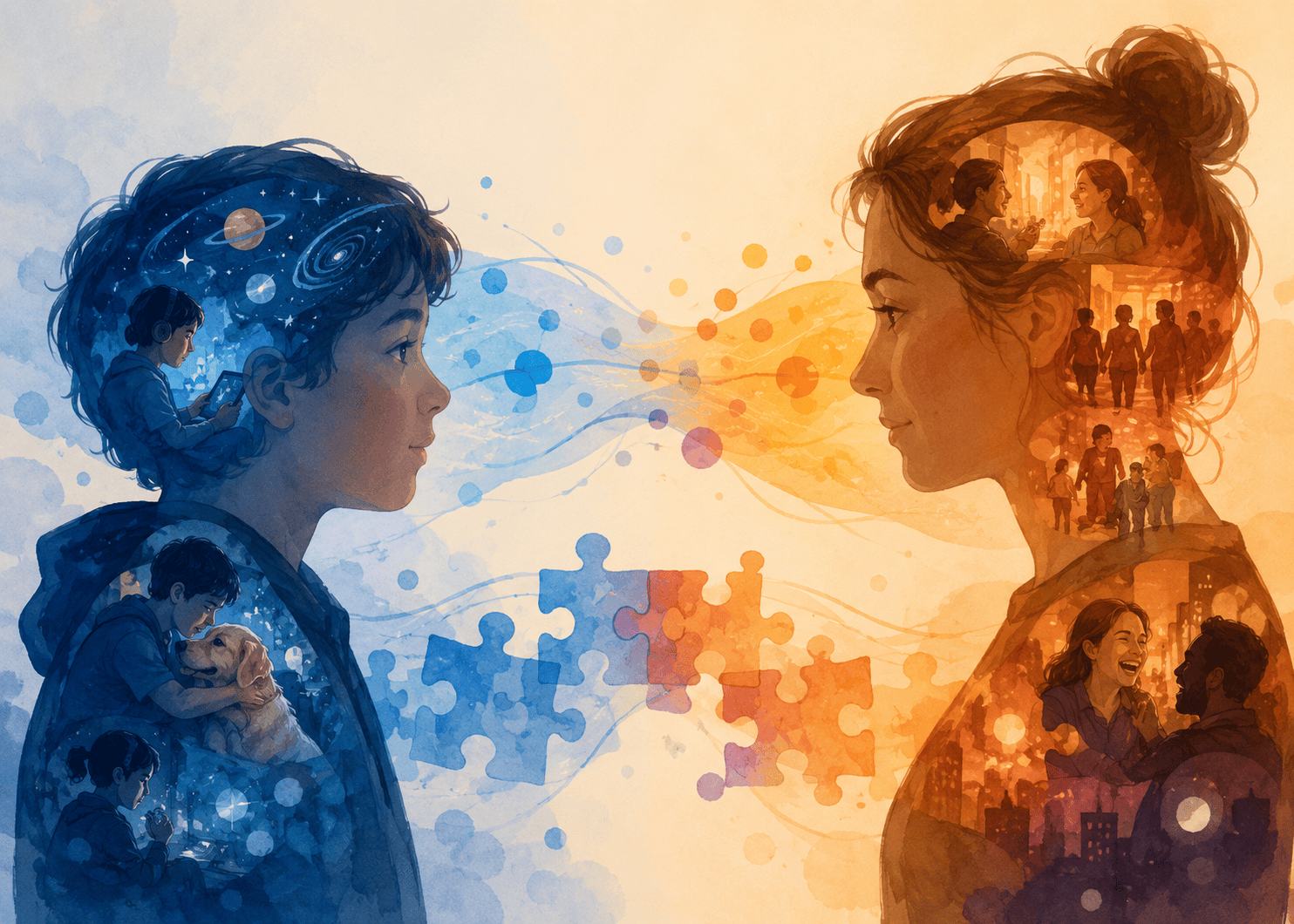
His idea — the Double Empathy Problem — is deceptively simple. When an autistic person and a non-autistic person interact and struggle to understand each other, we have always assumed the failure lies with the autistic person. But Milton asked: what if non-autistic people are equally bad at reading autistic people?
"What if this was never about a deficit in one group — but about a mutual communication gap between two groups with genuinely different ways of experiencing the world?"
Early empirical research has begun to back this up. Researcher Elizabeth Sheppard at the University of Nottingham tested this directly. Her findings showed that when non-autistic people tried to read the mental states, emotions, and intentions of autistic people, they performed just as poorly as autistic people do on traditional social cognition tests. The empathy gap runs in both directions.
This is not a minor revision to existing theory. It is a fundamental reframing of who the "problem" belongs to.
What this means for your child
Here is the part that matters most for families.
The old model said: your autistic child is missing a skill — they need to be trained to understand others. Almost every social skills programme built on Theory of Mind followed this logic: teach your child to read faces, rehearse emotions, practise eye contact, decode neurotypical behaviour until it becomes second nature.
The Double Empathy model says something fundamentally different: your child is not broken. They are communicating, feeling, and connecting — through a different lens. The difficulty they experience in social situations is not evidence of an internal deficit. It is evidence of a mismatch — between two genuinely different ways of being in the world.
Not: "Train the autistic child to fit into a non-autistic world."
But: "Build genuine two-way understanding — and teach everyone in the child's environment to recognise autistic communication, not just the other way around."
This reframing has immediate, practical meaning for Indian families:
- When your child struggles in a social setting at school, it is not solely their failure to adapt — it is also the environment's failure to be accessible to them
- When a teacher says your child "doesn't pick up on social cues," the reverse question is equally valid: does the teacher pick up on your child's cues?
- Autistic children often communicate, connect, and express empathy in ways that non-autistic observers — including Indian paediatricians and school counsellors — are simply not trained to recognise
- If your child shows love, protectiveness, distress at others' pain, or deep loyalty, that is empathy — expressed authentically in their own way
The empathy your child already has
Research has drawn an important distinction that the "mindblindness" narrative obscured: the difference between cognitive empathy and affective empathy.
Cognitive empathy is the intellectual process of figuring out what someone else is thinking. Affective empathy is genuinely feeling what another person feels — caring about their pain, resonating with their joy.
Many autistic people report not reduced empathy, but heightened emotional resonance — feeling others' distress so intensely it becomes overwhelming. As researcher Francesca Happé of King's College London has noted, many autistic individuals say they "resonate too much with people's emotions." That is the opposite of the empathy-less caricature that dominated for decades.
This matters enormously for how we interpret behaviour. When an autistic child becomes distressed in a busy or emotionally charged environment — a classroom argument, a family gathering, a crowded festival — that distress may not be about sensory overload alone. It may be about feeling too much, not too little.
Understanding how a child actually experiences and expresses emotion — not just whether they pass a clinical checklist — is central to the FAIRY assessment approach. Rather than relying on a single clinic visit, FAIRY builds a domain-level profile of your child's development over time, including how they communicate and connect in real-world contexts.
What good support should look like now
If the Double Empathy Problem holds up — and the evidence is building — it has direct implications for how we support autistic children in Indian homes, schools, and therapy rooms.
For parents and caregivers, this means:
- Advocating for teachers who are trained in autistic communication styles — not just trained to manage autistic behaviour — particularly as India's inclusive education policy begins to take shape in more schools
- Choosing therapy approaches that start from a position of communication difference, not deficit correction. Approaches that ask "how does this child communicate?" rather than "why can't this child communicate normally?"
- Trusting your own observations. If your child shows empathy at home in ways their school does not see, that data matters. Consistent, structured documentation of what you observe is far more valuable than a single clinic snapshot — and tools like Hidden Hum are built precisely for this
- Asking better questions of the professionals around your child: has the school counsellor heard of the Double Empathy Problem? Does the therapist work from a neurodiversity-affirming framework?
This is also why oversimplified views of autism are not just intellectually incomplete — they have real consequences for the kind of support children receive. And why understanding the trajectory of a child's development, not just their diagnostic label, gives families and clinicians a far more useful picture.
A new story for a new generation
The Double Empathy Problem is not the end of research into social differences in autism — it is a new beginning. Researchers are now asking better questions: How do autistic people connect powerfully with each other? What does successful autistic-to-autistic communication look like? How do we build environments — in Indian homes, schools, and clinics — where both neurotypes can be understood and supported?
One of the most striking findings from this line of research: when autistic people interact with other autistic people, they communicate and build rapport just as effectively as non-autistic pairs do. The difficulty is not in autistic communication itself. It is in the cross-neurotype mismatch — which means both sides have work to do.
For too long, the story told about autistic children and empathy was incomplete. It shaped policies, IEP meetings, therapy goals, and how millions of families — including Indian families — were made to feel about their children. The science is correcting itself. What it now tells us is both simpler and more demanding: your child was never missing empathy. The world was missing a better understanding of them.
"Your child was never missing empathy. The world was missing a better understanding of them."
Based on research published in The Transmitter / Spectrum: "Theory of Mind in Autism: A Research Field Reborn" (2022). The Double Empathy Problem was first proposed by Dr. Damian Milton (2012).