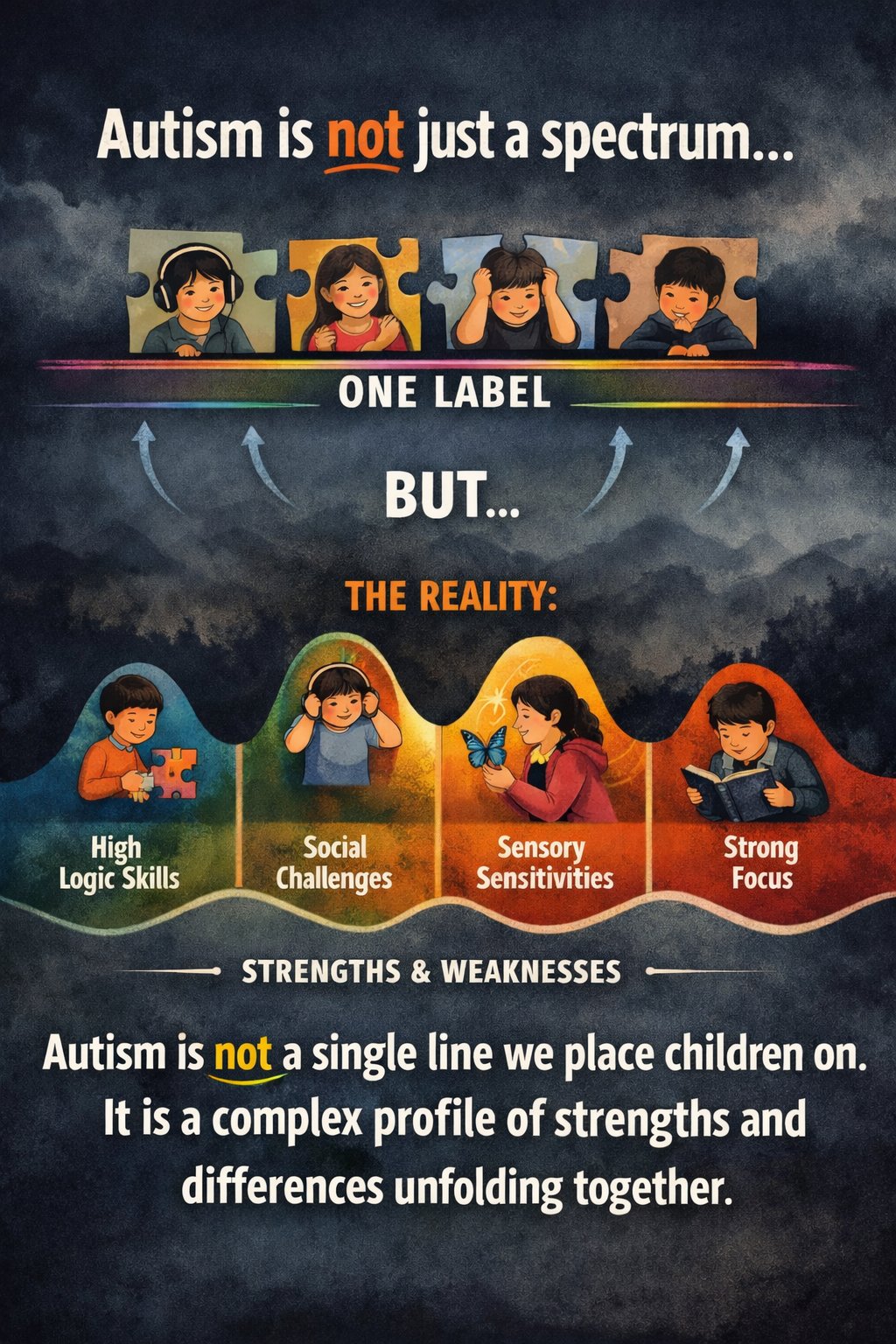
One label — very different profiles
In her recent interview, Uta Frith raises an uncomfortable point: autism may not just be a spectrum — it may be something we've oversimplified to the point of losing meaning.
Because what we call "autism" today includes children who are:
- Highly verbal and analytical
- Minimally verbal
- Socially engaged but rigid
- Withdrawn but perceptive
Completely different profiles. Yet, one label.
Not severity — uneven development
But Frith points to something more important: autism isn't just variation in severity. It's uneven development across different abilities.
A child may excel in pattern recognition, struggle with social understanding, process information differently, and show strengths and challenges side by side. Not a linear condition. But a spiky, uneven developmental profile.
"Autism is not a single line we place children on. It is a complex profile of strengths and differences unfolding together."
And this is where we miss something critical. When we look at children through a single label, we flatten that unevenness. We stop asking:
- Where exactly is the child strong?
- Where exactly are they finding difficulty?
- How do these differences show up in real life?
Because behaviour is where these uneven abilities interact — not in isolation, but in everyday situations.
Where most assessments break down
Most assessments are built to conclude: confirm a diagnosis, assign a category, define a condition. But what often gets lost is resolution.
The child's domain-specific strengths, domain-specific differences, and how these shift across contexts — which is exactly what Frith is pointing toward: we need to understand autism not just as a category, but as a detailed profile of abilities.
With FAIRY, your child is assessed as per WHO's ICF framework, powered by DSM-5, and enriched by domain-level behavioural patterns — to better support your little one.
Where FAIRY fits into this shift
This is where FAIRY aligns directly with this shift. Instead of relying on one-time, clinic-based observation, FAIRY builds understanding through:
- Structured, parent-led video capture
- Natural, real-world contexts
- Multiple short observations across activities
What this allows is something traditional assessments struggle with: seeing how a child actually functions across domains — how they move, how they communicate, how they respond, how they regulate.
Not as isolated checkpoints. But as a connected profile. And importantly, these observations are not taken once — they are layered, extended, and reviewed to build depth, not just conclusions.
Not: "Does this child meet criteria?"
But: "How is this child developing across domains — and where exactly do they need support?"
The real shift
Frith's point is not to discard autism as a concept. It's to stop flattening it into a single dimension. Because when complexity is reduced to a label, we lose the detail required to understand it. And without that detail, support becomes generic.
"Autism is not a single spectrum to place a child on — it is a multi-dimensional profile that needs to be understood in detail."
With the preliminary assessment, you can discuss all your concerns with the doctor while also understanding whether an advanced assessment may be needed.