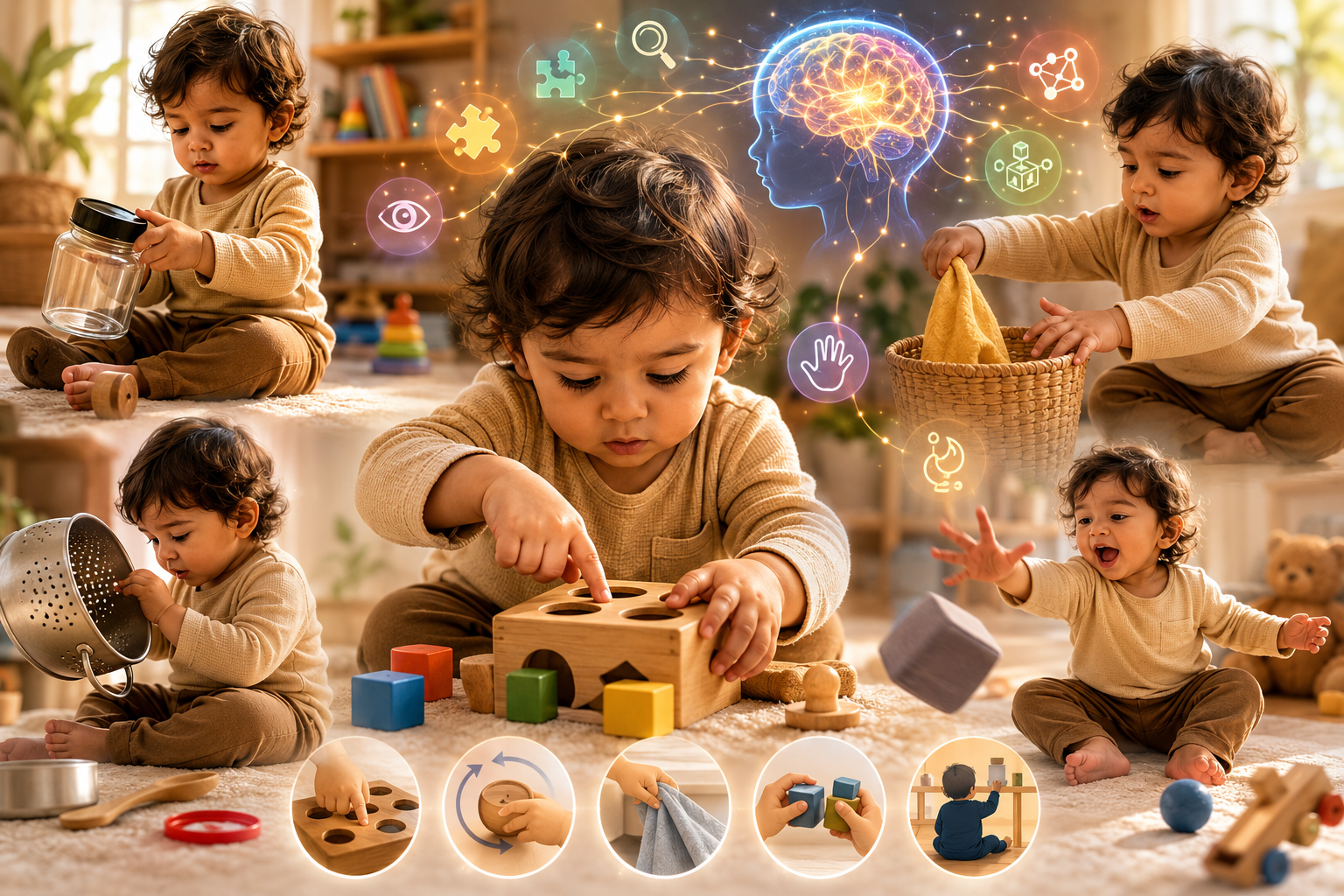
Picture this. You hand your toddler a simple toy. Within seconds they've poked it with one finger, turned it upside down, shaken it, tried to pull it apart, and thrown it across the room. You're exhausted just watching.
Here's what the science says is actually happening: your 18-month-old is thinking. Hard. Object manipulation at 18 months isn't random behaviour that needs managing — it is your toddler's primary cognitive activity, the main way they are building their understanding of the world right now. And how richly they do it at this age directly predicts where their mind is headed eighteen months from now.
Your 18-month-old's object play is structured cognitive inquiry
A detailed longitudinal study by Lobo and colleagues (Infant Behavior & Development, 2014) followed infants from birth to 24 months, precisely coding every manual action — fingering, picking, squeezing, rotating, manipulating, transferring. Their conclusion: by 12 months, infants are already what the researchers called "intense and sophisticated explorers."
By 18 months, these actions become more precise and varied — deliberate fingertip motions into surfaces, controlled rotations, intentional transfers from one hand to the other. The researchers coded these not as motor exercises but as exploratory behaviours — systematic, information-seeking actions through which toddlers extract knowledge about how objects work.
"That poking, turning, and squeezing you see every day? Your child is running experiments on the physical world."
How object exploration directly drives cognitive development
Babik, Galloway & Lobo (Developmental Psychology, 2022) followed 52 infants from 3 to 24 months, tracking object-oriented behaviours — bimanual holding, mouthing, looking, banging, manipulating, and transferring — alongside motor, language, and cognitive development simultaneously.
Their finding: object exploration and cognitive development relate dynamically across the first two years — each one continuously driving the other forward.
When your toddler bangs, transfers, and manipulates objects at 18 months, they are not taking a break from learning. They are learning. Object exploration at this age is cognition happening in real time.
The number every parent needs to know
A 2025 longitudinal study by Herzberg and colleagues tracked infants at 12 and 30 months and produced two findings worth remembering:
- Typically developing infants between 11 and 24 months spend approximately 60% of their play time actively interacting with objects — feeling, moving, shaking them in frequent, brief bouts of manual interaction
- And more significantly: features of object play at 12 months predicted cognitive scores at 30 months — eighteen months later
How richly your toddler engages with objects today is carrying forward information about where their mind is headed a year and a half from now. That unstructured time with blocks, lids, and household objects isn't downtime. It may be the most cognitively productive part of their day.
Why pulling and throwing is actually problem-solving
A longitudinal means-end problem-solving study assessed infants at 6, 9, 12, 18, and 24 months on tasks requiring them to pull a towel or rotate a turntable to obtain a toy. Performance improved markedly between 12 and 24 months. By 18 months, children were using purposeful, controlled pulling and rotating actions to achieve a specific outcome.
The researchers were explicit: this is goal-directed, intentional behaviour — not motor activity. When your toddler pulls a toy toward them or rotates something to access what's underneath, they are demonstrating that their action produces a specific outcome.
"That is causal reasoning. That is early executive function. That is not a child making a mess — that is a child solving a problem."
When they start exploring independently — that's a milestone
Burling & Yoshida (Child Development, 2019) used head-mounted eye-tracking with infants aged 5 to 24 months during parent-infant play, tracking who was generating object handling — parent or child. Between roughly 15 and 24 months, there is a clear developmental shift from parent-generated handling to self-generated exploration. And it is the child's own self-directed manipulation that produces sustained visual attention, object recognition, and learning.
The shift to independent object exploration at 15–18 months is itself a cognitive milestone. If your toddler is picking things up, investigating them, and moving on entirely on their own — that independence is exactly what healthy development looks like right now.
What healthy object manipulation looks like at 18 months
Based directly on what these studies document as typical by 18 months:
- Fingering and poking — deliberate fingertip exploration of surfaces. Information-seeking, not fidgeting
- Rotating and turning — systematically turning objects to explore from different angles. A distinct, coded exploratory action
- Pulling and pushing toward a goal — purposeful movement to achieve a specific outcome. By 18 months this should look intentional, not random
- Both hands working together — holding with one while acting with the other. A documented marker of increasing neurological coordination in the second year
- Independent exploration — self-initiating object play without waiting for you. The research is clear this shift between 15–18 months matters cognitively
When to talk to your paediatrician
Research on high-risk infants — those with an older sibling diagnosed with autism — found that both high-risk and low-risk groups showed similar qualitative progression of object exploration, with high-risk infants developing on a somewhat delayed timescale. The researchers were explicit: differences are informative and worth observing carefully, but must be read alongside other developmental signals — not in isolation.
If by 18 months your toddler:
- Rarely fingers or pokes objects deliberately
- Shows little goal-directed pulling or rotating
- Doesn't attempt using both hands together
- Still waits for you to generate all object interaction
— raise it with your paediatrician. Not with alarm. With early, structured attention.
How Hidden Hum helps parents track object exploration
The research is unambiguous: object manipulation at 18 months is a direct window into cognitive development, and features of how a toddler engages with objects in their second year predict cognitive outcomes eighteen months later. Yet most Indian parents have no structured way to track this. Growth charts exist. Vaccination schedules are meticulous. But how your toddler explores objects — one of the strongest early predictors of cognitive outcomes — is left entirely to memory and instinct.
Hidden Hum, our RBSK-aligned early skills profiler, changes that. At the 15 and 18-month stages, Hidden Hum prompts you to observe and record exactly what the research identifies as significant — whether object exploration is intentional, whether it's self-generated, whether both hands are working together.
It builds these observations into a clear, longitudinal developmental picture — so you arrive at your paediatrician's clinic with structured, evidence-grounded observations rather than a gut feeling.
Hidden Hum doesn't diagnose anything. It makes sure the signals that matter don't get missed.
Frequently asked questions
What does object manipulation at 18 months tell us about a toddler's cognitive development?
Research shows object exploration behaviours — fingering, rotating, pulling, transferring — are directly and dynamically linked to cognitive development across the first two years. A 2025 longitudinal study found that features of object play at 12 months predicted cognitive scores at 30 months.
How much time should an 18-month-old spend playing with objects?
Research by Herzberg and colleagues found that typically developing infants between 11 and 24 months spend approximately 60% of their observed play time actively interacting with objects. This level of engagement is both typical and developmentally important.
Is pulling and throwing objects normal behaviour for an 18-month-old?
Yes — and it's cognitively significant. A means-end problem-solving study found that by 18 months, children use purposeful, controlled pulling and rotating actions to achieve specific outcomes. The researchers framed this as goal-directed, intentional behaviour — causal reasoning, not restlessness.
What if my toddler isn't exploring objects independently at 18 months?
Research documents a clear shift from parent-generated to self-generated object handling between 15 and 24 months, identifying self-generated exploration as the driver of visual attention and cognitive learning. If your toddler still primarily depends on you to generate object interaction at 18 months, raise it with your paediatrician alongside other developmental observations.
Sources: Lobo et al. (2014), Infant Behavior & Development; Babik, Galloway & Lobo (2022), Developmental Psychology; Herzberg et al. (2025); Burling & Yoshida (2019), Child Development; Means-end problem solving study (2019, Wiley); California Infant/Toddler Learning & Development Foundations; CHOC Developmental Milestones Guide.
Hidden Hum is part of the Fairy Tales Wellbeing family — a non-diagnostic, RBSK-aligned early skills profiler helping Indian parents track developmental milestones from birth to 6 years.