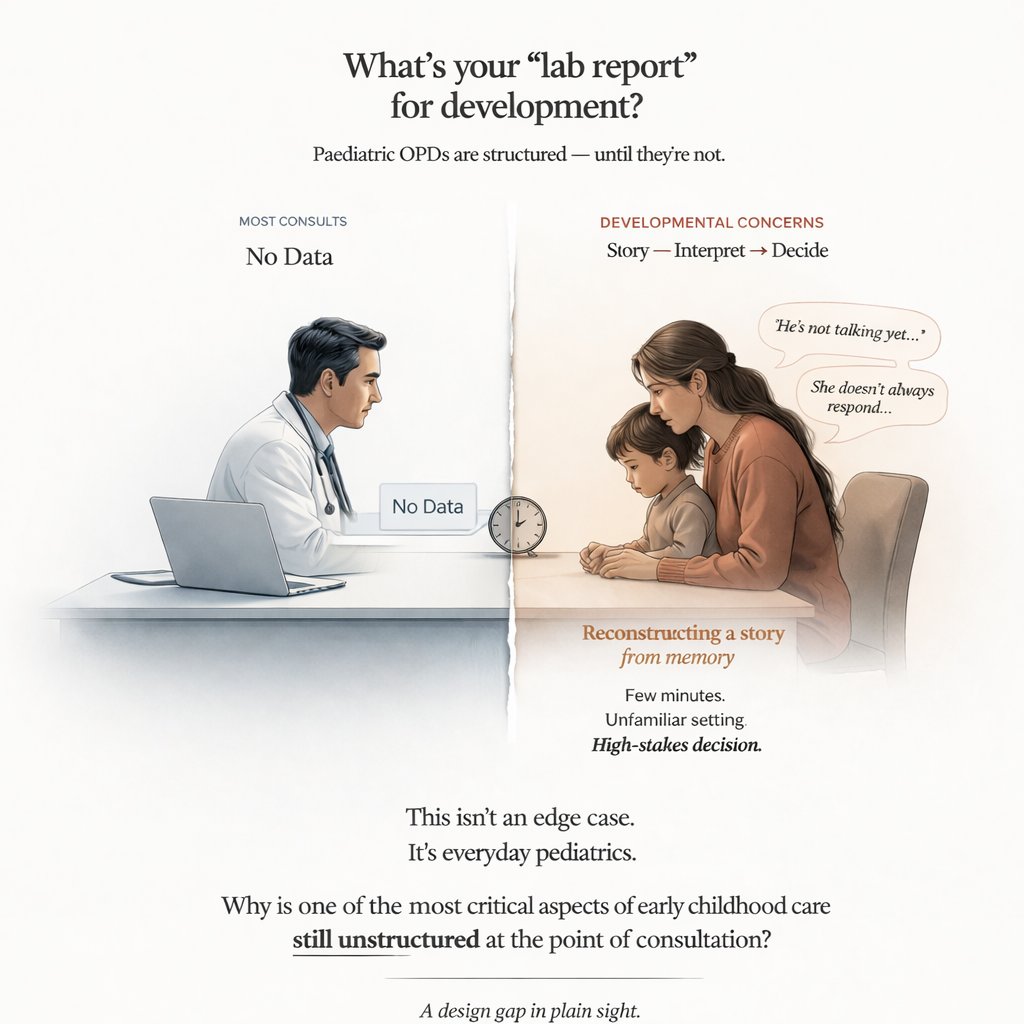
Developmental tracking is a structured way of noting how a child communicates, plays, and responds over time, so a parent walks into a consultation with a clear picture instead of trying to recall everything from memory.
When physical health feels clear — but development doesn't
When you visit a paediatrician, most things feel structured. Your child is weighed. Height is measured. If needed, tests or reports give more clarity. There's always something concrete to go by.
But then there are moments that feel very different. You might say:
"He's not talking properly yet…" or "She doesn't always respond when I call her…"
And suddenly, things feel less certain. You try to explain what you've been noticing at home. The doctor asks a few questions. Sometimes they observe your child briefly. But deep down, you might still feel:
- Did I explain it properly?
- Did I miss mentioning something important?
- Is this normal… or should I be worried?
Why developmental concerns feel confusing
That's because development is not like a fever or a cough. It's not something that shows up clearly in a single moment. It unfolds slowly, through everyday interactions, play, and behaviour. And the truth is, even for doctors, it's hard to fully understand that from just a few minutes in a clinic.
This is why developmental concerns often feel confusing — for both parents and doctors. Not because they aren't important. But because there isn't always a clear starting point.
For physical health: you have numbers and reports.
For development: you're often relying on memory and description.
And that can make things feel uncertain.
| Physical health (fever, cough) | Development (speech, behaviour) | |
|---|---|---|
| What you bring in | Numbers and reports | Memory and description, recalled in the moment |
| At the consultation | Something concrete to go by | Trying to explain what you've noticed at home |
| Walking in | A clear starting point | Starting from doubt about what you might have missed |
What if you had clarity before the consultation?
But what if you had a clearer picture before you even met the doctor? A simple way to capture what your child is doing — how they respond, play, communicate — in a structured way.
So instead of trying to recall everything in the moment, you walk in with clarity. The conversation becomes:
- Easier
- More focused
- More meaningful
Because you're not starting from doubt — you're starting from understanding. And when it comes to your child's development, that clarity can make all the difference.
Be in Charge
Developmental differences can be quiet — often hidden in everyday moments. Knowing how your child is developing early gives you more opportunity to support them.
Know today, through your child's RBSK developmental markers. Objective, from home, in 6 minutes.
Frequently asked questions
Why does my child's development feel harder to assess than something like a fever?
Because development doesn't show up clearly in a single moment the way a fever or a cough does. It unfolds slowly through everyday play, interaction, and behaviour, which is hard to capture fully in a few minutes at a clinic.
Why do I feel unsure after describing my child's behaviour to the doctor?
Because for physical health you have numbers and reports to go by, but for development you're often relying on memory and description in the moment — which naturally makes things feel less certain.
What can I do before a consultation to make the conversation clearer?
Capturing what your child is doing — how they respond, play, and communicate — in a structured way before you meet the doctor means you walk in with clarity instead of trying to recall everything from memory.
Does a short doctor's visit capture everything about my child's development?
Not fully. Even for doctors, it's hard to understand a child's development from just a few minutes in a clinic, which is exactly why developmental concerns often feel confusing for parents and doctors alike.