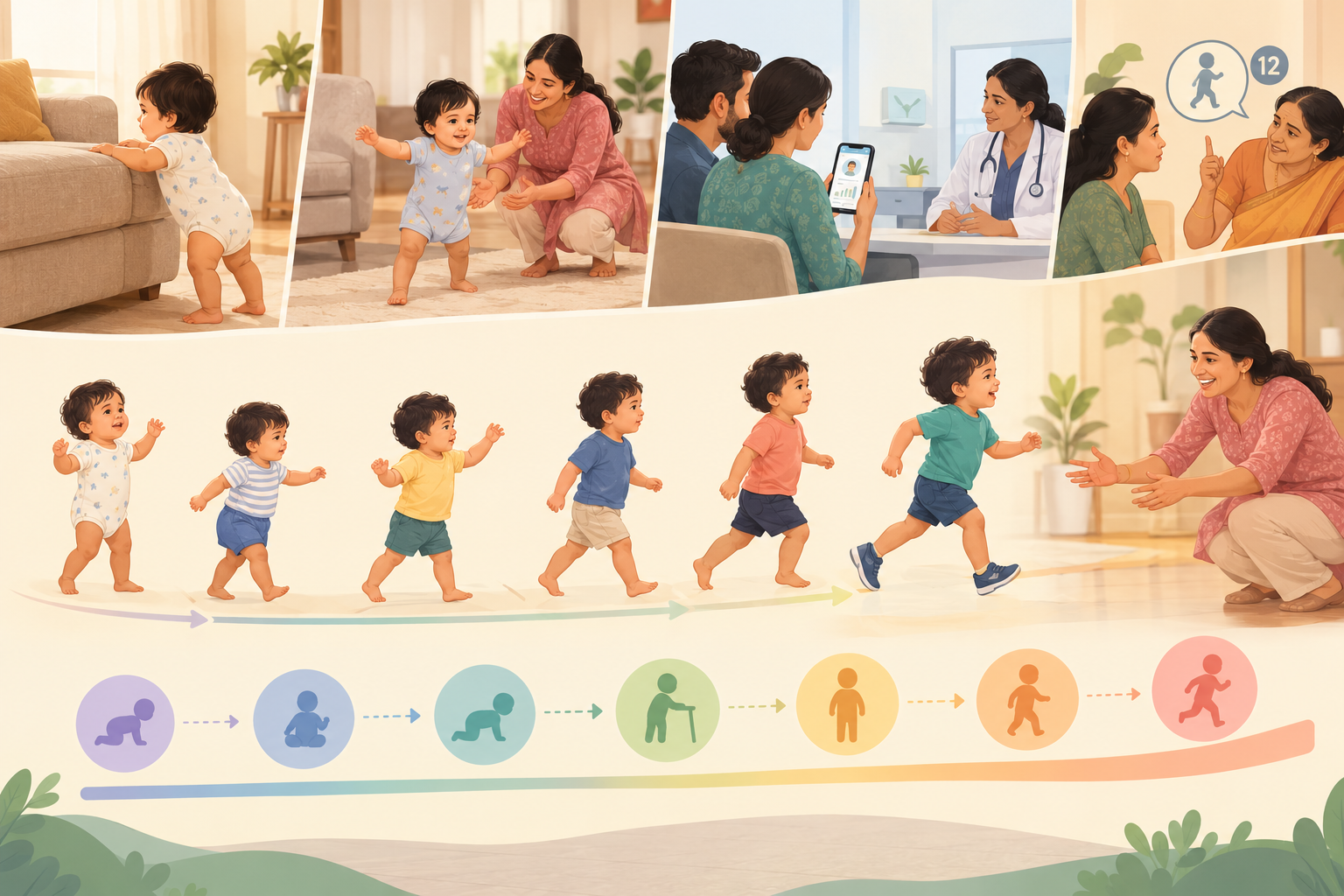
Watching your toddler take their very first steps is a massive, unforgettable milestone. One day they are pulling themselves up on the living room sofa, and the next, they are taking wobbly steps across the floor. If you have just witnessed this transition, you are likely feeling immense pride mixed with anxiety, hovering to catch every tumble. In India, parents often track these moments meticulously through digital platforms or paediatric visits. It is common to hear well-meaning relatives mention that walking by 12 months is the absolute standard, creating unnecessary stress if your little one takes their time.
But what happens after those initial steps? Is it normal for your 14-month-old to still lose their balance frequently? And what does the gross motor progression from 12 to 18 months actually look like when they start speeding up? This guide on your toddler's walking-to-running progression in the 12–18 month window is designed to give you clear, reassuring answers about your child's locomotor development.
Understanding the 12-month myth and global milestones
It is easy to feel pressure if your child is not walking perfectly by their first birthday. However, developmental timelines have a very broad range of normal. A series of analyses from the WHO Multicentre Growth Reference Study provides definitive clarity on how children acquire these essential skills (de Onis et al., 2006). By following infants longitudinally from four months until independent walking, researchers established robust windows of achievement for six fundamental gross motor milestones — mapping the entire sequence your toddler has already moved through to reach this point.
Sitting without support
Crawling on hands and knees
Standing with assistance
Walking with assistance
Standing alone
Walking alone
The six WHO windows of achievement — your toddler has already moved through every step before reaching this page.
Why this includes India, specifically
Importantly, this landmark normative study included India as a primary site, tracking children across different cultural settings alongside cohorts in Ghana, Norway, Oman, and the USA. Trained fieldworkers rigorously assessed 816 children with monthly visits in their first year and bi-monthly visits in their second year.
The resulting data confirms that variability in motor milestone attainment between sexes and across global populations is completely normal. The study specifically assessed the heterogeneity of gross motor milestone achievement ages, proving that the timeframe for walking alone varies widely and safely accommodates a lot of natural variation. Researchers also carefully linked this motor evolution to broader physical growth indicators, ensuring milestones reflect a holistic developmental picture.
This rigorous methodology means the milestone charts your paediatrician relies upon are not just based on Western averages — they are comprehensively tested benchmarks that account for healthy children growing up in India (de Onis et al., 2006). If your 14-month-old just started walking without support, they are firmly within the normal spectrum of gross motor development.
Mastering the wobble: the first six months of walking
Once the first independent steps are taken, parents often assume their toddler will quickly transition to smooth, confident walking. Instead, the reality involves a lot of stumbling, a wide-legged stance, and sudden drops. Do not panic — this is a critical and expected phase of gait maturation. A longitudinal study evaluating toddlers' different strategies during the first six months of independent walking shows how actively their mechanics and approaches evolve over this specific window (Bisi & Stagni, 2015). The research highlights that the immediate months following those first steps are defined by continuous trial and adjustment as toddlers figure out how to propel themselves forward.
What this looks like at 14 to 16 months
During this phase, your toddler is continuously experimenting. They test different ways to balance their top-heavy body on relatively short, rapidly growing legs. You might notice them walking with their arms held high to maintain balance, gradually lowering them as they gain core control. This ongoing motor evolution is deeply connected to their overall physical growth, as changing height and weight directly influence how they manage their centre of gravity.
Frequent falling at this age is not a sign of delayed development.
It is your child actively figuring out the complex mechanics of their changing body.
Moving towards running: the 16 to 18 month transition
As your toddler approaches the 16 to 18-month mark, you will see a distinct shift from cautious, wobbly walking to something resembling running. True running typically develops a little later, but the rapid, determined power-walk definitely happens in this window. Experts have developed a 'fingerprint' of locomotor maturation that identifies specific motor development descriptors and reference development bands (Bisi, Tamburini & Stagni, 2019). This fingerprinting maps out exactly how a toddler's gait shifts from the variable steps of a new walker to the more rhythmic stride of an older toddler.
These reference development bands provide vital normative benchmarks for the walking-to-running progression relevant to the 12–18 month age range, mapping out how speed and balance naturally improve over time. Driven by this maturation, your toddler will slowly start taking much faster steps. They will learn how to stop smoothly without toppling over, and they will begin navigating uneven surfaces with far more skill. Whether transitioning from a hard tile floor to a thick carpet, or stepping over small thresholds found in Indian homes, you will notice a significant upgrade in their coordination.
Supporting your toddler's locomotor journey
While understanding the science behind these milestones is comforting, your primary job between 12 and 18 months is to provide a safe, encouraging environment for your child to practice their evolving locomotor skills. Offer a steadying hand or a sturdy piece of furniture nearby when they reach for it, and resist the urge to hover too closely — let the trial and adjustment happen. Always remember that there is a wide range of normal when it comes to early childhood mobility, and the transition from walking to running is a gradual process.
When it's worth a closer look
None of the following are reasons to panic on their own — they are simply signs that a conversation with your paediatrician would be worthwhile:
- Not yet walking independently by 18 months — this is typically the outer edge of the standard windows of achievement established by WHO normative research
- Marked asymmetry — consistently favouring one leg or side of the body while walking
- Persistent toe-walking that doesn't reduce with practice over several weeks
- Loss of a skill your toddler previously had — for example, walking confidently and then suddenly refusing to bear weight
If they are simply taking their time moving from those wobbly first steps to a more confident stride, give them the space they need. Celebrate their small victories, comfort them when they fall, and enjoy watching them master their newfound independence.
Getting a clearer picture at home
If you've read this far and you're still unsure whether your toddler's walking is a late bloomer's pace or something to understand more carefully, the most useful next step is structured observation rather than comparison with the fastest walker at playgroup. Watch your toddler across a few ordinary days — are they making steady progress, however gradual? Are they curious, engaged, and motivated to move, even if the mechanics are still wobbly? That pattern, described clearly, is exactly what a paediatrician needs to hear.
India's RBSK (Rashtriya Bal Swasthya Karyakram) framework includes gross motor development as part of routine developmental monitoring, the same way growth and hearing are checked — not something reserved for when a problem is already suspected. Hidden Hum, Fairy Tales' parent-led early developmental baselining tool, is built on these RBSK standards and takes under six minutes to complete from home. It gives you a structured developmental baseline across all eight domains — including gross motor skills — so that what you're noticing about your toddler's walking becomes a clear picture, not a private worry carried alone until the next paediatrician visit.
Be in Charge
Gross motor differences can be quiet — often hidden in everyday moments. Knowing how your child is developing early gives you more opportunity to support them.
Know today, through your child's RBSK developmental markers. Objective, from home, in 6 minutes.
The journey from those first wobbly steps to a confident, rhythmic stride is rarely a straight line — it is a wide, well-documented range of normal, backed by research that includes children growing up in India. What matters most is steady progress and a toddler who stays curious and motivated to move, at their own pace.
We know your little one is a gem — and you are a fantastic parent too.
Frequently asked questions
Is it normal for a toddler to walk by 12 months exactly?
No — walking by exactly 12 months is a common misconception, not a strict standard. The WHO Multicentre Growth Reference Study, which included India as a primary site alongside Ghana, Norway, Oman, and the USA, found a wide and normal range for when children achieve independent walking.
Why does my 14-month-old keep falling and losing balance while walking?
This is expected. Research evaluating toddlers in their first six months of independent walking found this period is defined by continuous trial and adjustment, as toddlers experiment with balancing a top-heavy body on short, rapidly growing legs. Frequent falling is not a sign of delay — it's active mechanical learning.
When do toddlers start running instead of just walking?
A rapid, determined power-walk typically emerges around 16 to 18 months, with true running developing a little later. Research mapping a 'fingerprint' of locomotor maturation has identified reference development bands showing how a toddler's gait shifts from variable new-walker steps to a more rhythmic stride over this window.
At what age should I be concerned if my toddler isn't walking yet?
If your child is 18 months old and not yet walking independently, it's worth consulting your paediatrician, as this is typically the outer edge of the standard windows of achievement established by WHO normative research.
Sources: WHO Multicentre Growth Reference Study Group & de Onis et al. (2006), Acta Paediatrica (windows of achievement; sex differences and heterogeneity; growth-motor relationship; reliability of motor development data); Wijnhoven, de Onis et al. (2004), Food and Nutrition Bulletin; Bisi & Stagni (2015), Gait & Posture; Bisi, Tamburini & Stagni (2019), Gait & Posture. This article is educational and does not replace assessment by a qualified clinician.
Hidden Hum is part of the Fairy Tales Wellbeing family — a non-diagnostic, RBSK-aligned early skills profiler helping parents track developmental milestones from birth to 6 years.