School admission season has a way of making every parent look at their child a little more closely. Suddenly the question isn't just Is she eating well? or Is he growing on track? — it's Is she ready? Will he cope? Is what I'm seeing at home normal for a 3-year-old, or is it something I should understand better before the school year begins?
If you've found yourself watching your child snatch a toy back from a cousin, dissolve into tears over the wrong colour cup, or hover at the edge of a playgroup rather than joining in — and wondering quietly whether this is just being three, or something more — you are in exactly the right place. And the answer, for most children most of the time, is reassuring: what you are describing is the very texture of being three years old.
But "most of the time" is not the same as "always." And you, as your child's parent, are the most important observer they have. So let's look carefully at what social-emotional development actually looks like at this age — what's typical, what sits at the edges of typical, and when it's worth paying a little closer attention.
What does social-emotional development look like at 3?
Social-emotional development is the broad, beautiful, sometimes exhausting process by which your child learns to understand their own feelings, manage those feelings, connect with other people, and navigate the give-and-take of relationships. At three years old, this process is very much underway — but it is nowhere near complete. That distinction matters enormously.
How 3-year-olds typically play together
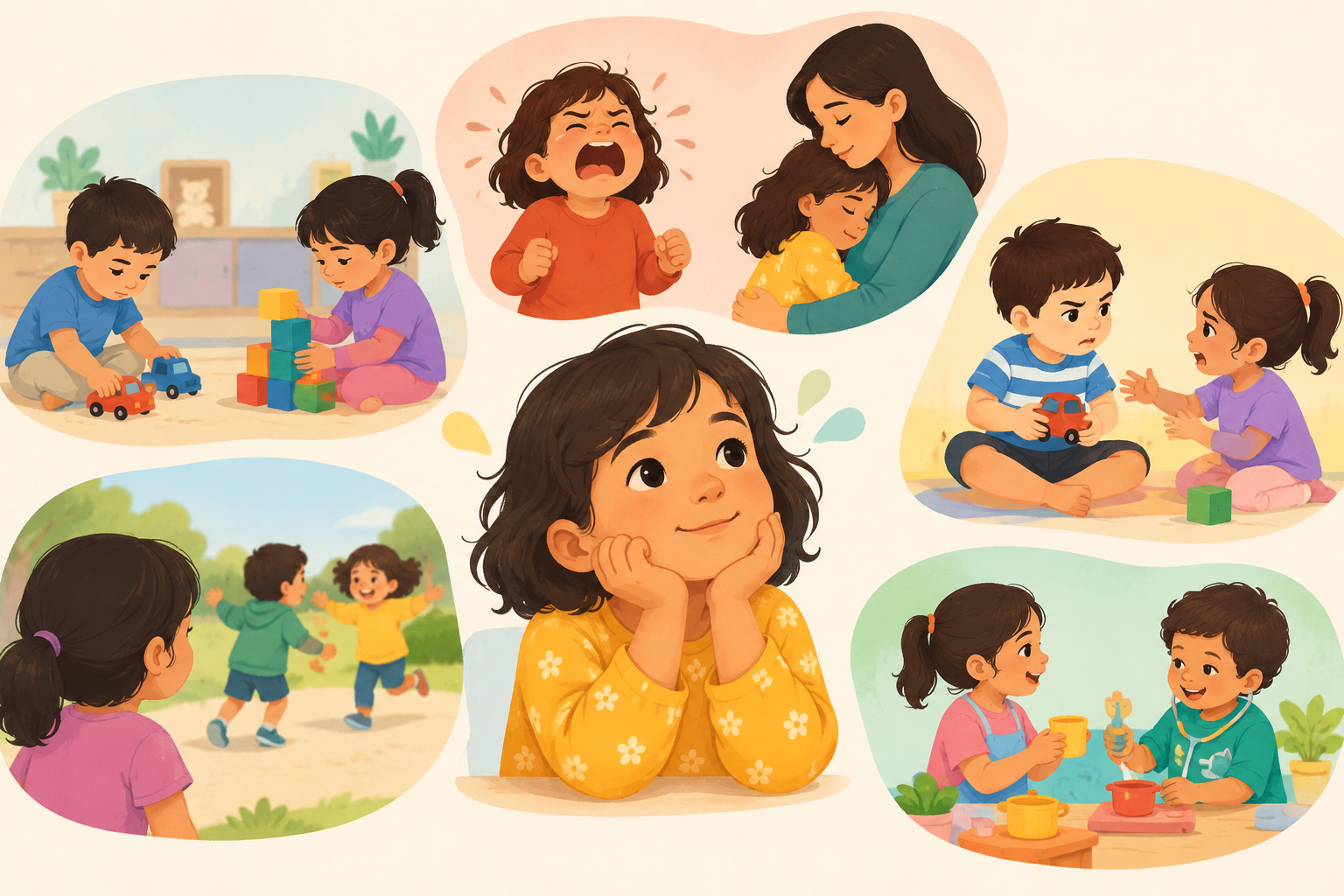
If you watch a group of three-year-olds at a park or a playdate, you'll notice something interesting: they are often playing near each other rather than truly with each other. This is called parallel play — each child absorbed in their own activity, occasionally glancing at what the other is doing, sometimes imitating it, but not yet coordinating or collaborating in a sustained way.
This is entirely normal and developmentally appropriate. Cooperative play — where children assign roles, negotiate rules, and work toward a shared goal — is an emerging skill at three. You will see flashes of it: two children deciding together that this corner is the "kitchen" and that one is the "doctor." But it will be brief, it will break down, and that is fine. The capacity is budding, not yet bloomed.
How 3-year-olds typically manage big feelings
Three-year-olds feel things with extraordinary intensity. Joy, frustration, disappointment, excitement — all of it arrives at full volume. The part of the brain responsible for regulating these feelings — putting the brakes on, finding words, calming down — is still in very early development and will continue maturing well into adolescence and beyond.
This means that meltdowns are not a failure of parenting or a sign that something is wrong with your child. They are the predictable result of big feelings meeting an immature regulation system. A three-year-old who falls apart when a plan changes, cries hard when they lose a game, or screams when they have to stop playing is not being difficult — they are being three.
What you will also start to see at this age, alongside the meltdowns, are the first real signs of self-regulation beginning to develop: a child who takes a breath, who accepts a hug, who can be talked down from the edge of a tantrum with a calm voice and a simple explanation. These moments are the green shoots of emotional regulation — celebrate them.
How 3-year-olds typically share and take turns
Sharing is genuinely hard at three. Not because your child is selfish, but because the concept of ownership, fairness, and delayed gratification are all still being constructed in their developing mind. A three-year-old who grabs a toy back, who says "mine" with fierce conviction, or who struggles to wait for their turn is not showing a character flaw — they are showing you exactly where they are developmentally.
Most three-year-olds are beginning to understand the idea of sharing and taking turns, especially with adult support and scaffolding. But consistent, spontaneous sharing — without a prompt, without a struggle — is a skill that develops gradually through the preschool years. Expecting a three-year-old to share easily and cheerfully is, in most cases, expecting more than the developmental stage can reliably deliver.
How 3-year-olds typically respond to other children
Some three-year-olds are social butterflies, running toward new children with arms open. Others are observers — watching from the sidelines for a long time before they feel ready to join. Both are within the range of typical. Temperament plays a significant role in how a child approaches social situations, and a naturally quieter, more cautious child is not a child with a problem — they are a child with a particular social style.
What you should see at three, even in quieter children, is interest in other children — watching them, smiling at them, wanting to be near them even if not yet ready to play alongside them. The desire to connect is there; the confidence or comfort to act on it may take longer to develop.
Is your child's behaviour within the typical range?
Difficulty sharing — what's normal, what's worth paying closer attention to
Struggling to share at three is normal. Becoming extremely distressed when another child touches their belongings, or showing no interest in or awareness of other children's feelings at all, is worth a gentle look. The question is not whether your child shares perfectly — they won't — but whether they show some awareness that other people have feelings and needs, even if acting on that awareness is still hard.
Big feelings and meltdowns — when they're age-appropriate, when they signal something more
Frequent, intense meltdowns are typical at three. What is worth paying closer attention to is meltdowns that are extremely difficult to recover from — lasting a very long time, escalating rather than gradually settling, or happening so frequently that they are significantly disrupting daily life and family functioning. A child who cannot be comforted at all, who hurts themselves or others regularly during dysregulation, or who seems to have no window of calm across the day is showing you something that deserves a closer look — not alarm, but attention.
Playing alone vs. playing with others — the spectrum of social engagement
Playing alone is not a red flag at three. Many children this age spend significant time in solitary or parallel play, and this is healthy. What is worth noticing is a child who shows no interest in other children at all — who doesn't look at them, doesn't respond when approached, and actively avoids social contact rather than simply preferring to play independently. The distinction is between a child who is cautious about social engagement and a child who seems unaware of or indifferent to the social world around them.
Cautious — watches from the sidelines, warms up slowly, but shows interest and eventually engages.
Unaware or indifferent — shows no response to other children's bids for connection, consistently, across settings.
Responding to other children — shyness, avoidance, and social interest
Shyness is a temperament trait, not a developmental concern. A shy three-year-old who warms up slowly, who needs time to feel comfortable, who watches before joining — this child is showing social awareness and social interest, just at their own pace. What is worth paying attention to is a child who consistently shows no response to other children's bids for connection, who doesn't make eye contact in social situations, or who seems genuinely unaware that other children are trying to engage with them.
What you can do at home — right now
The good news is that the most powerful thing you can do for your 3-year-old's social-emotional development doesn't require a programme or a specialist. It happens in the ordinary moments of your day.
Create opportunities for cooperative play — not forced, but available
You don't need to engineer elaborate playdates. Simple, low-pressure opportunities — a cousin visiting, a neighbour's child playing in the same space, a small group activity at a playgroup — give your child the chance to practise the social skills that are still emerging. Don't push them to interact before they're ready. Be present, be warm, and let the interaction unfold at their pace.
Coach emotional naming and regulation
One of the most powerful things you can do is name feelings out loud — yours and theirs. "You're feeling really frustrated right now because you wanted the red cup. That makes sense." When children have words for feelings, they gradually develop the ability to use those words instead of acting them out. This is a slow process, but it begins with you narrating the emotional world around them.
Model calm yourself. When you feel frustrated and take a breath, say so: "I'm feeling a bit overwhelmed. I'm going to take a slow breath." Your child is watching everything you do.
Validate big feelings without judgment
Your child is not misbehaving when they cry over a broken biscuit or rage because it's time to leave the park. They are experiencing a feeling that is, to them, enormous — and they don't yet have the tools to manage it. Saying "I can see you're really upset. It's okay to feel upset." before you move to problem-solving or redirection makes a significant difference. Children who feel heard regulate faster and more reliably over time.
Observe and understand your child's social style
Some children are naturally quieter, more cautious, more internal. This is not a problem to fix — it is a characteristic to understand and support. Spend time simply watching your child in social situations without intervening. Notice what they gravitate toward, what makes them comfortable, what overwhelms them. This kind of attentive observation is the foundation of everything — and it is something you, as their parent, are uniquely positioned to do.
When to pay closer attention — before school begins
School admission season is actually a genuinely useful moment to take stock. Not because school readiness is a pass-or-fail test, but because the transition to a group setting will place new demands on your child's social-emotional skills — and understanding where they are right now gives you time to support them well.
Signs that warrant a closer look
If you notice any of the following, it is worth talking to your paediatrician or seeking a structured developmental check — not with alarm, but with the same calm attention you'd give to any other aspect of your child's health:
- Extreme avoidance of other children — not shyness or caution, but consistent, distressed withdrawal from any social contact
- No interest in other children — your child doesn't look at, respond to, or seem aware of other children even in familiar settings
- Severe, frequent dysregulation — meltdowns that are very difficult to recover from, happening many times a day, significantly disrupting daily life
- No emotional connection or reciprocity — your child doesn't seek comfort from you when distressed, doesn't share enjoyment (pointing at something exciting, bringing you something to show you), or doesn't respond to your emotional cues
- Significant regression — a child who had been developing social-emotional skills and has clearly lost them
None of these, on their own, is a diagnosis. They are signals — invitations to look more carefully, with the right support.
How to observe your child's social-emotional skills systematically
For parents who want to take a structured first step at home, Hidden Hum — Fairy Tales' parent-led early developmental baselining tool — is built on RBSK standards and takes under six minutes to complete. It gives you a baseline across multiple domains, including social-emotional skills, and helps you understand whether what you're seeing at home is within the typical range or worth exploring further.
What a developmental assessment can tell you
If a structured check suggests that a closer look is warranted, a full developmental assessment is not something to fear. It is not a label. It is not a verdict. It is a thorough, structured understanding of your child's developmental profile — their strengths, their emerging skills, and where they might benefit from support. FAIRY, Fairy Tales Wellbeing's home-based assessment, is reviewed by a developmental paediatrician and gives you a Well-Being Guide: a detailed, actionable picture of your child's developmental needs and recommended next steps. No waiting room. No referral queue. Clinically grounded, from your own home.
Be in Charge
Social and emotional differences can be quiet — often hidden in everyday moments. Knowing how your child is developing early gives you more opportunity to support them.
Know today, through your child's RBSK developmental markers. Objective, from home, in 6 minutes.
Next steps — if you want to understand more
If you've read this far, you're already doing the most important thing: paying thoughtful, caring attention to your child's development. That attention is not anxiety — it is good parenting.
Here is a calm, practical path forward:
Start with Hidden Hum. If you're wondering whether your child's social-emotional skills are within the typical range, Hidden Hum's parent-led tool gives you a structured, RBSK-aligned baseline — not a diagnosis, but a clear starting point. It's designed for parents exactly like you: thoughtful, caring, and wanting structured understanding rather than guesswork.
Talk to your child's school. If your child is starting school soon, a brief conversation with their teacher or school coordinator about your child's social style — their temperament, what helps them feel comfortable, what they're still working on — can make the transition significantly smoother. Schools that work well with young children understand that social-emotional development is a process, not a prerequisite.
Talk to your paediatrician. If you are noticing any of the signs described above — extreme avoidance, no social interest, severe dysregulation — bring it up at your next visit. You don't need to have a diagnosis in mind. You just need to say: "I've been noticing some things about how my child manages feelings and interacts with other children, and I'd like to understand it better." That is enough.
Your child is learning. You are learning alongside them. And the fact that you are asking these questions — carefully, lovingly, before the school year begins — means they have exactly the parent they need.
We know your little one is a gem — and you are a fantastic parent too.
Frequently asked questions
Is it normal for a 3-year-old to not share or play well with other children?
Yes. Struggling to share at three is developmentally typical, as concepts of ownership and fairness are still being constructed. Most three-year-olds engage in parallel play — playing near rather than with other children — with cooperative play only beginning to emerge.
Are frequent meltdowns normal for a 3-year-old?
Yes, frequent and intense meltdowns are typical at this age, since the brain's emotional regulation system is still in early development. What's worth closer attention is a meltdown that is extremely difficult to recover from, escalates rather than settles, or significantly disrupts daily family functioning.
Should I be concerned if my 3-year-old prefers to play alone?
Not necessarily. Playing alone or showing a cautious, observational social style is common and healthy at three. What's worth noticing is a child who shows no interest in other children at all — not looking at them, not responding when approached, and actively avoiding social contact rather than simply preferring independent play.
What social-emotional signs should I discuss with a paediatrician before my child starts school?
Signs worth raising include extreme avoidance of other children, no apparent interest in or awareness of other children, severe and frequent dysregulation that disrupts daily life, no emotional reciprocity such as seeking comfort or sharing enjoyment, or a clear regression in previously developed social-emotional skills.
This article is educational and does not replace assessment by a qualified clinician.
Hidden Hum is part of the Fairy Tales Wellbeing family — a non-diagnostic, RBSK-aligned early skills profiler helping parents track developmental milestones from birth to 6 years.