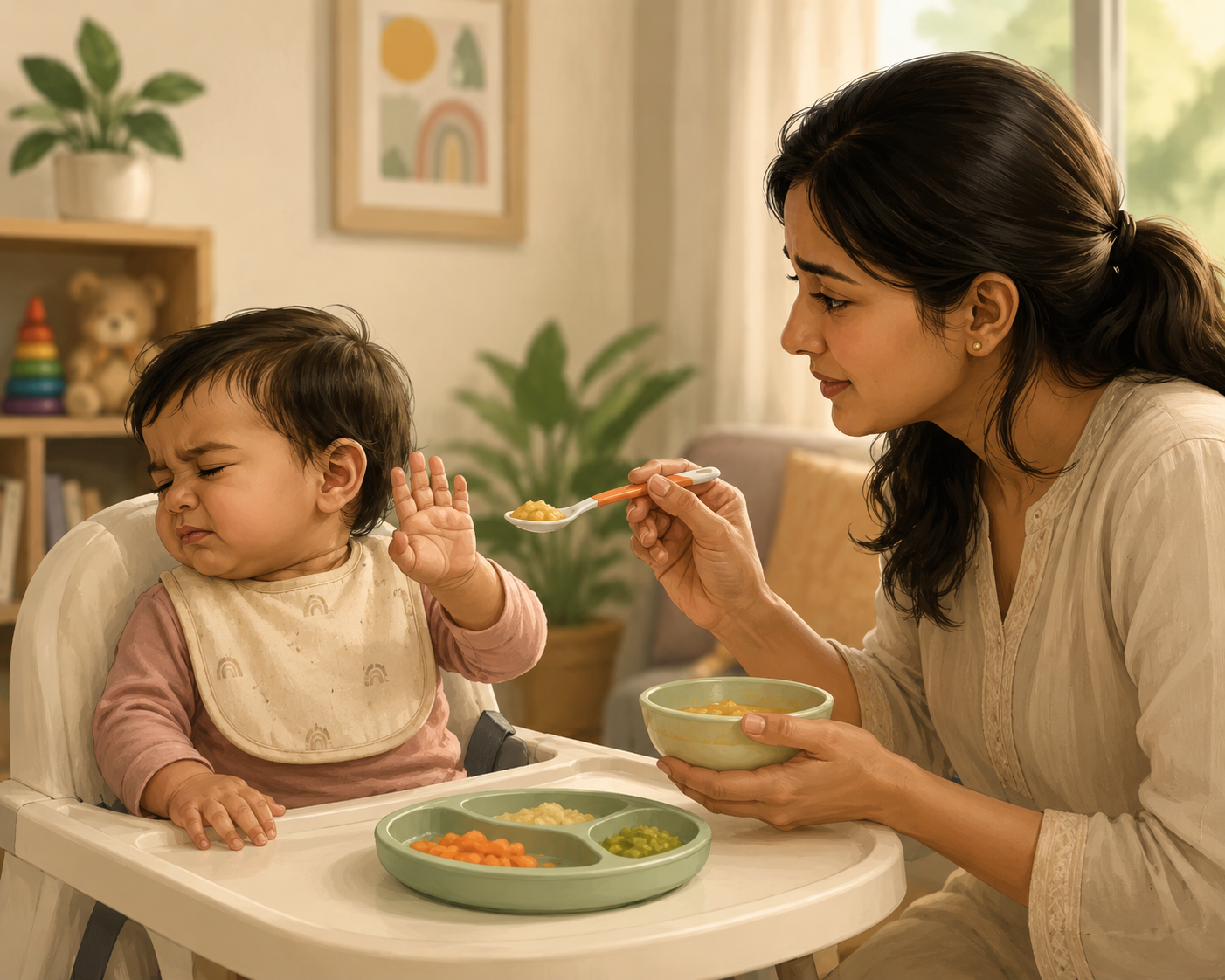
You've tried the purees. The mashed banana. The rice cereal. Your baby turns their head, clamps their mouth shut, or cries the moment the spoon comes near — but nurses eagerly minutes later.
It's one of the most common and most quietly stressful moments in early parenting. And it turns out, researchers have spent decades studying exactly this pattern — frequent breastfeeding paired with refusal of solid food — trying to understand what's actually driving it.
Most of the time it's addressable. And for some babies, refusal isn't fussiness at all — it's a message about how they experience texture and taste, which is worth understanding rather than simply waiting out. Here's what the evidence says.
Worried about how your little one is developing? Hidden Hum is a free, 6-minute, RBSK-aligned check you can do from home — clarity today, not guilt later.
A specific, documented pattern: frequent nursing and food refusal together
One of the most directly relevant studies on this exact scenario comes from O'Connor and Szekely, published in Clinical Pediatrics. Their research described a specific clinical triad in infants aged 8 to 11 months: frequent breastfeeding, refusal of complementary foods, and failure to thrive.
Their detailed case series of six infants found a consistent thread — mothers using breastfeeding as a primary source of comfort during periods of psychosocial stress, which in turn reduced the infant's motivation to accept solid food. The researchers termed this pattern "vulnerable child syndrome," and importantly, framed it as addressable — something that improves once the underlying feeding pattern and maternal stress are identified and supported.
This reframes food refusal. It isn't necessarily about the food. Sometimes it's about what breastfeeding is being used for beyond nutrition — and that's a solvable pattern, not a fixed trait.
In rare cases, refusal has a medical root
While most food refusal has behavioural or developmental explanations, research has documented cases where the cause is medical — and worth ruling out if refusal is severe or persistent.
A case report published in the European Journal of Pediatrics described an exclusively breastfed 8-month-old with persistent refusal of solids. After investigation, the infant was found to have significant vitamin B12 deficiency, caused by undiagnosed maternal pernicious anemia passed through breast milk. Once the infant received B12 treatment, their eating improved rapidly.
"This is not a common cause — but it illustrates an important principle: persistent, severe refusal accompanied by poor growth deserves clinical evaluation, not just behavioural strategies."
Timing of solids matters — in both directions
A frequently cited study by Carruth and colleagues, published in the Journal of the American Dietetic Association, found that infants introduced to complementary foods before 6 months had 2.5 times higher odds of developing food neophobia — a persistent wariness of new foods. Conversely, infants who were exclusively breastfed to 6 months showed 75 to 80% lower odds of food refusal and neophobia.
But timing too late carries risk as well. A large 2024 scoping review synthesising 54 studies, published in Child: Care, Health and Development, identified late introduction of solids and lumpy textures as a distinct and significant risk factor for early feeding difficulties, including refusal.
The takeaway from the research is consistent: there's a window, not just a single rule.
Both introducing solids too early and delaying textured foods too long are associated with higher refusal rates later.
Feeding method matters less than parents assume
Many parents worry intensely over choosing between baby-led weaning and traditional spoon-feeding, believing one method prevents refusal better than the other.
Research published in Nutrients by Białek-Dratwa and colleagues compared these approaches directly in children aged 2 to 7 years and found high rates of food neophobia and feeding problems in both groups — with limited meaningful differences between methods. In other words, reluctance toward new foods is common across feeding styles, not something caused by choosing the "wrong" method.
This is worth knowing if you're anxious about having picked the "less optimal" approach. The evidence doesn't strongly support that concern.
Formula-fed infants show more refusal behaviours than breastfed infants
A study of premature infants published in Codas examined feeding behaviours in 38 infants between 6 and 24 months corrected age and found that defensive mealtime behaviours, including food refusal, were more strongly associated with formula-feeding than with breastfeeding.
This aligns with a broader pattern in the research: a 2021 systematic review in Nutrition Reviews, synthesising 22 studies on infant feeding practices, found that while no single early feeding practice fully explains later food refusal, longer breastfeeding duration consistently showed small protective effects against later feeding difficulties.
Why repeated exposure matters more than parents expect
A narrative review published in the International Journal of Environmental Research and Public Health by Schreuder and colleagues examined what actually drives acceptance of new foods during the transition to solids. The key factors identified: prior milk-feeding experience, timing of introduction, repeated exposure to a food, variety, sensory properties, mealtime context, and — critically — responsive feeding, meaning feeding that follows the infant's own cues rather than a fixed schedule or pressure to finish.
A related umbrella review published in the American Journal of Clinical Nutrition reinforced this specifically for vegetables, finding that repeated exposure, a "vegetable-first" approach, and even earlier exposure through breast milk itself all increased later acceptance.
The research is consistent on one point that surprises many parents: refusal on the first, fifth, or even tenth attempt with a new food is not unusual. Acceptance often requires far more repeated exposure than instinct suggests.
When food refusal is a sensory issue
There's one more thread the research keeps returning to — and it's the one most parents never hear about. For some children, refusal isn't about timing, comfort nursing, or exposure at all. It's about how the food actually feels in the mouth and hands.
Paediatric feeding research led by Irene Chatoor identified a distinct pattern she termed "sensory food aversions" — where infants consistently refuse foods with particular textures, tastes, or smells, often surfacing at exactly the point new textures are introduced during weaning. A baby who happily takes smooth purée but gags, spits, or clamps shut the moment a lumpy or mixed texture arrives may be reacting to the sensory experience, not the food itself.
This is backed by direct experimental work. A study by Farrow and Coulthard (2012, Appetite) found that higher sensory over-responsivity in children was significantly associated with more selective and fussy eating. Nederkoorn and colleagues (2015, Appetite) went further in a study pointedly titled "Feel your food," showing that children with greater tactile sensitivity — those who disliked touching certain textures — ate a narrower range of foods. Earlier work by Coulthard and Blissett (2009, Appetite) linked the same sensory sensitivity to food neophobia and lower fruit and vegetable intake.
This is the bridge worth understanding: persistent, texture-specific refusal — accepting only smooth foods, gagging on lumps, avoiding foods that are wet, sticky, or mixed — can point to sensory sensitivities rather than ordinary picky eating.
It doesn't mean something is wrong. But it's a different kind of refusal — and it responds to a different kind of support: gradual sensory exposure rather than pressure to eat.
In its most significant form, sensory-based food avoidance is now formally recognised in clinical classification as one presentation of Avoidant/Restrictive Food Intake Disorder (ARFID). The vast majority of children who refuse by texture are nowhere near that threshold — but it's exactly why texture-specific, persistent refusal is worth noticing rather than dismissing as fussiness.
What WHO guidance says
The WHO's 2023 Guideline for Complementary Feeding of Infants and Young Children, along with a related 2021 review by Lutter and colleagues in Nutrition Reviews, both identify inappropriate timing, inappropriate texture progression, and non-responsive feeding patterns as significant contributors to early food refusal and under-nutrition.
Responsive feeding — watching and following an infant's hunger and fullness cues rather than a rigid feeding schedule — is repeatedly identified across this research as one of the most consistently protective factors against persistent refusal.
What this means for your baby
Bringing the research together, food refusal during the shift from breast milk to solids typically traces back to one or more of these identifiable factors:
- Timing — solids introduced too early (before 6 months) or textured foods introduced too late both carry documented risk.
- Comfort nursing patterns — frequent breastfeeding used primarily for comfort, particularly during periods of parental stress, can reduce an infant's motivation to accept solids.
- Insufficient repeated exposure — research shows new foods often require far more attempts than parents expect before acceptance.
- Feeding responsiveness — following the infant's own cues, rather than fixed schedules or pressure, is consistently linked to better acceptance.
- Sensory sensitivity — for some children, refusal is texture-, taste-, or smell-driven; persistent texture-specific refusal can point to sensory sensitivities rather than ordinary picky eating.
- Underlying medical causes — rare, but documented, especially when refusal is severe, persistent, and accompanied by poor weight gain.
When to talk to your paediatrician
If food refusal is persistent, severe, accompanied by poor weight gain, paired with very frequent comfort nursing that seems to be replacing rather than complementing solid food intake, or narrowly texture-specific (gagging on lumps, accepting only smooth foods) and paired with sensitivity to textures beyond mealtimes, this is worth raising with your paediatrician directly — not managed through trial and error alone.
For more on how everyday behaviours reveal your baby's developing mind, see our pieces on when to start solids in India and hide-and-seek and object permanence.
How Hidden Hum helps parents track feeding milestones
Feeding difficulties are common, but most parents have no structured way to track patterns over time — whether refusal is improving, staying the same, or linked to specific textures, times of day, or feeding contexts.
The Hidden Hum early skills profiler, our RBSK-aligned tool, helps parents observe and record exactly these patterns as part of a broader developmental picture — building a clear, longitudinal record that makes conversations with your paediatrician more precise and evidence-based, rather than relying on memory alone.
Hidden Hum doesn't diagnose any condition. It ensures patterns that matter — including feeding patterns — don't go unnoticed or unrecorded during a period that can otherwise feel confusing and isolating for parents.
Frequently asked questions
Is my baby refusing solids because of a sensory issue, not fussiness?
Sometimes, yes. For some babies, refusal is texture-, taste-, or smell-driven rather than fussiness — a recognised pattern paediatric feeding research calls "sensory food aversions." A baby who accepts smooth purée but gags or clamps shut the moment a lumpy or mixed texture arrives may be reacting to the sensory experience, not the food. Persistent, texture-specific refusal can point to sensory sensitivities and is worth understanding rather than simply waiting out.
Why does my breastfed baby refuse solid food?
Research has identified several distinct patterns. One study describes frequent breastfeeding, refusal of complementary foods, and poor weight gain occurring together, often linked to using breastfeeding for comfort during periods of maternal stress. Other research points to feeding technique, timing of introduction, and texture progression as contributing factors.
Can food refusal in babies be caused by a nutritional deficiency?
In rare cases, yes. A published case report documented an exclusively breastfed 8-month-old with persistent solid food refusal traced to vitamin B12 deficiency from undiagnosed maternal pernicious anemia. The infant's eating improved rapidly once B12 was corrected.
Does introducing solids too early or too late cause food refusal?
Research shows both ends carry risk. One study found infants introduced to solids before 6 months had 2.5 times higher odds of food neophobia, while exclusive breastfeeding to 6 months reduced refusal odds by 75 to 80%. A separate large review identified late introduction of solids and lumpy textures as a distinct risk factor.
Is baby-led weaning better than spoon-feeding for preventing food refusal?
Research comparing the two approaches found high rates of food neophobia and feeding problems with both, with limited differences between methods — suggesting reluctance toward new foods is common regardless of feeding style.
Sources: O'Connor & Szekely (2001), Clinical Pediatrics; Ide et al. (2011), European Journal of Pediatrics; Menezes et al. (2018), Codas; Brown et al. (2021), Nutrition Reviews; Białek-Dratwa et al. (2023), Nutrients; Carruth et al. (2011), Journal of the American Dietetic Association; Scoping review (2024), Child: Care, Health and Development; Schreuder et al. (2016), IJERPH; Umbrella review (2022), American Journal of Clinical Nutrition; WHO Complementary Feeding Guideline (2023); Lutter et al. (2021), Nutrition Reviews; Chatoor (2002), Child and Adolescent Psychiatric Clinics of North America; Farrow & Coulthard (2012), Appetite; Nederkoorn et al. (2015), Appetite; Coulthard & Blissett (2009), Appetite; ARFID, DSM-5 (2013).
Hidden Hum is part of the Fairy Tales Wellbeing family — a non-diagnostic, RBSK-aligned early skills profiler helping parents track developmental milestones from birth to 6 years.