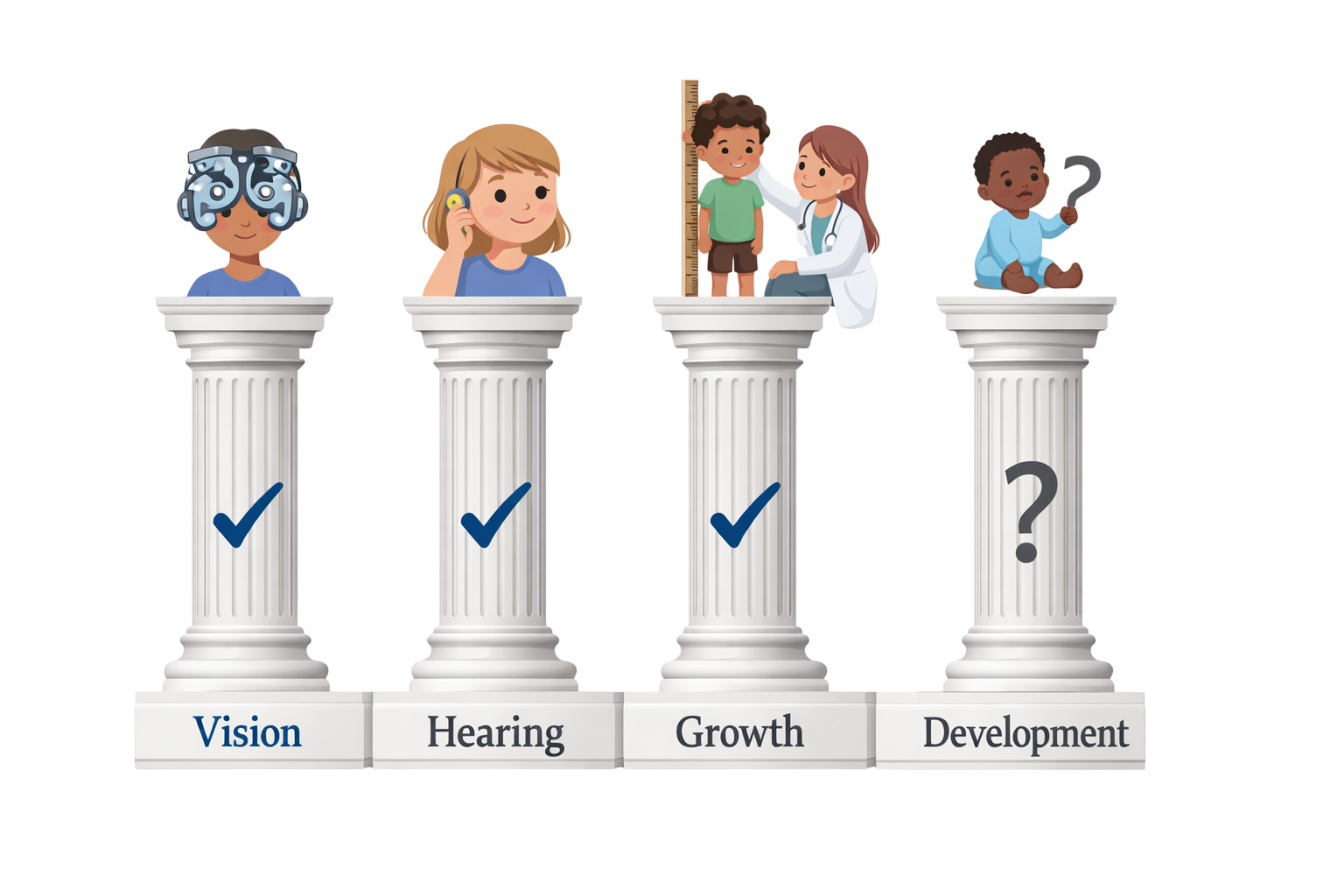
Most parents can recite their child's vital statistics without thinking: birth weight, current percentile, date of last vision check, hearing test results. These measurements form the foundation of paediatric care — a structured system of monitoring that tracks whether a child's body is developing as expected. You've likely watched a nurse measure your child's head circumference, stood them against the height chart, answered questions about vaccines. These rituals of well-child visits feel predictable, comprehensive.
But while we routinely screen physical growth, sensory function, and immunity, we often overlook an equally fundamental dimension of child health: developmental progress.
Developmental screening — the systematic assessment of whether a child is developing appropriately in communication, motor skills, problem-solving, and social interaction — remains notably absent from many routine well-child visits. This gap represents not a failure of parenting or medicine, but an incomplete standard of care.
The three pillars we already monitor
Paediatric care has evolved around three core monitoring systems, each supported by decades of research and standardised protocols:
Physical Growth Tracking
Routine measurement of height, weight, and head circumference allows clinicians to identify nutritional concerns, hormonal imbalances, or chronic conditions before they become critical.
Vision & Hearing Screening
Early detection of sensory impairments significantly improves developmental outcomes. Undetected sensory deficits can cascade into learning difficulties and social challenges.
Immunisation Protocols
Vaccination schedules are precisely timed, carefully documented, and universally understood as non-negotiable components of responsible paediatric care.
These three pillars share common characteristics: they're evidence-based, universally recommended, systematically documented, and broadly accepted as standard rather than optional.
The missing pillar: developmental health
Developmental screening fits the same profile. It's evidence-based, recommended by major medical organisations, and designed to identify concerns early when intervention is most effective. Yet it remains inconsistently implemented.
of children receive formal developmental screening using validated tools during well-child visits, despite major medical organisations recommending it since 2006.
While the American Academy of Paediatrics has recommended standardised developmental screening at 9, 18, and 30 months since 2006, India's Rashtriya Bal Swasthya Karyakram (RBSK) advocates developmental monitoring beginning as early as two months of age. Despite this, research published in Paediatrics found that fewer than 10% of children receive formal developmental screening using validated tools during well-child visits.
This gap exists not because developmental screening is controversial or unproven, but because healthcare systems haven't fully integrated it into routine workflows. Time constraints, reimbursement challenges, and incomplete training create implementation barriers even when providers recognise screening's importance.
Parent-led screening: removing the clinic-time barrier
These operational constraints have prompted interest in parent-led screening models that remove clinic-time dependency while maintaining structured assessment protocols. Platforms such as Hidden Hum illustrate this model in practice. When screening can occur outside appointment windows — completed by caregivers at home using validated frameworks — it eliminates scheduling bottlenecks without reducing clinical rigour.
Digital platforms designed for rapid baseline establishment, typically requiring under six minutes to complete, allow families to conduct screening aligned with recommended intervals (starting from 2 months) independent of appointment availability. This approach addresses infrastructure friction rather than clinical methodology — enabling systematic developmental monitoring without expanding practice workload.
Be in Charge
Developmental differences can be quiet — often hidden in everyday moments. Knowing how your child is developing early gives you more opportunity to support them.
Know today, through your child's RBSK developmental markers. Objective, from home, in 6 minutes.
What developmental screening is — and isn't
Clarity about purpose matters. Developmental screening is not a diagnosis, a label, or a judgment of a child's ability. It is not an exam a child passes or fails. It is not a prediction of outcome.
Hidden Hum approaches screening as structured observation. It combines caregiver insights with objective indicators — such as eye-tracking patterns — to understand how a child naturally responds to age-appropriate stimuli. Rather than questioning what a child cannot do, the focus is on how a child engages, attends, explores, and communicates within their developmental stage.
"Every child develops in their own rhythm. Screening does not assume uniformity — it maps patterns. The process functions less like a test and more like establishing a baseline."
In this way, developmental screening becomes an information system rather than a verdict. It helps families understand where to pay attention — not where to worry.
Research in the Journal of Developmental & Behavioural Paediatrics demonstrates that children who receive early developmental screening are significantly more likely to access intervention services before age 3 — when neuroplasticity is greatest and intervention effects are strongest.
Why standard of care matters
Framing developmental screening as standard of care rather than optional enhancement changes how families approach it. When something is standard, it carries implicit institutional endorsement. It's what responsible systems do — not what worried parents request.
This framing also addresses equity concerns. Optional screenings become proxies for parental education, access, and advocacy capacity. When developmental monitoring is standard, all children receive it regardless of whether their parents know to ask.
In practical terms, comprehensive developmental monitoring looks like:
- Receiving standardised developmental monitoring at well-child visits (starting from 2 months)
- Having results documented in your child's medical record alongside other growth data
- Discussing developmental progress as routinely as discussing sleep or nutrition
- Receiving clear guidance about next steps if screening indicates monitoring or referral
The evidence base: why it works
A comprehensive review in Academic Paediatrics analysed multiple longitudinal studies and found that standardised screening tools correctly identified developmental concerns with sensitivity rates between 70–80% — substantially higher than clinical judgment alone.
Importantly, screening's value isn't limited to identifying delays. It also provides reassurance when development is proceeding typically, creates documentation of developmental trajectory over time, and opens conversations between parents and providers about age-appropriate expectations.
Combining validated parent questionnaires (such as those aligned with RBSK frameworks) with quantifiable measures — including eye-tracking patterns that correlate with attention regulation and social engagement — creates a hybrid assessment structure. This layered approach preserves the efficiency of parent-completed screening while incorporating objective data points that strengthen identification accuracy.
"Early identification through screening creates opportunities for intervention during the first three years of life — a window when environmental input and targeted support produce measurable changes in developmental trajectory."
Completing the health picture
Developmental screening belongs in every child's health record. Hidden Hum is a parent-led screening platform that combines RBSK-aligned developmental questionnaires with objective eye-tracking indicators, structured to establish a developmental baseline in under six minutes. Designed by developmental specialists to integrate into routine care intervals rather than replace paediatric evaluation — it enables families to maintain systematic developmental monitoring as part of standard health practices.
Be in Charge
Developmental differences can be quiet — often hidden in everyday moments. Knowing how your child is developing early gives you more opportunity to support them.
Know today, through your child's RBSK developmental markers. Objective, from home, in 6 minutes.