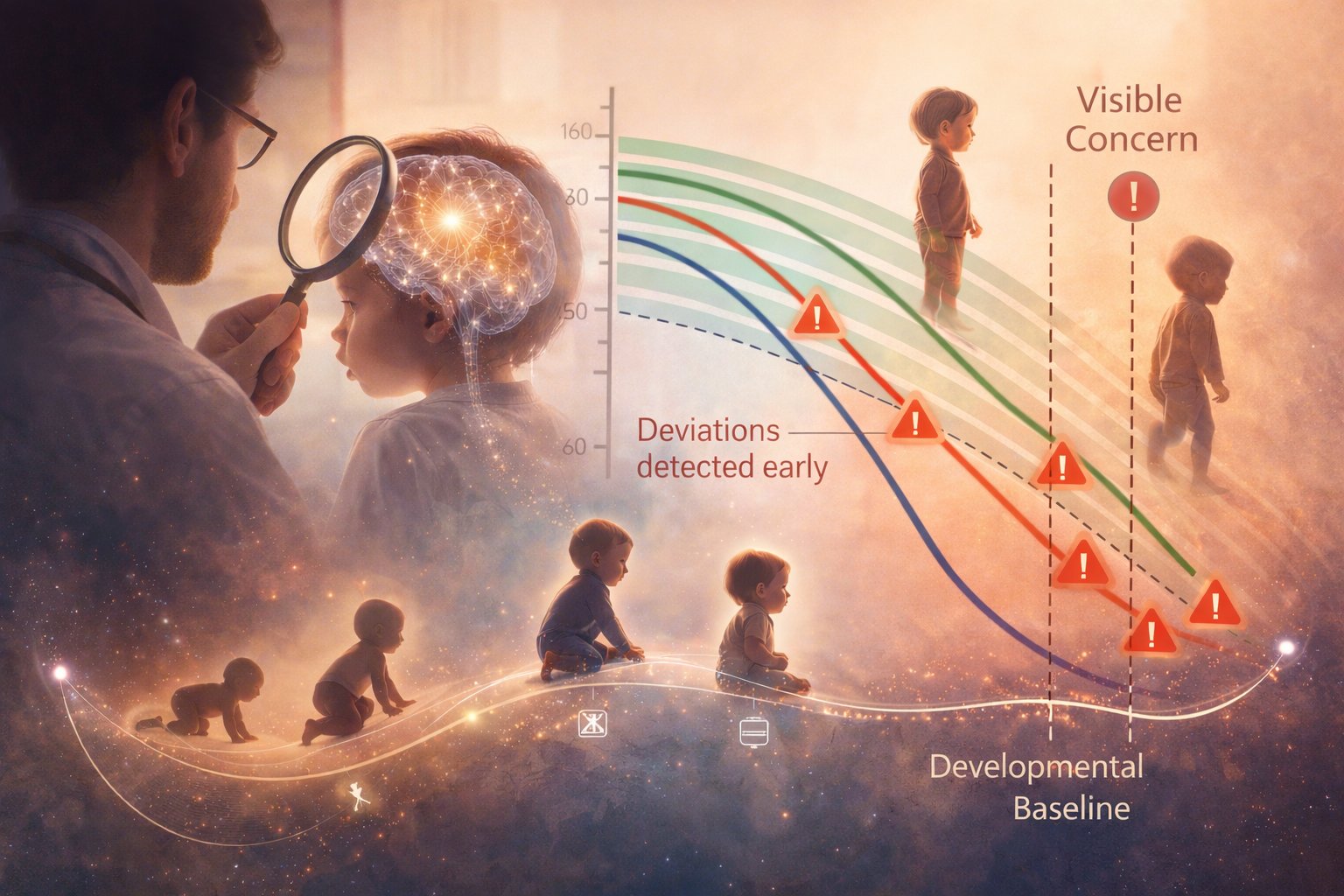
What the clinic actually reveals
A parent brings their child to the clinic — not for development, a routine visit. While interacting, the paediatrician notices something. Not obvious. Not alarming. But responses feel slightly different, engagement isn't quite typical, regulation seems a bit harder than expected.
Nothing a parent would clearly identify as a concern. Nothing that appears to have "started" recently.
"This is not where it began."
Research studying autism-linked conditions suggests that what we later observe as behavioural differences may be linked to how underlying brain systems have been developing over time. What is observed is not a single localised change, but differences across multiple brain regions and networks — areas linked to cognition, emotion, and regulation.
Not isolated differences. But systems organising differently during development.
Visibility is not the same as origin
What is being noticed in the clinic is not the beginning of a concern. It may be the point at which underlying differences have become observable enough in behaviour.
Importantly, this does not mean those differences were clearly visible earlier. It means they may have been present — but subtle.
This is where we struggle. We tend to anchor understanding to when something becomes noticeable. But in development, visibility is not the same as origin. A pattern can be forming long before it becomes clear enough to recognise.
Not: "When did this start?"
But: "What may have been unfolding before it became noticeable?"
What was missing
Not awareness. Not attention. But a reference point.
Because when differences are subtle, they don't stand out in isolation, they don't immediately signal concern, and they can look like normal variation.
This is where the idea of a developmental baseline becomes relevant — not as a diagnostic tool, but as a way to understand:
- How a child typically responds
- How their patterns are evolving over time
- Whether small differences are consistent or changing
Without that, each moment is judged on its own. And when viewed in isolation, patterns remain hidden.
Monitor your little one's development with Hidden Hum — so you can move forward with clarity today, instead of looking back with guilt later.
What this means for parents
For parents, this can feel unsettling. "If something was present earlier, why didn't I see it?"
But the reality is: you're not meant to notice what doesn't clearly stand out. Early differences don't appear as "problems." They appear as small variations — easy to miss, easy to normalise. What makes the difference is not sharper observation. It's having a way to see patterns over time.
Because when you can observe how your child typically responds, how those responses are changing, and what stays consistent — you move from reacting to moments to understanding development.
This is exactly where structured tools like Hidden Hum become meaningful. Not as a diagnostic solution. But as a way to create that missing developmental baseline:
- Capture how your child is developing across domains
- Build a time-stamped reference of patterns
- Make subtle differences visible over time
Because once you have that reference, you're no longer asking: "Is something wrong right now?" You're able to see: "How has my child been developing all along?"
"By the time a concern is noticed, the underlying differences may have been present earlier — just not yet visible as a clear pattern."
Monitor your little one's development with Hidden Hum — so you can move forward with clarity today, instead of looking back with guilt later.