Most parents track language development the obvious way: counting words, waiting for "mama" and "dada," comparing notes with other parents about who's talking and who isn't yet. It's a natural instinct. But new research from the UC Davis MIND Institute, published in 2026 in Translational Psychiatry, points to something most parents — and even many standard checkups — overlook: some of the strongest early signs of language development have nothing to do with speech at all.
They're in your child's hands. And in the way your child shares their world with you.
Two early signs of language development every parent should watch for
Researchers followed 122 young children, first around age three and again roughly two years later, tracking how spoken vocabulary changed over time. Across the group, two specific early skills — observable at home, with no special equipment — stood out as strong predictors of how quickly vocabulary would grow over the following two years.
"Long before a child says their first real word, their hands and their eyes are already telling you where their language is headed."
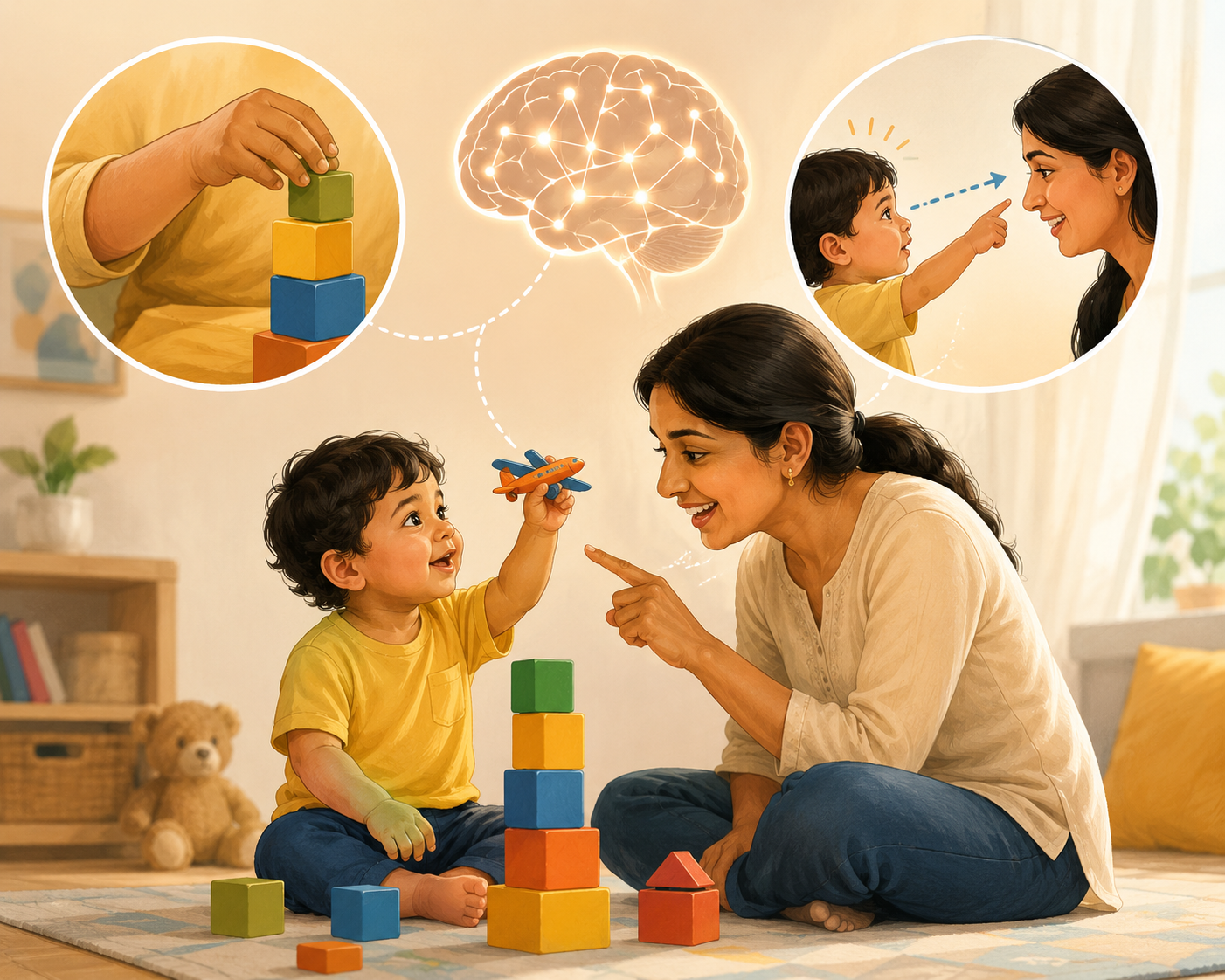
Sign #1: Fine motor skills — how a child uses their hands
The ability to stack blocks, turn pages, or pick up small objects with precision turns out to be closely tied to language. The connection makes biological sense: fine hand control reflects the same underlying neurological maturity that also supports oral-motor coordination — the muscle control needed to physically form words.
There's a behavioural pathway too. A child who can skilfully handle objects explores the physical world more richly, and caregivers naturally narrate and name what their child is doing — touching leads to labelling leads to speaking.
Sign #2: Joint attention — how a child shares their world with you
This is the act of following your gaze, pointing at a plane in the sky, or holding up a toy to show you. Every time a child makes that bid for shared attention, they are essentially saying look at this with me. And every time a caregiver responds by naming what the child pointed at, a word gets built. In this study, children who initiated these moments more often at age three went on to grow their vocabularies fastest over the following two years.
Together, fine motor skills and joint attention weren't just separate signals — children who were strong in both showed the most reliable vocabulary growth, more than either skill predicted alone.
Why these signs matter even more for late-talking and autistic children
For most children, these signs simply add texture to development that's already progressing visibly. But for one group of children, they matter enormously more: children who are slow to start talking, including many autistic children.
Nearly half of the autistic children in this study — 47% — had very limited spoken vocabulary at age three, comparable to a typically developing two-year-old or younger. Some had only a handful of words. Some had none.
Two years later, many of these same children showed striking gains in vocabulary.
And critically, fine motor skills and joint attention were the strongest predictors of that growth specifically within this group of late-starting talkers — more so than in children who were already talking comfortably at three.
In other words: for parents most anxious about their child's silence, these are exactly the signals worth paying closest attention to.
What brain scans add to the picture
Researchers also scanned children's brains during natural sleep — no sedation, no distress — mapping the white matter pathways that carry language signals between brain regions. Children who showed less mature, more actively-developing white matter structure in these pathways at age three tended to show faster vocabulary growth by age five — again, an effect that was strongest in children with the smallest starting vocabularies.
Brain imaging added predictive power beyond what behavioural observation alone could offer. Models combining fine motor skills, joint attention, and brain measures together explained roughly two-thirds of the variation in vocabulary growth — nearly double what behaviour alone explained.
"No single factor tells the whole story. Brain and behaviour build language together, like the foundation and the frame of a house going up at the same time."
What every Indian parent can do with this information
Whether your child is talking on schedule, a little behind, or significantly delayed, the same two things are worth watching and nurturing:
- Notice fine motor play. Stacking, sorting, threading, turning pages, picking up small objects with finger and thumb — these aren't just "keeping busy" activities. Encourage them, narrate them, and notice how your child's hand control is developing over time
- Notice and respond to joint attention. When your child points at something, looks at you and back at an object, or holds something up to show you — that's a bid for shared attention. Responding by naming what they're showing you, every time, is one of the simplest and most evidence-backed things a parent can do to support language
These signals are observable right now — in your home, in a play session, in the ordinary moments of a Tuesday morning. You don't need an MRI to notice whether your child reaches to show you something, or threads a bead onto a string. You just need to know what to look for.
When to pay closer attention
For most children, gradual, steady development in both areas is reassuring, even if spoken words are slower to arrive. But if by around three years old your child shows very limited fine motor coordination and rarely initiates joint attention — rarely points to show you things, rarely checks in with your gaze, rarely brings objects to share — it's worth raising with your paediatrician, regardless of how many words your child is or isn't saying yet.
These two signals, more than word count alone, are what this research identifies as the clearest early window into future language development.
How Hidden Hum helps parents track these exact signals
This is precisely why Hidden Hum, our early skills profiler, was built around fine motor development and joint attention as core pillars — not as an afterthought to word counts, but as primary signals in their own right.
Most parents have no structured way to track these early indicators. Growth charts exist for height and weight. Vaccination schedules are tracked with precision. But fine motor coordination and joint attention — arguably more predictive of a child's developmental trajectory than any single milestone checklist — are usually left to memory and gut feeling.
Hidden Hum, aligned with RBSK guidelines and the Indian Academy of Pediatrics, closes that gap. It prompts parents at the right ages to observe and record exactly these signals: how their child manipulates objects, how often their child initiates shared attention, and how these patterns evolve over time.
Rather than reducing your child to a single word-count milestone, Hidden Hum builds a fuller, evidence-grounded picture of how language is forming — the same picture this research shows matters most, especially for children who are slower to start talking.
Hidden Hum doesn't diagnose any condition. It's a structured, non-diagnostic early skills profiler designed to help parents notice what matters, early enough for it to make a difference.
Source: Surgent, O., Naigles, L., Dakopolos, A., et al. "Multimodal predictors of spoken vocabulary development in autism: the role of early childhood brain and behavior." Translational Psychiatry (2026). UC Davis MIND Institute. DOI: 10.1038/s41398-026-04168-2
Hidden Hum is part of the Fairy Tales Wellbeing family — a non-diagnostic, RBSK-aligned early skills profiler helping Indian parents track developmental milestones from birth to 6 years.