The FAIRY Diagnostic Engine
How FAIRY transforms
assessment
FAIRY transforms how developmental assessments are conducted, interpreted, and acted upon — turning real-world observations into immediate, meaningful action.
Naturalistic Observation
Real life. Real behaviour.
Real insights.
Performance → Participation
Traditional assessments often rely on structured clinic environments where children are expected to perform on cue. But development doesn't happen on cue — it unfolds in everyday moments, routines, and relationships.
FAIRY eliminates this gap by grounding assessment in real-world context. Naturalistic observation shifts the lens from performance to participation.
- Parent-led, home-based video capture
- Children observed in familiar environments and daily routines
- Authentic behaviours, not clinic-induced responses

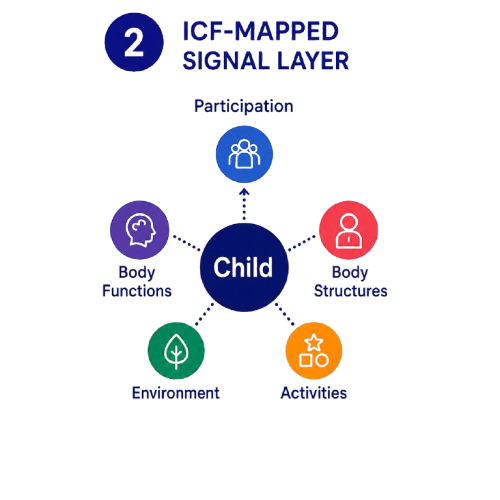
ICF-Mapped Signal Layer
Every observation becomes
structured clinical data.
Observation → Clinical language
Observation alone isn't enough — what matters is how those observations are translated into clinically usable insight. The ICF-Mapped Signal Layer is where FAIRY turns everyday behaviours into a standardized, multidimensional clinical language.
Instead of isolated notes or subjective interpretations, every observed action becomes a structured signal aligned with the International Classification of Functioning, Disability and Health (ICF) from WHO.
- Each activity mapped to functional domains (ICF framework)
- Behaviours translated into multi-condition signals
- Participation, body functions, structures, environment and activities — all captured
DSM-5 Differentiation Logic
Not just detection —
true clinical interpretation.
Screening → Understanding
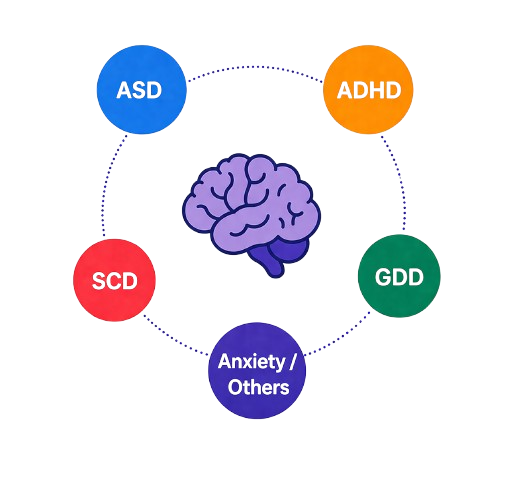
Early developmental concerns rarely present in clean, isolated ways. The same outward behaviour — limited eye contact, repetitive play, poor response to name — can point to very different underlying pathways.
FAIRY's DSM-5 plugged differentiation logic is designed to separate signal from similarity, using structured, criteria-aligned reasoning rather than broad screening labels.
- Built-in differentiation across conditions (DSM-5 aligned)
- Pattern-based insights — social reciprocity vs repetitive behaviour, attention vs regulation
- Distinguishes overlapping developmental presentations
- Structured, criteria-aligned interpretation — not screening or scoring
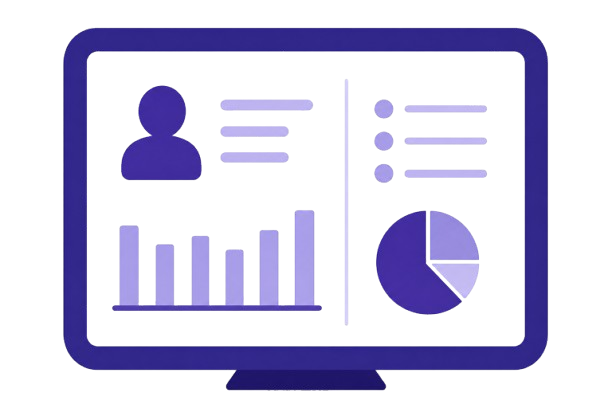
Integrated Clinical Profile
One child. One unified view.
Data → Clarity
After signals are captured and patterns are differentiated, FAIRY brings everything together into a single, unified clinical profile. No scattered notes. No disconnected reports. Just a clear, structured understanding of the child — ready for interpretation and action.
- No fragmented reports across sessions or tools
- Real-time generation of a comprehensive clinical profile
- Organised, interpretable evidence — not raw data overload
- Designed for clinician-led decision-making
Intervention-Ready Output
From insight to action —
instantly.
Assessment → Action
Most assessment systems stop at identifying concerns. FAIRY goes further — translating clinical understanding into clear, structured, and immediately usable intervention pathways.
Because insight without action doesn't change outcomes. In traditional workflows, reports take days to finalise, recommendations are often generic, and intervention planning happens separately. FAIRY closes that gap.
- Domain-mapped strengths and challenges
- Therapy-linked, goal-oriented recommendations
- Built-in baseline and review timelines
- Start intervention immediately — not weeks later