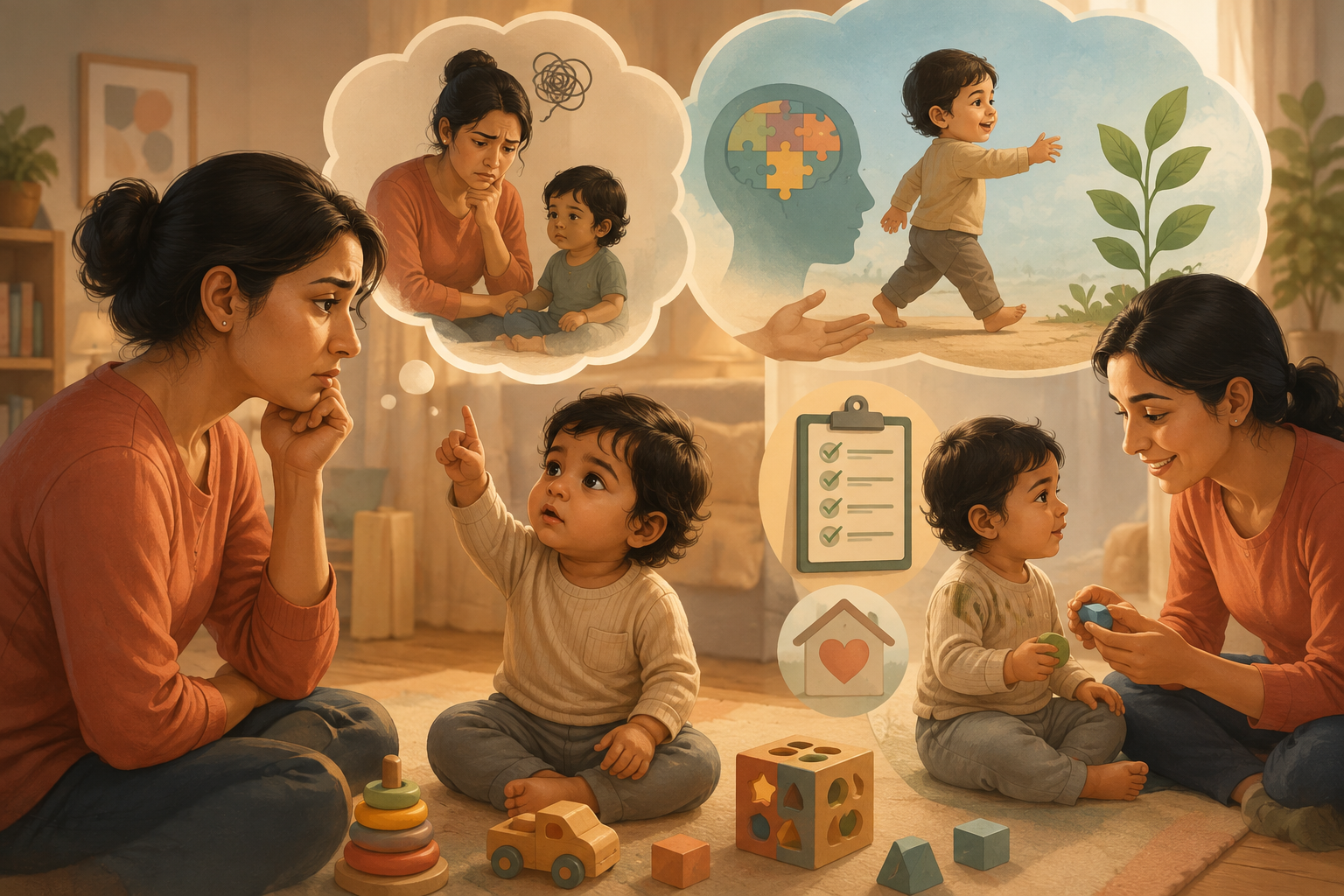
If you have found yourself watching your 18-month-old play — really watching, the way only a parent does — and quietly wondering why the words aren't coming the way you expected, you are not alone. Not even close. Across India, thousands of mothers are sitting with exactly this question right now: Is my toddler just a little behind? Is this a speech delay? Could it be something else entirely? The worry is real, and it deserves a real answer — not a dismissive "every child is different," and not a spiral of alarm, but a clear, grounded picture of what the research actually tells us.
That is what this guide is for. We'll walk through what is typical at 18 months, what the science says about late talking and its long-term outcomes, how to tell the difference between a late bloomer and a child who needs a little extra support, and — most importantly — what you can do right now, from home, to get a clearer picture. Because structured understanding is always better than anxious guessing.
Be in Charge
Speech and language differences can be quiet — often hidden in everyday moments. Knowing how your child is developing early gives you more opportunity to support them.
Know today, through your child's RBSK developmental markers. Objective, from home, in 6 minutes.
Is it normal for an 18-month-old to not be talking much?
How many words should a toddler have at 18 months?
At 18 months, most toddlers are using a handful of meaningful words — sounds or approximations that consistently refer to something specific, like "mama," "dada," "ball," or "no." They are also typically pointing, waving, and using gestures to communicate. They understand far more than they say: they can follow simple instructions, look toward familiar objects when named, and respond to their name being called.
But here is the thing: there is a wide range of what is typical, and the number of words is only one piece of a much larger communication picture. What matters as much — sometimes more — is how your child is communicating. Are they making eye contact? Pointing to share something interesting with you? Imitating sounds or actions? Bringing you things to show you? These are the building blocks that words grow from, and they tell us a great deal about the language that is developing underneath the surface.
Late language emergence is more common than you might think — around 1 in 7 toddlers
If your toddler is not yet talking much, the first thing to know is that you are far from alone. A large prospective study of 1,766 toddlers found that approximately 13.4% of two-year-olds showed late language emergence — that is roughly 1 in 7 children (Zubrick et al., 2007). When the measure was simply whether a child was combining words, the figure rose to nearly 1 in 5. Late talking is genuinely common, and it is not a reflection of how much you read to your child, how you parent, or how much you love them.
That same research found something reassuring and important: the risk of late language emergence was not linked to parental education levels, socioeconomic resources, parental mental health, parenting practices, or family functioning (Zubrick et al., 2007). In other words, this is not something you caused. The significant predictors were a family history of late language emergence, being male, and early neurobiological factors — things that are simply part of a child's developmental makeup, not a verdict on your parenting.
Late talking affects roughly 1 in 7 toddlers — and the research is clear that it is not caused by your parenting, your education, or your family circumstances.
What matters more than word count: understanding and gestures
When paediatricians and speech-language pathologists look at an 18-month-old, they are not just counting words. They are looking at the whole communication system. Does your child understand what you say to them? Do they gesture — pointing, waving, reaching, showing? Do they make eye contact and share attention with you? Do they try to imitate? These signals tell us a great deal about how language is developing, even when words haven't arrived yet.
This is why the question "is my toddler talking enough?" is really the beginning of a bigger, richer conversation — one that looks at communication as a system, not just as a word count. It develops hand in hand with earlier gesture milestones like index-finger pointing and responding to their name.
Late talking vs. speech delay vs. something else — how to tell the difference
This is the question that keeps many parents up at night, and it is worth answering carefully and honestly.
What late talkers often have in common: normal comprehension, normal nonverbal skills
A child described as a "late talker" or showing "late language emergence" typically has expressive language — the words they produce — that is behind their age, but their comprehension and nonverbal abilities are broadly intact. They understand what you say. They play purposefully. They make eye contact. They point and gesture. They are socially engaged. The words are just slower to arrive.
Research comparing children with different long-term outcomes has shown that late talkers as a group have heterogeneous developmental trajectories — meaning they do not all follow the same path (Perry et al., 2022). Some catch up fully and quickly. Others catch up more slowly. And a smaller subset go on to have persisting language differences. Early in development, it can be genuinely difficult to know which path a child is on — which is exactly why structured observation matters so much.
Early signs that suggest it's more than just late talking: social communication, response to name, gesture use
The picture changes when the delay in talking is accompanied by differences in social communication. Research comparing toddlers with autism spectrum differences, language delay, and global developmental delay found that distinct patterns of early social communication were already evident by around 20 months (Delehanty et al., 2018). These patterns included differences in how children used gestures, shared attention, responded to their name, and initiated social interaction.
So a child who is not yet talking but is pointing enthusiastically, making eye contact, imitating your actions, and clearly trying to communicate through sounds and gestures is showing a very different picture from a child whose communication as a whole — words, gestures, social engagement, response to name — seems quieter or less connected. This is not about alarm. It is about looking at the whole picture, not just the word count.
Why autism screening is different from speech-language screening
It is natural, when your toddler isn't talking, to wonder about autism. And it is a question worth taking seriously — not with fear, but with clarity. Autism and speech-language delay can look similar on the surface (both involve fewer words), but they involve different underlying patterns.
A speech-language evaluation focuses on the mechanics and development of language itself — how sounds are produced, how vocabulary is growing, how sentences are forming. An autism evaluation looks more broadly at social communication: how a child shares attention, responds to their name, uses gestures to connect with others, and engages in back-and-forth interaction. Research confirms that these are meaningfully different profiles, even when they overlap (Delehanty et al., 2018). A child can have both. A child can have one without the other. Getting a clear picture requires looking at both dimensions — and that is exactly what a structured developmental assessment is designed to do.
"The important thing is not to guess — and not to wait indefinitely in uncertainty. Structured observation and screening exist precisely so that families do not have to navigate this alone."
The vocabulary composition clue: what words your child is choosing can tell you something
Here is something fascinating that research has uncovered — and something parents can actually observe at home. A retrospective study of 850 children found that the type of words a late-talking toddler uses may offer a clue about their longer-term trajectory (Perry et al., 2022). Children who go on to catch up tend to have vocabularies that include names for object categories — words like "cup," "ball," "dog" — while children with persisting language differences tend to use a smaller proportion of these shape-based category names. Children who later received a developmental language disorder diagnosis also said a significantly smaller proportion of these shape-based nouns in their second year compared to typically developing children (Perry et al., 2022).
This does not mean you should be analysing your child's word list with a spreadsheet. But it does mean that the quality and composition of early vocabulary — not just the quantity — carries information. It is one of the reasons that a structured developmental check, done by someone who knows what to look for, is more informative than simply counting words.
What happens to late talkers? The long-term picture
Most catch up by school age — but some retain subtle language differences
The honest, research-grounded answer to "will my late talker catch up?" is: most do, but not all, and even those who do may retain some subtle differences worth knowing about.
A longitudinal follow-up of the same large cohort of nearly 1,800 children found that by age 7, the group mean for children who had been late talkers at 24 months was within the typical range on general language measures (Rice et al., 2008). That is genuinely good news. But a greater proportion of late talkers — compared to children who had been on track — performed below normative expectations on specific areas like syntax and morphosyntax, the grammar of language (Rice et al., 2008). So while the headline is reassuring, the detail matters.
Looking even further ahead, a study that followed late-talking toddlers all the way to age 17 found that they continued to perform in the average range on language and reading tasks — but obtained significantly lower scores on vocabulary, grammar, and verbal memory compared to peers who had been on track as toddlers (Rescorla, 2009). The differences were subtle, but they were real and persistent. The researcher described this as a "dimensional perspective" on language delay — meaning that slow language development in toddlerhood is not simply a phase that fully resolves, but rather a starting point on a continuum that can have long, gentle echoes into adolescence (Rescorla, 2009).
Why early identification matters — even for late bloomers
None of this is meant to alarm you. The vast majority of late-talking toddlers grow into children and teenagers who function well, communicate effectively, and thrive. But the research does make a clear case for early identification and monitoring — not labelling, not diagnosing, but understanding what is happening so that support can be offered if and when it is needed.
A systematic review of screening for language and speech delay in children under five found that targeted interventions do improve measures of speech and language delay and disorders (Jullien, 2021). The earlier a child's needs are understood, the earlier support can be put in place. And the earlier support begins, the more it can shape the developmental trajectory in a positive direction.
This is the difference between waiting and watching in the dark, and watching with a structured, informed eye.
Early identification is not about finding something wrong with your child. It is about giving them every possible advantage, as early as possible.
How to get a clear picture of your child's development at home
What to observe: comprehension, gestures, social engagement — not just words
If you are concerned about your 18-month-old's talking, the most useful thing you can do right now is shift your attention from word count to communication as a whole. Here is what to notice over the coming days:
- Comprehension: Does your child understand simple instructions without you gesturing? Can they point to familiar objects or people when you name them? Do they look toward the door when you say "let's go outside"?
- Gestures: Is your child pointing — not just to ask for things, but to show you things? Waving? Reaching? Bringing you objects to share? Gestures are a critical bridge to spoken language, and their presence is deeply reassuring even when words are few.
- Social engagement: Does your child make eye contact with you? Do they look at your face to check your reaction? Do they enjoy back-and-forth games? Do they respond when you call their name?
- Imitation: Does your child copy your actions or sounds? Imitation is one of the most important building blocks of language development.
These observations, taken together, give a much richer picture than word count alone — and they are exactly what a structured developmental screening is designed to capture.
RBSK developmental screening: India's national standard for child health
In India, parents have access to something genuinely valuable: a national framework for developmental monitoring built into child healthcare. The Rashtriya Bal Swasthya Karyakram (RBSK) is a Government of India initiative designed to bring structured developmental screening to every child under six — making developmental monitoring as routine as growth checks and vaccination.
A validation study of the RBSK developmental screening tool for speech and language disorders in Indian children found it to be highly accurate. In children under two and a half years, the tool demonstrated 100% sensitivity and 97.1% specificity for identifying speech and language disorders. In the older age group — two and a half to six years — sensitivity was 97.33% and specificity 92.19% (Chandrasekar et al., 2023). These are strong numbers, meaning the tool is very good at correctly identifying children who need support, and very good at correctly reassuring families whose children are on track.
This is the standard that Fairy Tales Wellbeing's Hidden Hum screening is built on. It is not a guess. It is India's national evidence base for child developmental health — the same framework your paediatrician is trained to use.
Hidden Hum: a 6-minute structured screening you can do from home
Hidden Hum is Fairy Tales Wellbeing's parent-led developmental screening platform, built on RBSK standards and designed to be completed in under six minutes — from your own home, in your child's most natural environment. Instead of a clinic visit where your toddler may be anxious or unfamiliar, Hidden Hum captures how your child actually communicates in everyday life.
It establishes a developmental baseline and an Early Skills Profile across multiple domains — not just speech, but communication, social engagement, motor skills, and more. It is not a diagnosis. It is structured understanding: a clear, clinically grounded picture of where your child is right now, so you know whether to feel reassured, or whether it is worth taking the next step.
If you have been sitting with this worry for a few weeks, Hidden Hum is a calm, practical first step. You do not need a referral. You do not need to travel anywhere. You just need six minutes and your honest observations of your child.
What happens after screening: next steps if concerns are identified
If Hidden Hum identifies areas worth looking at more closely, it will guide you toward the next step — which may be a conversation with your paediatrician, a referral to a speech-language pathologist, or a more detailed developmental assessment through Fairy Tales' FAIRY platform. FAIRY is a video-based assessment reviewed by a developmental paediatrician or clinical psychologist, grounded in the WHO ICF-CY framework and powered by DSM-5 — giving you a comprehensive, clinician-reviewed picture of your child's developmental needs and recommended next steps.
None of this is about labelling your child. It is about understanding them — and getting them the support they deserve, as early as possible.
When to seek professional evaluation
Red flags that warrant a speech-language pathologist evaluation
While late talking is common and often resolves, there are specific patterns that are worth bringing to a professional sooner rather than later. If you notice any of the following, it is worth talking to your paediatrician or a speech-language pathologist — not because something is definitely wrong, but because getting a clear picture is always the right move:
- Your child is not using any meaningful words at 18 months
- Your child is not pointing to share interest in things with you
- Your child is not responding consistently to their name
- Gestures are very limited or absent
- Your child seems less interested in social interaction than you would expect
- Your child has lost skills they previously had — any regression in communication or social engagement is always worth discussing promptly
- Your child's comprehension also seems limited — they are not following simple instructions or responding to familiar words
Research using parent-report developmental screening tools in India found that parents of children with developmental differences were more likely to report specific concerns about fine motor skills, behaviour, cognitive development, and health (Sheel et al., 2024). Your instinct as a parent — the sense that something feels different — is data. It deserves to be taken seriously, and it deserves a structured response.
What a developmental paediatrician or SLP will look for
When you see a speech-language pathologist or developmental paediatrician, they will look at much more than whether your child can say words. They will assess comprehension, the range and type of sounds your child produces, how your child uses gestures and eye contact, how they engage in back-and-forth interaction, and whether there are any patterns that suggest a specific area of need. They may use structured observation tools, parent questionnaires, and direct interaction with your child.
The goal is not a verdict. The goal is a map — a clear picture of your child's strengths and the areas where a little extra support could make a meaningful difference.
The difference between a screening and a full assessment
A screening — like Hidden Hum — is a quick, structured check that tells you whether a closer look is warranted. It is not a diagnosis. A full developmental assessment, like Fairy Tales' FAIRY platform or a clinic-based evaluation, goes deeper: it looks across multiple domains, is reviewed by a clinician, and results in detailed recommendations. Both have their place. Screening is the right first step for most families — it is accessible, non-alarming, and gives you something concrete to act on. Think of it as the difference between a routine health check and a specialist consultation: both are valuable, and one often leads naturally to the other.
You are not alone — and structured understanding helps
Reassurance: guilt is not warranted — late talking is not linked to parenting
If there is one thing the research makes unmistakably clear, it is this: late language emergence is not caused by how you parent. The large epidemiological study of nearly 1,800 toddlers found no association between late talking and parental education, socioeconomic resources, parental mental health, parenting practices, or family functioning (Zubrick et al., 2007). You did not cause this. You are not failing your child. You are a parent who is paying attention — and that is exactly what your child needs.
The worry you feel is not a sign that something is wrong with you. It is a sign that you are tuned in. And being tuned in is the most powerful thing you can be for your child right now. At Fairy Tales Wellbeing, our founder's mission has always been to give voice to mothers who have something more to say about their children — because that voice matters, and it deserves to be heard.
The power of early observation: turning worry into actionable steps
Worry, left alone, tends to grow. But worry that is channelled into structured observation becomes something entirely different — it becomes information. And information is what allows you to act with confidence, whether that action is reassurance that your child is on track, or early support that gives them the best possible start.
Parent-report screening tools have been shown to support early detection of developmental delays in India (Sheel et al., 2024), and the RBSK framework — which underpins Hidden Hum — has been validated as a highly accurate tool for identifying speech and language needs in Indian children under six (Chandrasekar et al., 2023). You do not have to wait for a clinic appointment to begin getting clarity. You can start today, from home, in under six minutes.
And if the screening tells you everything is on track? That is not wasted time. That is peace of mind, grounded in evidence — which is worth everything.
Next steps: the Hidden Hum pathway, when to escalate, what support looks like
Here is a simple, calm pathway forward:
- Step 1: Observe. Over the next few days, pay attention to your child's whole communication picture — not just words, but gestures, eye contact, comprehension, and social engagement. Notice what is there, not just what isn't.
- Step 2: Screen. If you have concerns, take Hidden Hum's six-minute developmental check. It will give you a structured, RBSK-aligned Early Skills Profile and tell you clearly whether further steps are recommended.
- Step 3: Talk to your paediatrician. Share what you have observed and what Hidden Hum found. Your paediatrician can refer you to a speech-language pathologist or developmental paediatrician if needed.
- Step 4: If recommended, assess. Fairy Tales' FAIRY assessment gives you a clinician-reviewed, multi-domain developmental picture — grounded in WHO ICF-CY and DSM-5 — with concrete next steps tailored to your child.
- Step 5: Find support. If your child needs early intervention — speech therapy, occupational therapy, or other support — Fairy Tales' intervention platform will help you find the right therapist near you.
Every step of this journey is about understanding your child better. Not labelling them. Not alarming you. Just giving your little one the best possible start — with you, their most powerful advocate, leading the way.
Your child is a gem. And the fact that you are here, reading this, asking these questions — that makes you exactly the parent they need. If your toddler isn't talking much yet, take a breath. Get a clear picture. And know that whatever the picture shows, there is a path forward — and you do not have to walk it alone.
Frequently asked questions
How many words should an 18-month-old be saying?
Most toddlers at 18 months use a handful of meaningful words, along with pointing, waving, and gestures to communicate. Word count is only one part of the picture — comprehension, gestures, eye contact, and social engagement matter just as much.
Is it common for an 18-month-old to not be talking much?
Yes. A large study of 1,766 toddlers found approximately 13.4% of two-year-olds showed late language emergence — roughly 1 in 7 children. Research found this was not linked to parenting practices, parental education, or family functioning.
How can I tell if my toddler is just a late talker or if it's something more serious?
Late talkers typically have intact comprehension, eye contact, gestures, and social engagement — the words are simply slower to arrive. Research shows that when delayed talking is combined with differences in gesture use, response to name, and social communication, it may indicate something beyond typical late talking, and is worth a structured developmental screening.
Will my late-talking toddler catch up?
Most late talkers catch up by school age. A longitudinal study found that by age 7, the group average for former late talkers fell within the typical range on general language measures, though some retained subtle differences in grammar and vocabulary into adolescence.
Sources: Zubrick et al. (2007), Journal of Speech, Language, and Hearing Research; Perry et al. (2022); Delehanty et al. (2018); Rice et al. (2008); Rescorla (2009); Jullien (2021), BMC Pediatrics; Chandrasekar et al. (2023); Sheel et al. (2024), Children.
Hidden Hum is part of the Fairy Tales Wellbeing family — a non-diagnostic, RBSK-aligned early skills profiler helping parents track developmental milestones from birth to 6 years.