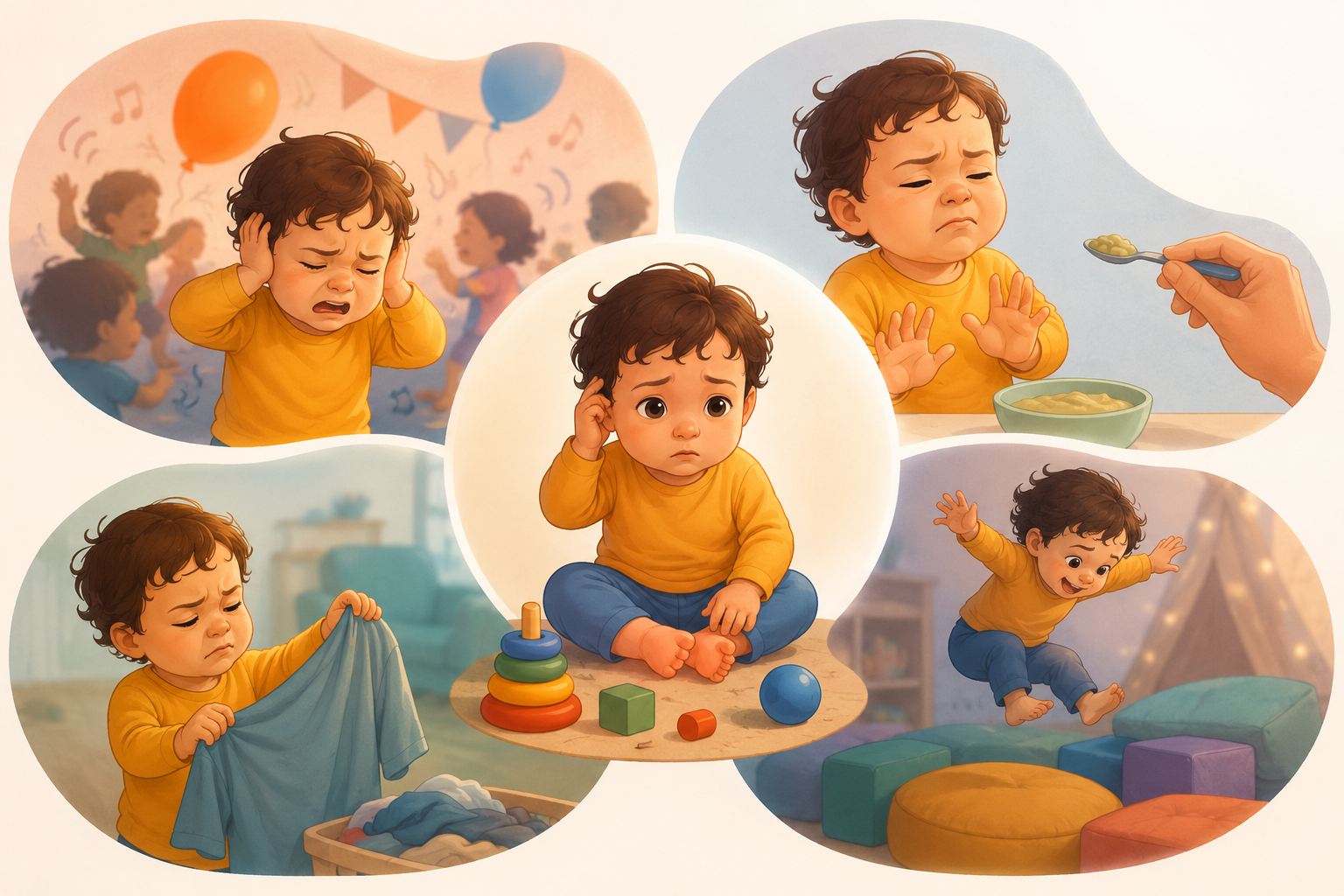
You've noticed it for a while now. Your two-year-old can't seem to sit still for more than a few seconds, gets overwhelmed in loud places, melts down when a new texture touches their skin, and darts away before you can finish a sentence. You've read a little online — and now you're caught between three possibilities: Is this ADHD? Is this autism? Is this something called sensory processing disorder? Or is it all three at once?
First: take a breath. You are not overreacting. You are paying attention — and that is exactly the right thing to do. What you're observing is real, it is worth understanding, and there is a clear, calm path forward. This article walks through what the research actually says about ADHD signs, sensory sensitivities, and autism in toddlers — and helps you figure out what to do next, from home, without waiting for months or worrying alone.
First, let's understand what you're observing
What ADHD-like signs look like in toddlers
In children under four, ADHD-like signs tend to show up as difficulty sustaining attention on a single activity, moving constantly from one thing to the next, acting before thinking (grabbing, running into traffic, climbing without caution), and struggling to follow simple two-step instructions. These are signs of differences in executive function — the brain's ability to plan, pause, and regulate itself. Research comparing children with ADHD to typically developing peers confirms that executive function differences are a core feature of ADHD, distinct from what is seen in autism alone (Huang et al., 2024).
It's worth saying clearly: many toddlers are busy, impulsive, and distractible. The question is not whether your child is active — it's whether the pattern is consistent, pervasive across settings, and getting in the way of everyday life.
What sensory sensitivities look like in toddlers
Sensory sensitivities are differences in how a child's nervous system receives and processes information from the world around them. A toddler with sensory sensitivities might refuse to wear certain fabrics, cover their ears at ordinary sounds, resist having their hair washed, gag at specific food textures, or seek intense physical input — spinning, crashing into cushions, hanging upside down. These are not tantrums or bad behaviour. They are your child's nervous system communicating that something feels genuinely overwhelming — or, in some cases, that they need more sensation to feel regulated. This same pattern often shows up around food, which we cover in our guide on texture-driven food refusal.
Research suggests that sensory processing difficulties in Indian preschoolers are more common than many parents and even medical professionals realise — and that awareness of what is age-appropriate versus what warrants a closer look has historically been limited in the Indian context (Kadkol, 2014). You are not imagining it, and you are not alone in finding it hard to interpret.
Why both can show up in the same child — and why that's not unusual
Here is the thing that surprises many parents: ADHD signs and sensory sensitivities very commonly appear together in the same child. This is not a sign that something is catastrophically wrong. It reflects the fact that sensory processing is not exclusive to any one neurodevelopmental profile. A growing body of research frames sensory processing differences as a transdiagnostic mechanism — meaning they cut across autism, ADHD, and other developmental profiles rather than belonging neatly to just one (Sağlam, 2026). Your child's nervous system is not reading from a diagnostic textbook. It is simply organised in a particular way.
The overlap: ADHD, sensory processing, and autism — what the research shows
Sensory sensitivities are common in ADHD — about 1 in 2 children
If your child has ADHD-like signs and also has sensory sensitivities, you might assume the sensory piece must mean autism. But the evidence says otherwise. A 2024 case-control study using standardised sensory profiles found sensory processing problems in approximately 50% of children diagnosed with ADHD — making sensory sensitivity a very common feature of ADHD in its own right, not a marker that points exclusively to autism (Salah et al., 2024).
Sensory sensitivities are common in autism — but in a different way
In children with autism, sensory processing difficulties are even more prevalent — the same study found them in 42 to 88% of children with autism (Salah et al., 2024). So yes, sensory sensitivities are a significant feature of autism. But because they are also common in ADHD, their presence alone cannot tell you which profile your child fits.
But they look different — here's how to tell them apart
While both groups show sensory differences, research comparing children with ASD, ADHD, and typical development found that the two groups differed on most sensory subscales — with the exception of auditory filtering, unresponsiveness, and visual/auditory processing, where the profiles overlapped most (Salah et al., 2024). In practical terms: a child with ADHD whose sensory sensitivities are primarily about attention and filtering (struggling to focus in noisy environments, easily distracted by background sounds) may look different from a child with autism whose sensory responses are more pervasive, more tied to repetitive or self-soothing behaviours, and more connected to social and motor patterns.
Research comparing preschool children with isolated sensory processing disorder to those with autism found that while both groups showed sensory-related behavioural symptoms, children with autism tended to show more widespread difficulties — and crucially, sensory difficulties in autism were more tightly linked to motor behaviours and repetitive patterns, while in isolated sensory processing disorder, specific links to body awareness and sameness behaviour were more prominent (Purpura et al., 2022). These are subtle distinctions that a structured assessment can tease apart — but they are real.
When both ADHD signs and sensory sensitivities appear together
Some children show signs of both ADHD and autism simultaneously. Research has found that children with a combined ASD+ADHD profile show particularly significant differences in both sensory processing and executive function compared to children with either condition alone — and that this combined profile represents a distinct phenotype, not simply an additive overlap (Huang et al., 2024). A population-based study using parent-completed sensory questionnaires found that overlapping sensory processing patterns can be detected in children with ASD/ADHD comorbidity as early as age three — and that early identification through parent-reported data can alert clinicians to the need for further evaluation (Fernández-Delgado et al., 2024).
"This is not alarming — it is useful. It means what you are observing at home has clinical meaning, and that your observations matter."
Is this autism, ADHD, sensory processing disorder, or a combination?
What makes each condition distinct
This is the question every worried parent wants answered — and the honest answer is that a single observation, or even a week of careful watching, is not enough to distinguish between them. Clinically, the key differences lie not just in sensory processing but in the full pattern of development: social communication, repetitive behaviours, attention regulation, and motor skills together tell a story that no single sign can tell alone.
Research specifically examining the differential diagnosis between sensory modulation disorder and ADHD found that while both conditions affect attention and participation, the underlying mechanisms differ — and distinguishing between them requires looking at sensation, attention, and participation across multiple contexts, not just one (Yochman et al., 2013). Similarly, a selective review of ADHD and autism found that the two conditions share overlapping traits but also have distinct clinical signatures — and that careful, structured evaluation is needed to understand which profile best fits a given child (Taurines et al., 2012).
Why a single observation isn't enough — structured assessment matters
This is why the question "Is this autism or ADHD?" cannot be answered by a checklist, a Google search, or even a single paediatric visit. It requires a structured, multi-domain look at your child across several areas of development — not to put a label on them, but to understand how their nervous system is organised and what kind of support would help them most.
You are not a passive bystander in this process. Parent-reported observations are a cornerstone of early developmental identification — the sensory questionnaires used in research, including those applicable from age three, are completed by parents, not clinicians in isolation (Fernández-Delgado et al., 2024).
What you notice at home, in everyday routines, is clinically meaningful data. Your instinct that something is worth understanding is the starting point, not an overreaction.
What you can do right now, from home, in under six minutes
How to observe your child's signs systematically
Rather than trying to mentally catalogue everything at once, start noticing patterns across specific situations: mealtimes (texture responses, food refusal), transitions (how your child moves from one activity to another), social moments (eye contact, response to their name, interest in other children), and sensory environments (reactions to loud sounds, crowds, physical touch). Note what triggers a response, how intense it is, and how long it lasts.
What to note and track — without alarm
You don't need a clinical degree to observe meaningfully. Note: Does your child cover their ears at sounds that don't bother others? Do they resist certain textures consistently, not just occasionally? Do they seek intense physical input — crashing, spinning — more than other children their age? Do they have difficulty shifting attention from one activity to another? These are the kinds of observations that, when structured and shared with a clinician, paint a meaningful picture.
How structured developmental monitoring works in India
In India, the Rashtriya Bal Swasthya Karyakram (RBSK) — the Government of India's national child health programme — establishes that every child deserves a structured developmental check as part of routine healthcare, not just when a concern becomes urgent. Developmental monitoring is not a specialist luxury; it is part of standard child care, sitting alongside growth, hearing, and vision checks as the fourth pillar of child health.
Hidden Hum, Fairy Tales Wellbeing's parent-led screening tool, is built on RBSK standards. In under six minutes, it helps you establish a developmental baseline across multiple domains — not to alarm you, but to give you and your paediatrician a structured, clinically grounded picture of where your child is right now. Think of it as a growth chart for development: a consistent record that turns your everyday observations into meaningful insight.
Be in Charge
Attention and sensory differences can be quiet — often hidden in everyday moments. Knowing how your child is developing early gives you more opportunity to support them.
Know today, through your child's RBSK developmental markers. Objective, from home, in 6 minutes.
When to seek structured assessment — and what that looks like
Red flags that warrant a closer look
If you notice the following patterns consistently — not just on a hard day — it is worth talking to your paediatrician or a developmental specialist:
- Sensory responses that are intense, frequent, and interfering with daily life (eating, dressing, sleep, play)
- Difficulty with attention that is pervasive across all settings, not just one
- Limited response to their name by 12 months, or loss of a skill they previously had
- Very limited eye contact, pointing, or interest in sharing experiences with you
- Repetitive behaviours (lining up objects, insisting on sameness) alongside sensory sensitivities
None of these, on their own, is a diagnosis. Each one is simply a signal that a structured, multi-domain assessment would give you — and your child — a clearer picture.
What a thorough developmental assessment covers
A good developmental assessment does not just screen for autism. It looks at the full picture: attention and executive function, sensory processing, social communication, motor development, language, and adaptive behaviour. This is precisely why the FAIRY assessment at Fairy Tales Wellbeing is built on the WHO ICF-CY framework and powered by DSM-5 — it covers eight developmental domains, not just one condition. The goal is understanding, not labelling.
How to get a clear answer from home, with clinical guidance
FAIRY is a video-based assessment that works from your home. Your child is observed in their natural environment — not a clinic — doing simple, everyday activities. A developmental paediatrician or clinical psychologist reviews the recordings and produces a Well-Being Guide: a comprehensive picture of your child's developmental pattern, their needs, and recommended next steps. No waiting room. No performance anxiety. Just your child, at home, being themselves.
What happens next — from assessment to understanding to support
Understanding your child's profile is not the end of the road — it is the beginning of the right road. Whether the picture points to ADHD, sensory processing differences, autism, a combination, or simply a developmental variation that needs a little extra support, knowing is always better than wondering. Early support, matched to your child's actual profile, makes a meaningful difference.
A reassuring note: your child is not a diagnosis
Your child's nervous system is not broken. It is organised differently — and that organisation has a logic to it, even when it makes daily life harder. Research increasingly frames sensory processing differences not as deficits to be eliminated, but as features of how a child's nervous system has developed — features that, with the right understanding and support, can be worked with rather than against (Sağlam, 2026).
At Fairy Tales Wellbeing, we believe that a thorough evaluation is not a label — it is a map. It tells you where your child is, what they need, and how to help. The goal is never to define your child by a diagnosis. It is to see them fully, understand them deeply, and support them well.
You noticed. You asked the question. You read this far. That is not anxiety — that is love in action. Whatever the picture turns out to be, you are already doing the most important thing: paying attention and seeking understanding.
If you'd like to start with a structured developmental baseline — from home, in under six minutes — Hidden Hum is a gentle, RBSK-aligned first step. Not a verdict. Just a clearer picture.
Frequently asked questions
What do ADHD signs look like in a toddler?
In children under four, ADHD-like signs typically include difficulty sustaining attention on one activity, constant movement between activities, acting before thinking, and struggling to follow simple two-step instructions. These reflect differences in executive function, distinct from what is seen in autism alone.
Do sensory sensitivities mean my toddler has autism?
Not necessarily. Research found sensory processing problems in approximately 50% of children with ADHD and in 42 to 88% of children with autism. Sensory sensitivities are common in both conditions, so their presence alone cannot indicate which profile fits a child.
How can I tell the difference between ADHD and autism-related sensory sensitivities in my toddler?
Research found that sensory profiles in ADHD and autism differ on most subscales, except auditory filtering and visual/auditory processing. In autism, sensory difficulties tend to be more tightly linked to motor behaviours and repetitive patterns, while sensory sensitivities in ADHD are often more connected to attention and filtering.
Can a toddler have both ADHD and autism signs at the same time?
Yes. Research shows children with a combined ASD and ADHD profile show particularly significant differences in both sensory processing and executive function compared to children with either condition alone, and this combined profile can be detected in sensory patterns as early as age three.
Sources: Huang et al. (2024); Kadkol (2014); Sağlam (2026); Salah et al. (2024); Purpura et al. (2022); Fernández-Delgado et al. (2024); Yochman et al. (2013); Taurines et al. (2012).
Hidden Hum is part of the Fairy Tales Wellbeing family — a non-diagnostic, RBSK-aligned early skills profiler helping parents track developmental milestones from birth to 6 years.