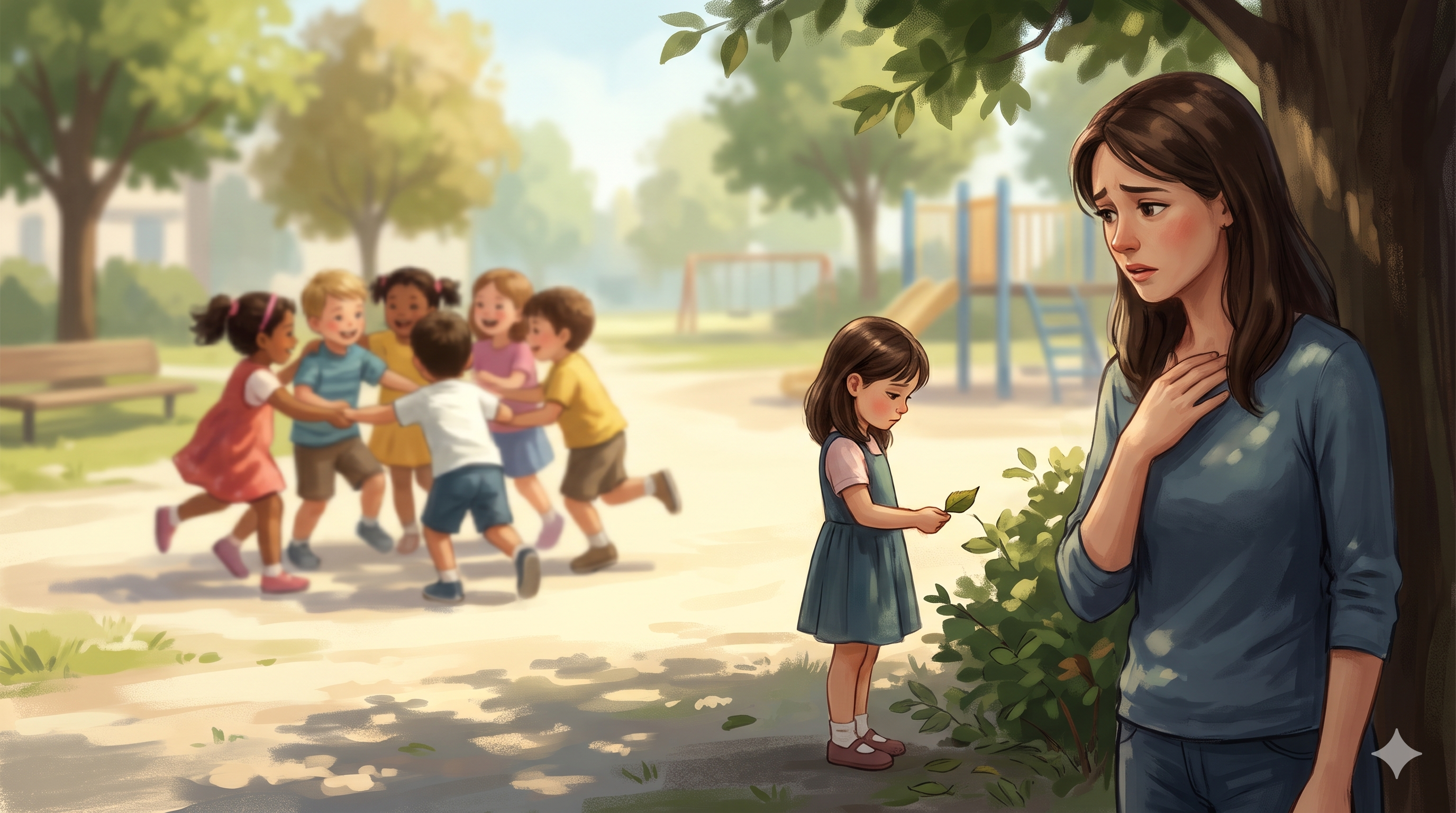
You're standing at the edge of the birthday party, watching a knot of five-year-olds form a game without your daughter in it. She's a few feet away, pretending to be interested in a leaf. She might not even register it as rejection yet. You do — the slight stomach-drop, the urge to walk over and fix it, the question that follows you home: is this just who she is, or is something making this harder for her than it should be?
Watching your child struggle socially is its own particular kind of parental pain — not worry about a symptom, but something closer to grief, playing out in real time, in public, while you stand there able to do little except watch.
This is more common than the playground makes it feel
Social and emotional struggles are genuinely common in early childhood — not a sign you're raising an unusually difficult or unusually fragile child. Screening studies find that roughly a quarter of preschoolers come up positive for social-emotional concerns, and peer-relationship difficulties specifically are consistently among the most frequently flagged issues in population studies of this age group (JAMA Pediatrics; PMC).
Of preschoolers screen positive for social-emotional concerns — common enough that peer-relationship difficulties are among the most frequently flagged issues at this age.
What matters is telling ordinary shyness apart from something that actually needs support, and the clinical line is simpler than it looks: a shy child takes a few extra minutes to warm up and then joins in; a child dealing with something more significant avoids the situation altogether regardless of how much they want to be there, and it starts limiting what they can actually do — school, friendships, activities they'd otherwise enjoy (Georgetown Psychology). Most children leaning on a leg at a birthday party are simply warming up. The ones worth a closer look are the ones for whom warming up never quite happens.
Why parents who want help often don't get it
This is one of the rare areas where the research shows the problem isn't parental reluctance. A study of preschoolers who screened positive for social-emotional difficulties found the overwhelming majority of their parents — close to 80% — said they'd welcome or accept a referral to a counsellor or psychologist. Only 16% of those same children had actually ever been referred (JAMA Pediatrics). Parents are asking. The system in front of them mostly isn't connecting the ask to an answer.
"Parents are asking. The system in front of them mostly isn't connecting the ask to an answer."
Where a referral does happen, the wait becomes the next obstacle, and it compounds on itself: research on children's mental health services found that long waits are themselves a barrier to help-seeking, discouraging families before an appointment is even reached, and that longer waits are linked to families disengaging from treatment altogether once it finally arrives (PMC). So a parent who did everything right — noticed, asked, was told yes — can still watch the window close simply by waiting for it.
And so, once again, the search engine becomes the stand-in specialist: open late at night, read ten different opinions on whether this is "just shyness," close the tab none the wiser (RACGP newsGP).
And underneath it, a parent quietly wondering if it's their fault
Social struggles carry a particular weight for parents because they so easily turn into a question about parenting itself. Research on parents whose children had been excluded or victimised by peers found a consistent, quiet refrain running under the distress: "What have I done wrong, or what haven't I done?" — guilt that parents carried even when nothing about their parenting had caused it (PMC). That same research found something worth naming plainly: guilt didn't make parents more protective or more helpful. It was linked instead to avoidance and self-blame, and it measurably got in the way of parents actually supporting their child through it.
So the guilt doesn't just sit there quietly — it actively works against the parent doing the one thing that would help most: asking someone qualified, instead of carrying the question alone.
What waiting actually costs the parent
Peer struggles that go unaddressed don't reliably stay contained to the playground. A systematic review of long-term outcomes found that children who experience sustained peer victimisation are more than twice as likely to go on to develop anxiety or depressive disorders, with evidence strong and consistent enough across large, long-running studies that researchers treat the link as well-established, not speculative (PMC).
None of this means every quiet or clingy moment needs intervention — most don't, and the distinction above (warms up vs. shuts down) still holds. It means a parent who's watched this pattern repeat, who already feels it in their own chest at every birthday party and school gate, deserves a real answer about which one they're looking at — before another year of standing at the edge of the party goes by.
Where ParentQ fits — for the parent standing at the edge, not just the child
Social & Emotional is one of ParentQ's seven categories by design, covering exactly what shows up at the birthday party and the school gate: a child getting along with others, and managing what they feel about it. The category exists because the research above shows the gap was never parents refusing help — it's a system that rarely connects the parents who ask with someone who can actually answer.
A parent doesn't need to wait for a referral that may never come, or sit on a waitlist long enough to lose the thread of what they were even worried about. A WhatsApp message is only a doorbell; the real conversation happens privately on a secure web thread with a real, named developmental paediatrician — someone who can actually tell a parent whether they're watching ordinary shyness or something that would benefit from a closer look. The first query is free, so a parent already carrying private guilt about this isn't also asked to clear a cost barrier before they're allowed to ask. And because it's asynchronous — text, or a voice note describing exactly what happened at pickup — there's no appointment to wait months for, and no need to perform composure while asking what's actually a painful question.
It's explicit about what it isn't: not a diagnosis, not a medical consultation, and not for physical or medical emergencies. What it closes, for this category specifically, is the space between watching your child stand apart from something and knowing — really knowing, from someone qualified — whether that's just who they are right now, or something worth a closer look.
Ask a Specialist
Watching your child struggle socially and not sure if it's a phase? Ask a developmental paediatrician directly — privately, with no appointment needed.
Most children who hang back, who need a minute to warm up, who have one bad year of friendships, turn out fine — the research backs that up clearly. But "most" doesn't quiet the particular ache of watching your own child stand apart from a group, wondering if you're the reason. The choice shouldn't be between a referral that never arrives, a waitlist that outlasts the worry, an unverified search result, or carrying the guilt alone. ParentQ exists so that question reaches an actual paediatrician instead — and the parent gets to stop wondering what they did wrong, and find out what's actually true.
Frequently asked questions
What does normal emotional development look like for a 3 year old?
At three, big feelings, shifting friendships, and occasional clinginess or shyness are typical — not signs of a problem on their own. The distinction worth watching for isn't the feeling itself, but whether your child can eventually settle into a situation and take part, or avoids it altogether no matter how much time passes.
Is it normal for my child to be shy or struggle socially?
Yes. Screening studies find that roughly a quarter of preschoolers come up positive for social-emotional concerns, and peer-relationship difficulties are consistently among the most frequently flagged issues at this age.
How do I tell shyness apart from something more serious?
A shy child takes a few extra minutes to warm up and then joins in. A child dealing with something more significant avoids the situation altogether regardless of how much they want to be there, and it starts limiting what they can actually do.
Why don't more children get referred even when parents want help?
Close to 80% of parents of preschoolers who screened positive for social-emotional difficulties said they'd welcome a referral, but only 16% of those children had actually ever been referred. The gap isn't parental reluctance — it's a system that rarely connects the ask to an answer.
How can I ask a paediatrician about my child's social struggles without booking an appointment?
ParentQ lets you message a real developmental paediatrician privately, with no appointment, referral, or existing account needed. Your first query is free, and the conversation happens asynchronously, so there's no rushed clock in the background.
Sources: Social-Emotional Problems in Preschool-Aged Children: Opportunities for Prevention and Early Intervention (JAMA Pediatrics); Emotional and Behavioural Problems among Preschool Children in Northeast Peninsular Malaysia (PMC); The Fine Line Between Shyness & Anxiety In Children (Georgetown Psychology); Problem severity and waiting times for young people accessing mental health services (PMC); Help parents search Dr Google about their child's health (RACGP newsGP); Parents' Feelings, Coping Strategies and Sense of Parental Self-Efficacy When Dealing With Children's Victimization Experiences (PMC); Longitudinal Evidence on Peer Victimisation and Persistent Mental Health Outcomes in Youth: A Systematic Review (PMC).