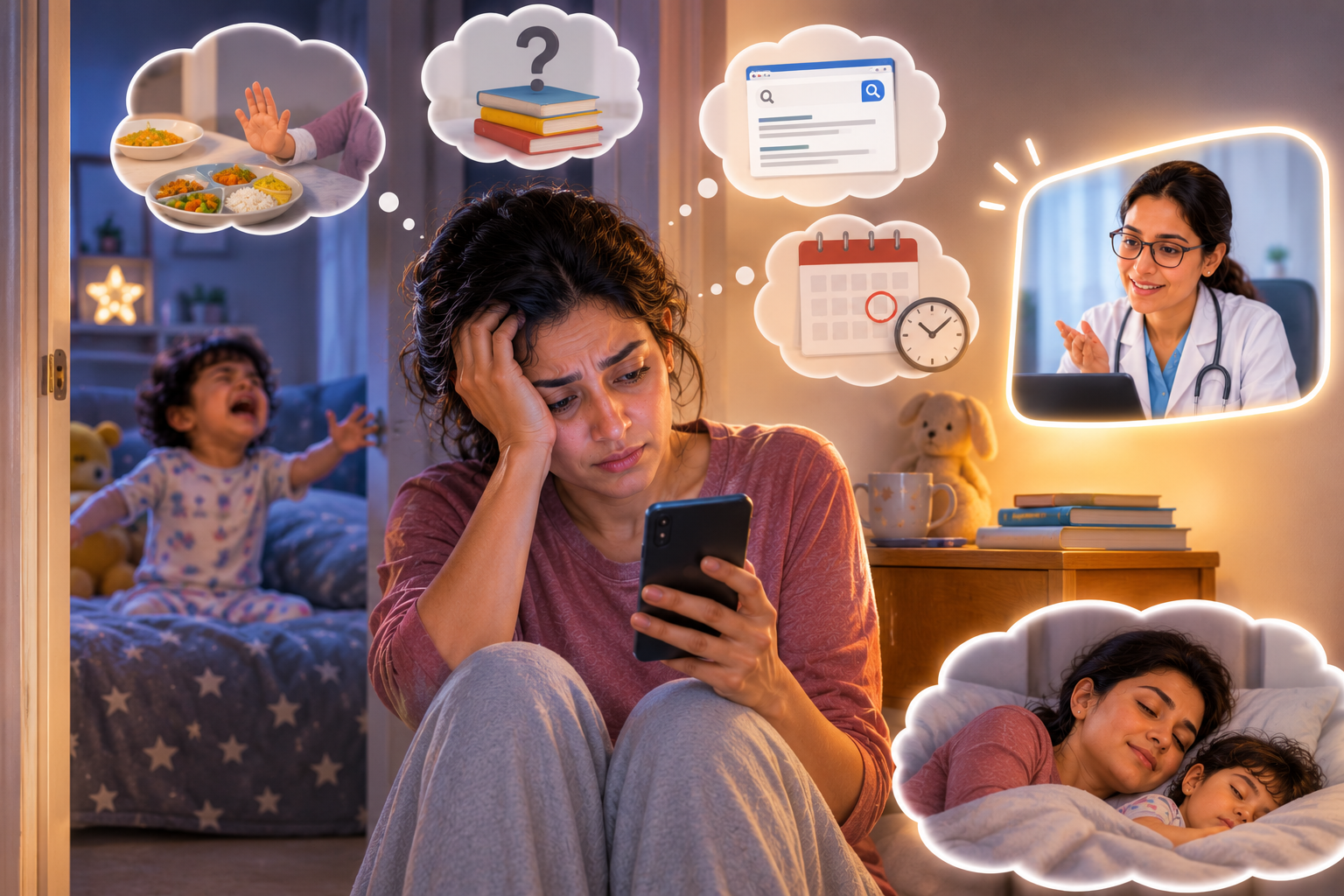
The bedtime routine ended an hour ago. The books are read, the lights are off, and your child is still calling out, or crying, or climbing out of bed for the fourth time — and you're sitting on the floor outside their door, phone in hand, searching the same question you searched last week: why won't my child just sleep. You're not thinking clearly, because you haven't slept properly either.
That's the thing almost nobody says about this particular worry: it doesn't just concern you. It exhausts you, specifically and directly, every single night, until thinking straight about it becomes part of the problem.
This exhausts almost every parent at some point — you're not failing
Bedtime resistance and frequent night waking show up in roughly a quarter to a third of toddlers and preschoolers in community studies — common enough that if your child is one of them, you're solidly in the majority, not the exception (PMC). For most of these children, this isn't a sign of anything wrong with them, or with your parenting; sleep in early childhood is genuinely uneven, shaped by age, temperament and daytime routine far more than by anything happening at the bedside.
Of toddlers and preschoolers show bedtime resistance or frequent night waking in community studies — common enough to be the norm, not an outlier.
What makes sleep different from a lot of other parenting worries is that it's rarely just the child who's affected. Research following parents through a sleep intervention found that when a child's sleep improved, parents' own mood, stress and even depression scores improved right along with it — moving in measurable, substantial ways within weeks (PMC). Read the other direction, that finding says something important: your own exhaustion isn't separate from your child's sleep problem. It's part of it — and it's a real reason this particular worry hits harder and faster than most.
Why a straight answer is so hard to find
Unlike most parenting questions, sleep advice doesn't just vary — it actively contradicts itself, in print, with confidence on both sides. A study of forty popular parenting books on child sleep found 61% endorsed some form of controlled crying, 31% opposed it outright, and more than half of all the books took a hard line for one method while explicitly rejecting the other — with many authors holding no medical, counselling or research credentials at all (Sleep). A parent searching for guidance isn't failing to find the answer. Often there isn't one agreed-on answer waiting to be found — just confident, opposing voices, each certain the other is wrong.
"A parent searching for guidance isn't failing to find the answer. Often there isn't one agreed-on answer waiting to be found."
The professionals aren't always better equipped to referee it either. An international survey found training on sleep disorders is minimal across most pediatric residency programs, which is part of why so many sleep concerns get waved off as "a phase" rather than properly assessed — and when a case genuinely needs a specialist, the wait is severe: pediatric sleep subspecialty appointments commonly book out many months in advance, with demand far outstripping the available workforce almost everywhere (PMC).
So, exhausted and still without a clear answer, a parent does what happens with every other worry like this: opens a search engine at 2am, reads ten contradictory opinions, and closes the tab no more certain than before (RACGP newsGP).
And most parents don't say how bad it's gotten
Sleep is one of the few parenting topics everyone feels entitled to ask about directly — "is she sleeping through the night yet?" — which makes it one of the hardest to answer honestly. Research on new mothers found a consistent pattern: comparing their child's sleep and development to others triggered real guilt and shame in both directions, while fear of being judged kept many from admitting how hard things actually were. One mother's words capture it exactly: "I don't want mum to think, 'Oh she can't manage it'" — a fear of judgment strong enough to keep real struggles hidden even from close family (PMC).
So a parent who hasn't slept properly in months, who's already tried three contradictory methods from three confident sources, often still answers "oh, we're figuring it out" when someone asks — because the honest answer feels like an admission of failure, not a request for help.
What an unanswered sleep problem actually costs — on both sides of the hallway
For the child, the evidence on inadequate sleep is some of the most consistent in all of pediatric research: it's linked to real, measurable problems with attention, impulse control and behaviour regulation, weaker academic performance, and a higher later risk of anxiety and depression — researchers describe the evidence as having converged strongly enough to call it a likely causal relationship, not just a correlation (PMC).
For the parent, the cost isn't hypothetical or years away — it's happening tonight. The same research that found parents' mood and stress improve once their child's sleep improves implies the reverse just as clearly: an unresolved sleep problem keeps a parent's own exhaustion, irritability and risk of depression elevated for as long as it goes unaddressed (PMC). This is the one category where getting a real answer sooner isn't just better for the child down the road. It's better for the parent lying awake right now.
Where ParentQ fits — for the parent who hasn't slept, not just the child who won't
Sleep is one of ParentQ's seven categories by design, covering bedtime resistance and refusal specifically. It exists because this particular worry comes with a particular cruelty: it exhausts the exact person who most needs a clear head to solve it.
A parent doesn't need to wait months for a sleep-subspecialty appointment, pick a side between two contradictory books, or decode forum threads at 2am to find out whether what they're dealing with is ordinary or worth real concern. A WhatsApp message is only a doorbell; the actual conversation happens privately on a secure web thread with a real, named developmental paediatrician — one answer, not ten competing ones. The first query is free, so a parent running on no sleep and little patience isn't also asked to shop around before they're allowed to ask. And because it's asynchronous — text, or a voice note recorded from the hallway outside a child's door, whatever hour this actually happens — there's no appointment to book and no need to sound composed while describing a night that wasn't.
It's explicit about what it isn't: not a diagnosis, not a medical consultation, and not for physical or medical emergencies. What it closes, for this category specifically, is the gap between two contradictory books and a genuinely qualified, judgment-free person who can say which parts of this are ordinary, and which parts are worth a closer look — so a parent can actually sleep on the answer, instead of without one.
Ask a Specialist
Running on no sleep and no answers? Ask a developmental paediatrician directly — privately, with no appointment needed.
Most bedtime struggles are ordinary, and the research is clear that they usually resolve. But "usually" doesn't help at 9:47pm on night forty of the same fight, with two contradictory books on the nightstand and no one qualified to ask. The choice shouldn't be between a months-long specialist wait, a confident stranger's book, an unverified search result, or just enduring it. ParentQ exists so that question reaches an actual paediatrician instead — and the parent gets to put the phone down and actually sleep.
Frequently asked questions
Is it normal for toddlers to resist bedtime or wake at night?
Yes. Bedtime resistance and frequent night waking show up in roughly a quarter to a third of toddlers and preschoolers in community studies. For most of these children, this isn't a sign of anything wrong — sleep in early childhood is genuinely uneven.
Does my child's sleep problem affect me too?
Yes, directly. Research following parents through a sleep intervention found that when a child's sleep improved, parents' own mood, stress and even depression scores improved right along with it, within weeks.
Why is sleep advice so contradictory?
A study of forty popular parenting books on child sleep found 61% endorsed controlled crying, 31% opposed it outright, and many authors held no medical, counselling or research credentials at all. Pediatric residency training on sleep disorders is also minimal almost everywhere.
How can I ask a paediatrician about my child's sleep without booking an appointment?
ParentQ lets you message a real developmental paediatrician privately, with no appointment, referral, or existing account needed. Your first query is free, and the conversation happens asynchronously, so there's no rushed clock in the background.
Sources: Behavioral and parental predictors of infant and toddler sleep quality (PMC); The influence of infant sleep problems and sleep training on maternal subjective well-being (PMC); Parenting Advice Books About Child Sleep: Cosleeping and Crying It Out (Sleep journal); Pediatric sleep disorders are common and costly: how can we help? (PMC); Help parents search Dr Google about their child's health (RACGP newsGP); 'Some Days Are Not a Good Day to Be a Mum': Exploring Lived Experiences of Guilt and Shame in the Early Postpartum Period (PMC); Cognitive, Behavioral, and Functional Consequences of Inadequate Sleep in Children and Adolescents (PMC).