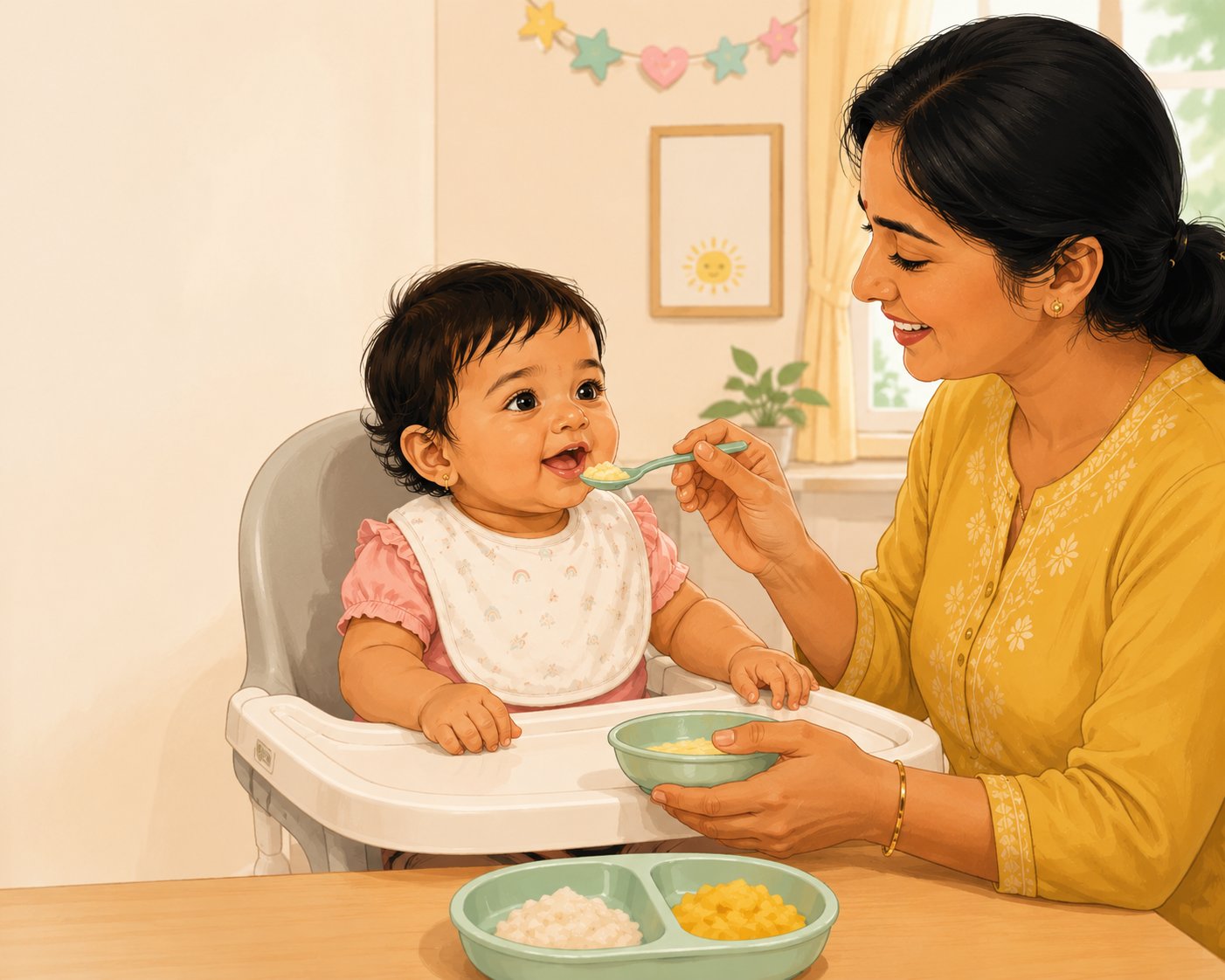
The noise around starting solids — called complementary feeding — is louder in India than almost anywhere else. And it matters more than most parents realise.
The evidence is unambiguous. Exclusive breastmilk provides everything a baby needs for the first six months. After that, it is no longer sufficient — not because it becomes less nutritious, but because your baby's iron stores, built up during pregnancy, begin to deplete at precisely this point. Breastmilk cannot replenish them fast enough.
The APACPH Public Health Nutrition Group guidelines — drawing on 15 Asia-Pacific cohort studies covering over 11,000 infants — are direct: complementary foods must begin at around six months, alongside continued breastfeeding ideally through two years.
Digestive system not ready. Risks of infection, allergy sensitisation, and gut inflammation are elevated.
Iron stores are depleting. Baby shows readiness signs. Breastmilk continues alongside solids.
Nutritional gap widens. Iron and zinc deficiency risk increases. Texture acceptance becomes harder.
India's real feeding gap — and where it hits hardest
Timing is only half the problem. A landmark review by Aguayo (Maternal & Child Nutrition, 2017), synthesising nationally representative data across South Asia, found that even when complementary feeding begins on schedule, the quality of what babies eat falls far short of what their developing bodies need.
Approximately 37% of South Asian children under five — around 64 million children — are stunted. Most of this stunting accumulates during the 6-to-23-month complementary feeding window, not at birth.
In Southern India, both figures improve — 61% and 33% respectively — but remain far from adequate. The consistent gap across all regions is dietary diversity: Indian complementary diets are typically built around a single staple, rice, roti, dal, without enough variety across food groups.
Be in Charge
Feeding and nutrition differences can be quiet — often hidden in everyday moments. Knowing how your child is developing early gives you more opportunity to support them.
Know today, through your child's RBSK developmental markers. Objective, from home, in 6 minutes.
What your baby's plate should actually look like
The APACPH guidelines define minimum dietary diversity as eating from at least four out of seven food groups. The table below maps the critical nutrients, why each matters during 6–23 months, and the most accessible Indian food sources.
| Nutrient | Why it matters (6–23 months) | Indian food sources | Form for baby |
|---|---|---|---|
| Iron Critical | Brain development, oxygen transport. Stored iron depletes by 6 months. Deficiency at this stage has irreversible cognitive effects. | Ragi, masoor dal, methi leaves, egg yolk, chicken liver, drumstick leaves | Mashed, pureed, or soft-cooked. Pair with Vitamin C foods to boost absorption. |
| Zinc Critical | Immune function, cell growth, wound healing. Deficiency linked to stunting and increased infection risk. | Chana dal, rajma, whole wheat, eggs, chicken, fish | Dal mash, soft-cooked grains, flaked fish or minced chicken. |
| Vitamin A | Vision, immune defence, skin health. Deficiency increases severity of infections like measles and diarrhoea. | Sweet potato, carrot, pumpkin, ripe mango, egg yolk, ghee | Mashed or pureed. Orange and yellow vegetables are easiest to introduce early. |
| Vitamin D | Bone development, immune modulation. Deficiency highly prevalent in Indian children 1–5 years, even in a sunny country. | Egg yolk, fortified cereals, fatty fish (rahu, rohu). Sun exposure alone is not enough. | Soft-cooked egg yolk from 6 months. Discuss supplementation with your paediatrician. |
| Folate | Cell division, red blood cell formation. Supports rapid growth during this phase. | Palak (spinach), methi, moong dal, beetroot, banana | Pureed greens mixed into dal or khichdi. Banana mash from 6 months. |
| Calcium | Bone density, nerve transmission, muscle function. | Ragi (finger millet), sesame (til), paneer, curd, tofu | Ragi porridge is the best Indian source. Soft paneer from 7–8 months. |
| Protein | Muscle development, enzyme production, tissue repair. Most Indian complementary diets are carbohydrate-heavy and protein-light. | Moong dal, masoor dal, egg, curd, chicken, fish, paneer | Dal water and mashed dal from 6 months. Whole egg from 8 months. |
Five things the research is clear about
1. Start at six months, not before. Begin with single-ingredient pureed or mashed foods. Gradual texture progression, lumpy by 8 months, soft family foods by 10–12 months, builds oral-motor skills that affect chewing and speech later.
2. Iron first. The most urgent nutritional priority at six months. Ragi porridge, mashed dal with ghee, egg yolk, and dark leafy greens are culturally familiar starting points. Pair iron-rich foods with Vitamin C sources (tomato, amla, lime) to enhance absorption.
3. Colour and variety on the plate. If your baby's meals look the same colour every day, diversify. The APACPH guidelines emphasise dietary variety, not just for nutrients but for texture and taste exposure, which shapes food acceptance long into childhood.
4. Keep breastfeeding. Starting solids is not a reason to stop. Breastmilk continues to provide immune protection, key fatty acids and comfort through the second year. Solids work alongside breastmilk, not instead of it.
5. Feed responsively. The Aguayo review found that counselling interventions improved feeding frequency and diversity significantly, but only when delivered consistently over time. How you feed matters as much as what you feed. Follow your baby's hunger and fullness cues.
What this has to do with development
Most parents track weight. Fewer connect nutrition to developmental outcomes — and the connection is direct. Iron deficiency in the 6–23-month window doesn't just affect growth. It affects motor skill development, language acquisition, attention, and social responsiveness.
A child who is iron-deficient at eight months is not simply lighter. They may be less exploratory, less responsive to interaction, slower to reach motor milestones — subtle early signals that structured developmental tracking is designed to catch.
"Most stunting accumulates during the 6-to-23-month complementary feeding window — not at birth. What a child eats during this period shapes brain development and attention for life."
If you've noticed changes in your baby's responsiveness, engagement, or motor progress alongside feeding concerns, a developmental profile gives you something precise to work with — not a vague reassurance, but a real picture across multiple domains.
That's exactly what Hidden Hum is built for.
Be in Charge
Feeding and nutrition differences can be quiet — often hidden in everyday moments. Knowing how your child is developing early gives you more opportunity to support them.
Know today, through your child's RBSK developmental markers. Objective, from home, in 6 minutes.
Based on: Aguayo VM. Complementary feeding practices for infants and young children in South Asia. Maternal & Child Nutrition. 2017;13(Suppl 2):e12439. | Binns C et al. Guidelines for Complementary Feeding of Infants in the Asia Pacific Region. Asia Pacific Journal of Public Health. 2020;32(4):179–187. | Dhami MV et al. Complementary feeding practices among children aged 6–23 months in India. BMC Public Health. 2019;19:1034.