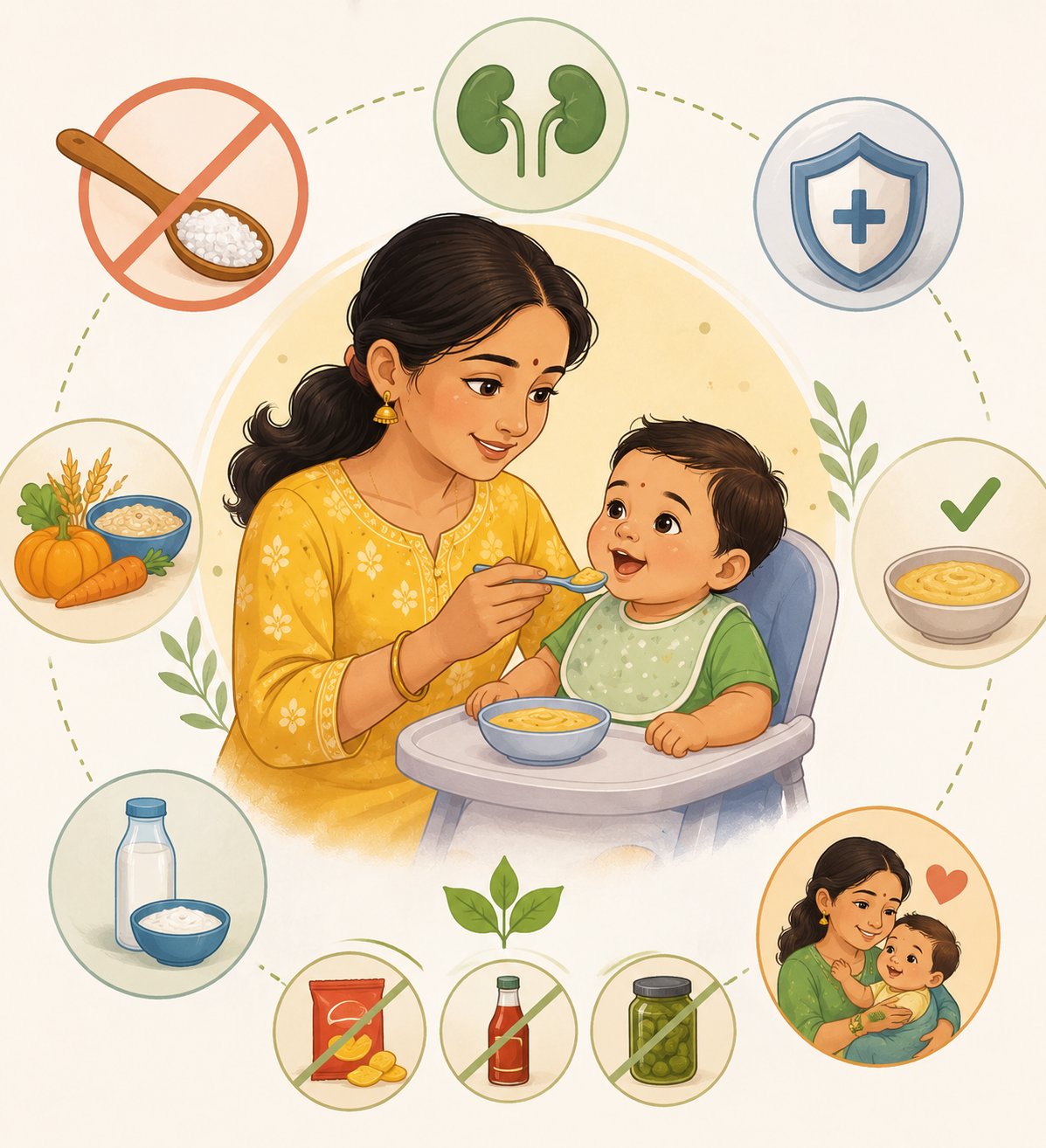
Salt is woven into Indian cooking in a way it simply isn't in most Western cuisines. Every dal, every sabzi, every khichdi gets seasoned instinctively. So when parents start complementary feeding at six months, the habit carries over — a pinch here, a little there, just to make it palatable.
But babies are not small adults. Their kidneys are immature, their sodium needs are tiny, and — critically — they are already getting the sodium they need from breastmilk, formula, and the natural sodium in dal, rice, vegetables and curd. Added salt doesn't fill a gap. It creates one.
The global picture is consistent: the problem in infant nutrition is too much sodium, not too little. High salt intake in early childhood is linked to elevated blood pressure and increased cardiovascular risk in adulthood — and taste preferences formed in infancy persist for years.
What Indian data actually shows
A study of 517 infants in West Bengal, with a median age of 6.5 months, looked directly at how salt use in complementary feeding affected growth outcomes. The finding was striking.
Babies on a lower-salt diet had measurably better growth indicators — their weight-for-length and BMI-for-age scores were nearly two-thirds of a standard deviation higher than those on higher-salt diets. The researchers raised concern that poor early growth combined with high salt intake may increase future risk of high blood pressure in these children.
In neighbouring Pakistan, a detailed laboratory analysis of infant cereals, biscuits and snacks found that many products contained more sodium than their labels claimed, often with very high sodium-to-potassium ratios. The authors concluded that nearly all Pakistani children consume substantially more salt than they need — a pattern directly relevant to Indian families using similar packaged products.
Be in Charge
Nutrition and dietary differences can be quiet — often hidden in everyday moments. Knowing how your child is developing early gives you more opportunity to support them.
Know today, through your child's RBSK developmental markers. Objective, from home, in 6 minutes.
What the guidelines say — and why they say it
The WHO's complementary feeding guidelines for 6–23 months emphasise home-prepared, minimally processed foods — rich in nutrients but without heavy salting. WHO's sodium reduction fact sheet is direct: sodium deficiency is rare, while excess is widespread and strongly linked to high blood pressure later in life.
Most international paediatric nutrition guidelines are aligned: avoid adding salt to foods for infants 6–12 months, and keep processed salty foods to a minimum through the second year. A recent evidence review acknowledged that the exact "no added salt" rule is based on limited direct trial data — but the logic is sound. Infant kidneys can handle normal sodium. They cannot efficiently excrete the very high intakes seen in modern diets, particularly when packaged foods are involved.
"Babies on a lower-salt diet had better growth indicators. The data from Indian infants is clear: more salt does not help growth. It may quietly harm it."
The key insight is this: your baby's food doesn't need to taste salty to be healthy or enjoyable. Infants who grow up tasting lightly seasoned food accept it readily — it's the default. It's adults who find unsalted food bland, because our palates have been calibrated over decades of salty food.
Salt by age — a practical guide for Indian kitchens
The table below maps what the research supports for each phase, with practical guidance for Indian home cooking.
| Age | Salt guidance | What to use instead | What to avoid |
|---|---|---|---|
| 6–12 months No added salt | No added salt in any form. Natural sodium in dal, rice, vegetables and breastmilk is sufficient for kidneys at this stage. | Ghee or oil in small amounts, jeera, hing, ajwain, mild homemade masalas without salt, coriander, natural flavours of dal and curd. | Table salt, rock salt, sendha namak, soy sauce, packaged soups, biscuits, chips, namkeen, instant noodles, ready-to-eat mixes. |
| 12–24 months Minimal salt | A very small amount of salt in shared family dishes is acceptable. Keep overall intake low and avoid frequent salty snacks. | Continue relying on spices and natural flavours. Introduce family foods gradually — cook shared meals with less salt for everyone. | Chips, namkeen, salty biscuits, instant noodles, processed soups, packaged snack foods. These add up fast even in small quantities. |
| After 2 years Family amounts | Child can eat family meals with normal seasoning. Still benefit from limiting salty packaged snacks as a general habit. | Home-cooked family meals with moderate seasoning. Keep packaged snacks as occasional treats. | High-sodium packaged snacks as daily staples. Taste preferences set in the first two years persist — keep the baseline low. |
The hidden sodium in packaged baby foods
Many parents are careful about not adding salt at the table — but don't realise that packaged baby foods, biscuits and cereals can be surprisingly high in sodium. The Pakistan study found products where actual sodium content significantly exceeded label claims. There is no reason to assume Indian-market products are substantially different.
Biscuits. A common "baby biscuit" or arrowroot biscuit can contain 80–120mg sodium per biscuit. Two or three over a morning adds up quickly relative to an infant's daily need of roughly 370mg total.
Instant cereals and porridge mixes. Many packaged infant cereals add salt for palatability and preservation. Check labels carefully — sodium above 100mg per 100g serving is a signal to look for an alternative.
Namkeen and family snacks. Sharing a handful of sev, chakli or bhujia with your baby feels harmless — but a small handful of namkeen can contain 200–400mg sodium, more than half the daily recommended intake for a 6–12-month-old in one handful.
Instant noodles and soups. A single serving of instant noodles typically contains 700–1200mg sodium — far above what an infant or toddler needs in an entire day. These are not appropriate for under-twos.
You're not depriving your baby. You're protecting them.
The goal here is not to make parents anxious about every pinch of salt. It's to shift the default. Salt is not a nutrient your baby is missing. It's not needed to make food enjoyable to a six-month-old who has never tasted salty food and has no reference point for it. The research from West Bengal and from global reviews consistently points in the same direction: lower salt in infancy is associated with better growth, not worse.
Taste preferences are formed early. Babies who get used to very salty flavours tend to prefer them later in childhood — and those preferences track into adulthood. Keeping salt low in the first two years is one of the simplest, lowest-effort things a parent can do for long-term cardiovascular health.
If you are worried about your baby's growth or appetite, the answer is not more salt. It's a closer look at overall dietary diversity, iron status, and developmental progress — which is exactly what a structured assessment is designed to give you.
Be in Charge
Nutrition and dietary differences can be quiet — often hidden in everyday moments. Knowing how your child is developing early gives you more opportunity to support them.
Know today, through your child's RBSK developmental markers. Objective, from home, in 6 minutes.
Based on: Ghosh S et al. Salt intake and growth in infants: a community-based study from West Bengal. PubMed. PMID:27819174. | WHO. Sodium reduction fact sheet. who.int/news-room/fact-sheets/detail/sodium-reduction. | WHO. Guideline for complementary feeding of infants and young children 6–23 months. 2023. | Zlotkin S et al. Sodium content of infant foods in Pakistan. PMC. PMC4500422. | Aburto NJ et al. Effect of lower sodium intake on health. PubMed. PMID:37805298.