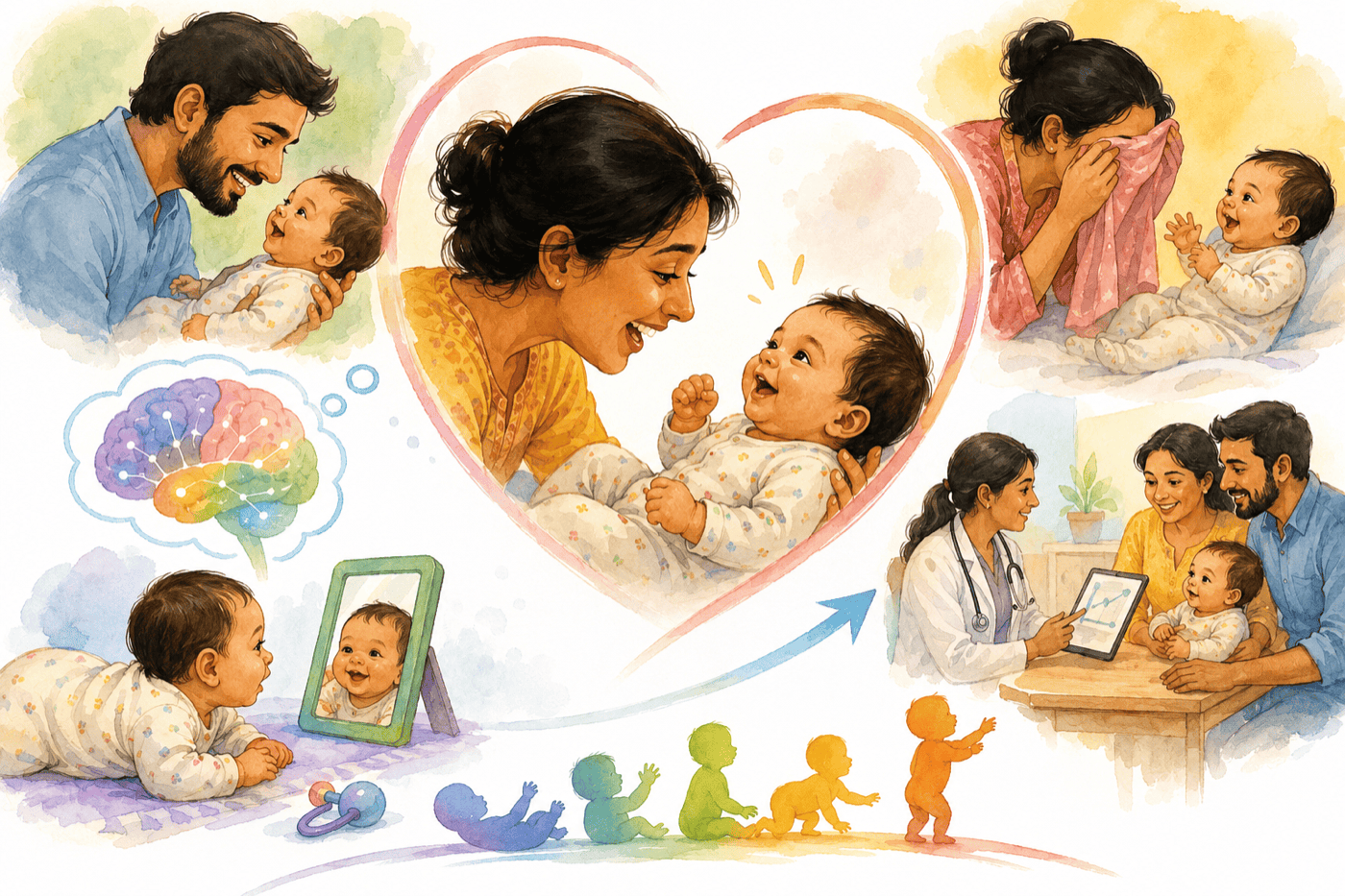
There is a morning, somewhere around six to eight weeks, when it happens. You lean over your baby, say good morning in that voice you have developed, and they look straight back at you and smile. Not a gas bubble. Not sleep. Back at you, at your face, because of you.
It is one of the purest moments in early parenting. It is also one of the most clinically significant milestones in your child's first year — and in India, it is one that paediatricians are explicitly trained to watch for.
What is a social smile in babies?
Newborns smile from the very first days — but those are reflex smiles, appearing during sleep or randomly, with no social trigger. A social smile is categorically different.
A social smile is a smile that appears specifically when your baby sees your face or hears your voice. It comes paired with eye contact, a brightening of the whole face, small body movements, perhaps a coo. And crucially, it forms a pattern — something your baby does consistently in response to familiar people.
"Think of it as your baby's first conversation: I recognise you. You make me feel safe. Keep going."
When do babies social smile? Indian guidelines vs global norms
Most babies show their first genuine social smile between six and twelve weeks, with many clearly smiling back at faces by around two months. This timing holds consistently across cultures — research comparing German and rural Cameroonian infants found similar emergence windows despite dramatically different caregiving styles.
The Indian Academy of Pediatrics is explicit: social smiling is expected around two months. More critically, no social smile by three months is flagged in the IAP Developmental Milestone Checklist as a red flag requiring immediate developmental assessment.
That is not an overreaction. The social smile is an early window into how the brain, vision, emotional processing and social wiring are all working together — simultaneously.
Why does the social smile matter so much?
For a baby to smile socially, they need to see your face clearly, recognise it as familiar and positive, process your expression as a signal directed at them, and generate a response that communicates back. That is a remarkable amount of neural integration happening in a tiny person.
Research shows that by around four months, infants are already timing their smiles strategically — pausing after smiling to check whether their caregiver has responded, suggesting smiling is already goal-directed social behaviour. By eight to twelve months, some babies show anticipatory smiles: they smile and then look at the parent, using the smile to pull the adult into shared attention.
This is the beginning of joint attention — the shared social focus that forms the foundation of language, communication and learning.
The social smile is its earliest expression.
How to encourage social smiling — practical steps
You are the most powerful developmental stimulus your baby has. Babies with more responsive, engaged caregivers develop social smiling earlier and use it more richly.
- Face-to-face time, daily. Hold your baby approximately 20–30 cm from your face — their optimal visual focus distance in early weeks. Talk softly, use their name, keep your expression warm
- Smile first, then pause. Give a deliberate smile and say something simple. Then wait. That pause is not empty time — it is your baby's window to respond. Silence is where the conversation happens
- Layer voice and touch. Some babies respond more readily when voice is paired with gentle touch — a hand on the chest, a stroke on the cheek. Especially useful for babies who are slower to warm up
- Small, consistent games. Peek-a-boo, soft songs, mimicking your baby's sounds — these are structured social interactions that build precisely the circuits the social smile emerges from
When to talk to your paediatrician — red flags
Not every baby who smiles less is a cause for concern. Some babies are naturally more reserved. A baby with strong eye contact, clear interest in faces, and good responsiveness to voice — but fewer visible smiles — may simply have a quieter temperament.
But there are signals worth discussing with your paediatrician:
- Your baby shows no clear social smile in response to faces or voices by three months
- There is very limited eye contact or apparent disinterest in faces, even with primary caregivers
- Your baby loses social smiling or eye contact they previously had — loss of any skill is a red flag at any age
These observations do not tell you what is happening. They tell you it is time to ask. The IAP and RBSK guidelines exist precisely so that Indian families have a clear, structured framework for when to act.
Social smiling and autism — what Indian parents should know
Reduced or absent social smiling alongside other early social-communication differences — limited eye contact, reduced response to name, little interest in faces — can be among the earliest observable patterns in children later identified with autism. This is why Indian paediatric guidelines take its absence at three months seriously.
It does not mean a baby without a social smile has autism. It means the full picture deserves professional attention. In India, where access to developmental specialists can take time, acting early on a three-month red flag gives families the most possible runway.
For more on how early social and communication patterns connect to autism identification, see our piece on early signs parents often miss and what it means when a baby doesn't respond to their name.
Where Hidden Hum fits in
Hidden Hum is an early skills profiler for parents, organised around the same domains RBSK and IAP guidelines care about: vision and attention, hearing and response, motor and play, and social-emotional engagement.
For social smile specifically, it does not just ask a single yes/no question. It looks at a cluster of age-linked signals — smiling to faces and voices, eye contact quality, interest in people, early back-and-forth engagement — that together describe early social connection against Indian guideline windows.
Hidden Hum also uses subtle eye-tracking cues to understand how your child naturally engages — whether their attention tends toward faces, how long they sustain social gaze — enriching the profile without asking you to interpret technical data. What you see is plain-language feedback about how your child is engaging at each stage.
What you do not get from Hidden Hum is a label or a verdict. That is deliberate.
Hidden Hum's job is to help you baseline and track your child's early skills over time — and to tell you clearly, in RBSK-aligned language, when a pattern warrants a conversation with your paediatrician.
The difference between "I feel something might be off" and "here is what I have been observing, over time, structured against Indian guidelines" is significant when you sit down with a doctor. Hidden Hum gives you the second kind of conversation.
Track your baby's social milestones against IAP guidelines — starting from six weeks — with Hidden Hum's early skills profiler.
The bottom line
Your baby's social smile is not just a photograph moment. It is one of the earliest, most reliable signs that the brain is connecting vision, emotion, social recognition and response into the first real back-and-forth communication your child will ever have.
Most babies will show it between six and twelve weeks. Indian paediatric guidelines flag its absence at three months as something to act on immediately. And in the months that follow, that smile will evolve — into laughter, into pointing, into words, into the person your child is becoming.
Watch for it. Enjoy it. And if you want to track it with the same rigour you give to weight and vaccines, that is exactly what Hidden Hum is built for.
Based on: Indian Academy of Pediatrics Developmental Milestone Checklist (2015) · Nelson EAS et al. Dev Med Child Neurol. 2004;46(10):706–709 · WHO Multicentre Growth Reference Study Group. Acta Paediatrica. 2006;Suppl 450.