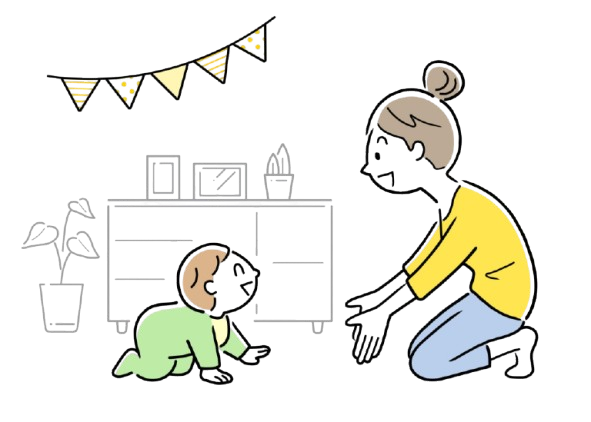
You call your baby's name. Sometimes they look up. Sometimes they don't. And you're left wondering — is that normal for their age, or is it something to pay attention to?
It's one of the most common early questions parents bring to us, and for good reason. Responding to their own name is one of the earliest and most-studied signals of social communication — the foundation on which pointing, words, and back-and-forth interaction are built. It changes meaningfully between 9, 12 and 18 months, so what's perfectly typical at one age can be worth a closer look at another. Here's how to read it — calmly, by age.
Why response to name matters so much
Turning to your name is not just a hearing test. It's a social act — the baby recognises that a sound belongs to them, and that someone is trying to connect. That's why researchers and clinicians treat it as an early window into social communication and joint attention (the shared "you-and-me-looking-at-the-same-thing" that language grows from).
Research following infants over time has found that a reduced or inconsistent response to name — particularly by around 12 months — is one of the earliest signals associated with later developmental differences, including autism. This does not mean a baby who sometimes ignores their name has autism; most don't. It means the behaviour is worth watching over time rather than dismissing — which is exactly what structured developmental monitoring is designed to do.
Response to name is a signal, not a verdict. What it tells you depends on your child's age, how consistent it is, and what other behaviours accompany it.
Response to name by age
At 9 months
At 9 months, most babies respond to their name at least some of the time in a quiet setting — a head turn, a brief glance, or a pause in what they're doing. Response is often inconsistent at this age, especially when your baby is deeply absorbed in play or when the room is noisy. That inconsistency is normal.
Worth a closer look if: your 9-month-old shows no response to their name at all, even in a calm, quiet room — or never turns toward your voice or familiar sounds.
At 10 months
At 10 months, response to name is usually becoming more frequent than at 9 months, but it's still normal for it to be inconsistent — a 10-month-old absorbed in a toy may not turn every time. What you're looking for is a pattern: does your baby respond at least sometimes in a quiet room, and turn toward your voice and familiar sounds? If a 10-month-old doesn't respond to their name at all, the first and most important step is simple — have their hearing checked, because even mild, intermittent hearing loss (very common after ear infections) can look exactly like this.
Worth a closer look if: your 10-month-old never responds to their name in a quiet setting, doesn't turn toward familiar sounds, and shows little eye contact or babbling alongside it.
At 12 months
This is the pivotal age. By 12 months, most babies respond to their name fairly consistently in quiet settings, usually with eye contact, and it increasingly comes with a smile or a reach. Twelve months is also the checkpoint the research highlights most: a consistent failure to respond by this age is one of the earliest signals worth taking seriously.
Worth a closer look if: your 12-month-old consistently doesn't respond to their name in quiet settings — especially if it's paired with reduced pointing, limited gestures, little eye contact, or reduced babbling. First step: have their hearing checked.
At 18 months
By 18 months, response to name should be reliable across settings — quiet or busy, home or outside — and woven into social interaction: your child looks, smiles, and often comes toward you or shows you something. It's now part of genuine back-and-forth.
Worth a closer look if: response is still inconsistent at 18 months, occurs only to loud sounds but not to the name itself, or — most importantly — if your child previously responded and has stopped. Any loss of a skill that was there before (regression) is a specific reason to speak with your paediatrician promptly.
Has your baby stopped responding to their name?
There's an important difference between a baby who has never responded reliably and one who used to respond and has stopped. If your 12-month-old was turning to their name at 9 or 10 months and no longer does, that change — a loss of a skill that was there before — is called regression, and it deserves a prompt conversation with your paediatrician rather than a wait-and-see.
This matters because loss of early social skills, including response to name, is one of the more specific early signals in child development research — not a diagnosis, but a pattern worth acting on early. It's easy to second-guess yourself here ("Maybe I'm imagining it, maybe they're just distracted lately"), which is exactly why writing down what you noticed and when is so useful.
Never quite started — inconsistent response that is slowly building is usually part of the normal range.
Started and stopped — a baby who responded and now doesn't is the pattern to raise with your paediatrician promptly, alongside a hearing check.
Whatever the cause, the first practical step is the same as for any response-to-name concern: rule out hearing first (intermittent hearing loss after ear infections is common and easily missed), then look at the wider picture — eye contact, gestures, babbling, and social back-and-forth.
Is it hearing, attention, or something else?
Before reading too much into it, it helps to separate three very different explanations:
Hearing
A hearing difficulty can look exactly like "not responding." This is always the first thing to rule out — ask your paediatrician about a hearing check.
Attention / absorption
A baby deep in play may genuinely not register their name. If they respond well when calm and not distracted, this is usually the explanation.
Social communication
If response is reduced even when calm and undistracted, and paired with less eye contact, pointing or shared attention, it's worth a structured look.
Temperament / phase
Some periods are simply less responsive. This is why the pattern over weeks matters far more than any single moment.
"One moment tells you very little. A pattern — how often, in what settings, and what accompanies it — tells you almost everything."
Why "wait and see" and memory both mislead
A baby ignores you in the morning, responds at night, and it feels reassuring again. But isolated moments are misleading. Development shows itself as consistency over time — not one-off responses. And trying to hold that pattern in your head — "he responded yesterday… she ignored me this morning…" — quickly becomes a blur. Memory is not built to track gradual developmental change accurately.
"Wait and see" without any structure is just waiting. The useful version is watchful waiting with a framework: a simple, repeatable way to see how often your child responds, whether it's stabilising or staying uneven, and what other signals appear alongside it.
How to get a clear picture — from home, in six minutes
In India, developmental monitoring is a national standard, not a specialist luxury. The Rashtriya Bal Swasthya Karyakram (RBSK) — the Government of India's child health programme — establishes that every child deserves structured developmental screening as part of routine care, alongside growth, hearing and vision. Development is the fourth pillar of child health.
Hidden Hum, Fairy Tales Wellbeing's parent-led tool, is built on those RBSK standards. In under six minutes, from home, it turns what you already observe — including response to name, eye contact, pointing and babbling — into a structured Early Skills Profile. Not a diagnosis. A clear, age-specific picture of where your child is, so you're working from a pattern, not a hunch.
Be in Charge
Communication differences can be quiet — often hidden in everyday moments. Knowing how your child is developing early gives you more opportunity to support them.
Know today, through your child's RBSK developmental markers. Objective, from home, in 6 minutes.
When to talk to your paediatrician
Raise it with your paediatrician if you notice any of these:
• No response to name at all in quiet settings by 9–12 months
• Consistent non-response by 12 months, especially with limited pointing, gestures or eye contact
• Still inconsistent at 18 months, or response only to loud sounds, not the name
• Any loss of a response that was previously there (regression) — at any age
None of these is a diagnosis on its own. Each is simply a signal that a closer, structured look — starting with a hearing check and a developmental screen — is the responsible next step. A preliminary assessment lets you discuss your observations with a clinician and understand whether a fuller assessment is warranted.
Book a Preliminary AssessmentFrequently asked questions
Should a 9-month-old respond to their name?
At 9 months, most babies respond to their name at least some of the time in a quiet setting — turning toward you, a brief glance, or a pause in play. Response is often inconsistent at this age, especially when a baby is absorbed or in a noisy room. What matters is that the response is emerging and present at least occasionally in calm settings.
My 10-month-old doesn't respond to their name — is that normal?
At 10 months, response to name is usually becoming more frequent than at 9 months, but some inconsistency is still normal — a baby absorbed in play may not turn every time. If a 10-month-old never responds to their name in a quiet room, doesn't turn toward familiar sounds, and shows little eye contact or babbling, it's worth acting on. The first step is always to have their hearing checked, since intermittent hearing loss after ear infections is common and easily missed.
Why has my 12-month-old stopped responding to their name?
A baby who responded to their name at 9 or 10 months and has stopped by 12 months is showing what's called regression — the loss of a skill that was previously there. This pattern is more specific than never having started, and it deserves a prompt conversation with your paediatrician rather than a wait-and-see approach. Have hearing checked first, then look at the wider picture: eye contact, gestures, pointing, and babbling.
What if my 18-month-old stopped responding to their name?
By 18 months, response to name should be reliable across settings and woven into social interaction. A child who previously responded and has stopped — a loss or regression of the skill — is a specific reason to speak with your paediatrician promptly, as is response that remains inconsistent at 18 months or occurs only to loud sounds rather than to the name itself.
Is not responding to name always a sign of autism?
No. Reduced response to name can also reflect a hearing difficulty, a temporary phase, or simply deep concentration. It is only one signal. It carries more weight when it is consistent over time and paired with other differences such as limited eye contact, pointing, or shared attention. Hearing should always be ruled out first, and a structured developmental check helps put the pattern in context.
Sources: Nadig et al. (2007), Archives of Pediatrics & Adolescent Medicine (response to name in infants at risk for autism); Ozonoff et al. (2010), on early skill loss/regression; CDC and AAP developmental milestone guidance; WHO/RBSK developmental surveillance frameworks. This article is educational and does not replace assessment by a qualified clinician; if you have concerns, start with a hearing check and speak with your paediatrician.
Hidden Hum is part of the Fairy Tales Wellbeing family — a non-diagnostic, RBSK-aligned early skills profiler helping parents track developmental milestones from birth to 6 years.