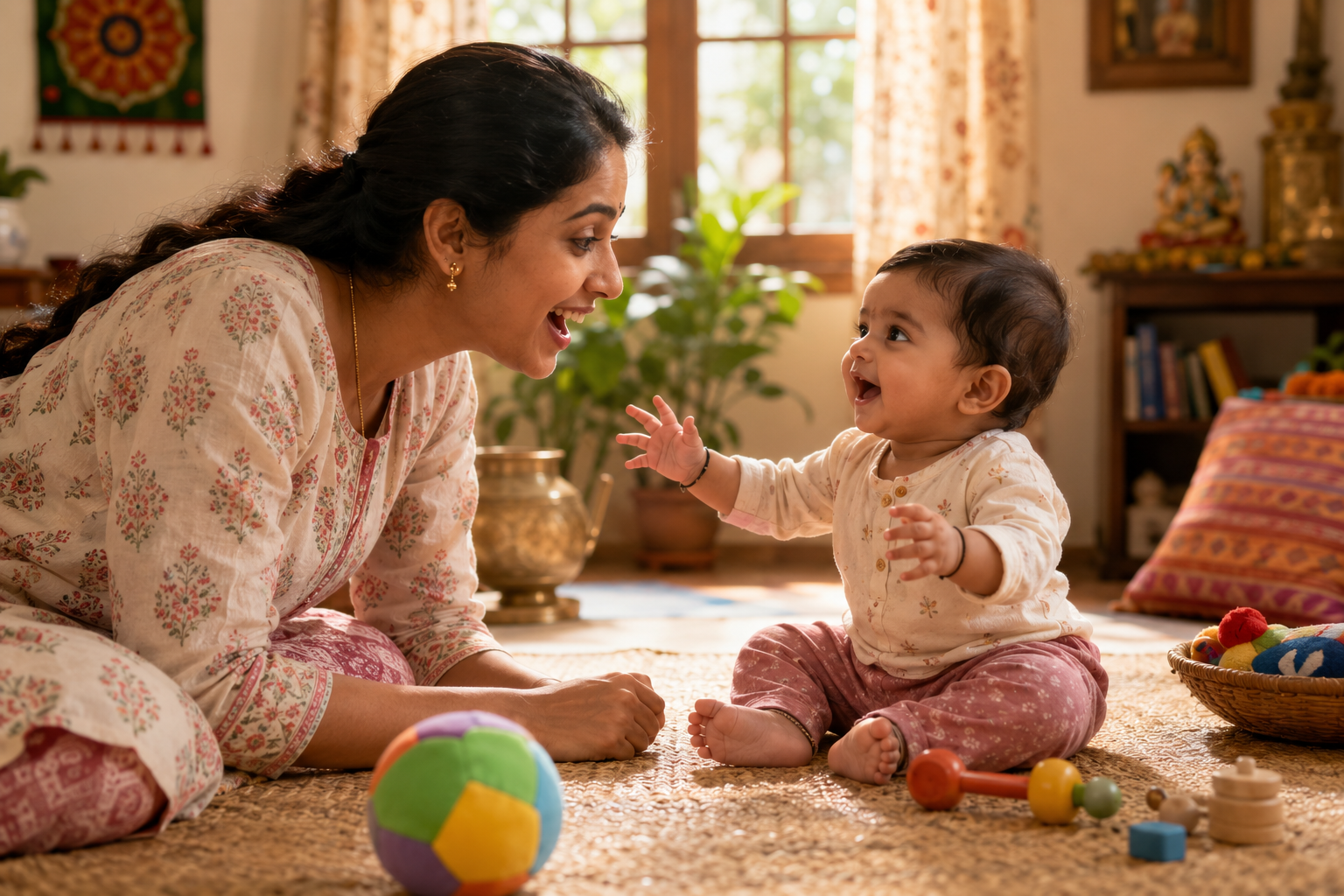
There's a sound every parent waits for. Not a word yet — just a clear, repeated "ba-ba-ba" or "ma-ma-ma," babbled with total confidence, like your baby has just discovered they have a voice worth using.
If you've started hearing it — or you're wondering when you should — here's what the research actually says about this moment, and why it matters far more than most parents realise.
Be in Charge
Speech and language differences can be quiet — often hidden in everyday moments. Knowing how your child is developing early gives you more opportunity to support them.
Know today, through your child's RBSK developmental markers. Objective, from home, in 6 minutes.
Why ba-ba and ma-ma specifically? The science behind these exact sounds
Parents often assume any babbling counts the same. It doesn't. Research shows that /p/, /b/, and /m/ — the sounds behind "ba-ba," "pa-pa," and "ma-ma" — are not random baby noise. They are the earliest and most universal consonants in human speech.
A major cross-linguistic review examining children's consonant acquisition across 27 languages found that plosives (like /p/ and /b/) and nasals (like /m/) are consistently among the first consonants children acquire, regardless of what language they're learning. A separate large-scale US study, synthesising data from nearly 19,000 children, found that /b/, /m/, /p/, along with /n/, /h/, /w/, and /d/, reach 90% accuracy by age 2 to 3 — confirming these specific sounds as biologically "early," not culturally specific.
"When your baby babbles 'ba-ba,' they're producing one of the first sounds every human baby, in every language, is wired to make."
When should babbling actually start? The real timeline
Canonical babbling — the stage where babies combine a consonant and vowel into a clear, repeated syllable like "ba" or "ma" — typically begins around 6 months, according to a landmark study following 42 infants. But there's an important distinction most parents don't hear about: the point at which babbling becomes consistent and stable — what researchers call "babble onset," meaning reliable production of multiple consonant sounds in canonical syllables — has been measured at a mean age of approximately 9.8 months in longitudinal research.
This typically happens several months before a baby's first real word.
So if your baby is 9 months old and is just finding their rhythm with "ba-ba" and "da-da," that is not late. That is squarely on time — right in the window where researchers expect this consistency to emerge.
Babbling isn't separate from talking — it's the rehearsal for it
One of the most reassuring findings for parents is that babbling and first words are not two separate milestones. They're deeply connected.
Research on the transition from babble to words has found that infants' early word productions closely match the sounds and objects most present in their babble — meaning the specific consonants your baby practises now often show up again in their first real words later.
There's a specific concept behind this: researchers call the consonants a baby produces frequently and stably in babble their "vocal motor schemes." Studies have found that infants who develop at least two of these stable, practised consonants — often /p/, /b/, or /m/ — are significantly more likely to transition successfully into meaningful, referential word use.
Even more strikingly, research using speech-perception experiments has found that babies pay closer attention to new words containing the consonants they've personally practised in their own babble.
Researchers describe this as an "articulatory filter" — your baby's own babbling is quite literally shaping how they listen to and process language around them.
That "ba-ba-ba" isn't noise in the background of your day. It's your baby building the exact sound system they'll use to talk to you.
Babbling is also being shaped by the language you speak at home
Research comparing infants across French, English, Cantonese, Arabic, and other languages has found that babies' consonant and vowel patterns in babble become increasingly language-specific over the second half of the first year — shaped directly by what they hear at home.
For Indian parents raising bilingual or multilingual children, this matters. Your baby's babbling is already adapting to the specific sounds and rhythms of the languages spoken around them, well before their first word arrives.
What to listen for at 9 months
Based directly on what the research identifies as typical canonical babbling by 9 months:
- Clear consonant-vowel syllables — sounds like "ba," "ma," "pa," "da" produced with a clean, recognisable consonant, not just vowel sounds like "aaa" or "ooo"
- Repetition — babbling in strings, such as "ba-ba-ba" or "ma-ma-ma," rather than a single isolated sound
- Consistency across the day — babbling that shows up regularly during play and interaction, not a one-off sound heard once
- A growing variety of consonants — most babies begin with one or two favourite sounds and gradually add more over the following months
When to talk to your paediatrician
Canonical babbling in the 5–10 month window has been studied specifically as an early marker relevant to developmental disorders. Research has found that infants later diagnosed with autism spectrum disorder often show delayed canonical babbling, and similar patterns of delayed onset and reduced consonant diversity have been documented in infants with fragile X syndrome.
This doesn't mean delayed babbling equals a diagnosis — it does not. But if by 9 to 10 months your baby shows no canonical babbling at all — no repeated consonant-vowel sounds, only cooing or vowel-like noises — it is a signal worth raising with your paediatrician early, rather than waiting.
For more on how early communication signs connect to development, see our pieces on what it means when a baby doesn't respond to their name and what to do if your 18-month-old isn't talking.
How Hidden Hum helps Indian parents track this milestone
Most Indian parents have a clear system for tracking height, weight, and vaccination schedules. Very few have a structured way to track something as specific — and as scientifically significant — as canonical babbling and consonant development.
Hidden Hum, our RBSK-aligned early skills profiler, closes that gap. At the 6, 9, and 12-month stages, Hidden Hum prompts parents to observe and record exactly what the research identifies as meaningful — whether their baby is producing clear consonant-vowel sounds, how consistently these sounds appear, and how their range of consonants grows over time.
These observations build into a clear, longitudinal picture of your baby's early speech development — so if a conversation with your paediatrician is ever needed, you're bringing structured, evidence-grounded observations rather than a vague sense that "something feels off."
Hidden Hum doesn't diagnose any condition. It ensures a milestone as important as your baby's first "ba-ba" doesn't quietly slip past unnoticed.
Frequently asked questions
When do babies start babbling ba-ba, ma-ma, pa-pa?
Canonical babbling typically begins around 6 months, but consistent production of clear consonant-vowel sounds — what researchers call "babble onset" — occurs at a mean age of approximately 9.8 months, usually several months before a baby's first real word.
Why are ba, ma and pa the first sounds babies make?
A cross-linguistic review of 27 languages found that plosives and nasals — including /p/, /b/, and /m/ — are among the earliest consonants acquired by infants worldwide. A separate US study of nearly 19,000 children found these sounds reach 90% accuracy by age 2 to 3.
Does babbling actually predict when a baby will start talking?
Yes. Research shows direct continuity between canonical babble and first words, with infants' early word productions matching the sounds most present in their babble. Babies with at least two stably produced consonants are more likely to transition successfully into meaningful word use.
Should I be worried if my 9-month-old isn't babbling yet?
If your baby shows no canonical babbling by 9 to 10 months — no repeated consonant-vowel sounds like ba-ba or ma-ma — it's worth discussing with your paediatrician. Research has linked delayed canonical babbling to later-identified developmental conditions, making early observation valuable.
Sources: Oller et al. (1998); McGillion et al. (2017); McLeod & Crowe (2018), American Journal of Speech-Language Pathology; Crowe & McLeod (2020), American Journal of Speech-Language Pathology; Laing & Bergelson (2020), Cognitive Psychology; McCune & Vihman (2001); DePaolis, Vihman & Keren-Portnoy (2011), Infant Behavior and Development; Vihman & Boysson-Bardies (1994), Phonetica; Wermke et al. (2019), Current Developmental Disorders Reports; Patten et al. (2014).
Hidden Hum is part of the Fairy Tales Wellbeing family — a non-diagnostic, RBSK-aligned early skills profiler helping Indian parents track developmental milestones from birth to 6 years.