Someone — a relative at a family gathering, a neighbour over chai — has said something that you haven't been able to stop thinking about. Maybe it was "he seems a little different, no?" or "have you thought about getting her checked?" And now, even though you know your child better than anyone in the world, a quiet worry has taken root.
First: you are not alone. And second: the fact that you're here, looking for understanding rather than a verdict, tells us something important about the kind of parent you already are.
This article is for you — the mother who wants to understand what words like "neurodiversity" and "autism" and "ADHD" actually mean before she decides anything. Who wants to support her child without the fear that a single assessment will define them forever. Who is looking for a framework, not a label.
Let's start there.
What is neurodiversity? Reframing difference as variation, not disorder
Autism, ADHD, sensory processing, dyslexia — what do these words really mean?
You've probably heard these words in conversation, on social media, or from a well-meaning relative. But what do they actually describe? Autism, ADHD, sensory processing differences, and dyslexia are all ways that a child's brain can be wired differently — not incorrectly, but differently. They describe variations in how a child processes the world: how they communicate, how they focus, how they experience sounds and textures, how they learn to read.
Research estimates that autism, for example, is currently identified in approximately 1 in 100 people globally (Kuenzel & Duerden, 2024). That's not a small number. It means that in every school, every neighbourhood, every extended family, there are children whose brains work in ways that are genuinely different — and who can thrive with the right understanding and support.
Why 'neurodiversity' matters: it's about how your child's brain works, not what's 'wrong'
The word "neurodiversity" is built on a simple but powerful idea: that the range of human brain types is natural, not a problem to be fixed. The neurodiversity movement has initiated a meaningful shift in how clinicians and educators think about children who develop differently — away from a framework of "what is wrong with this child" and toward one of "how does this child experience the world, and what do they need to flourish" (Zaks, 2025).
This isn't just a philosophical position. It has real consequences for how children are supported. When the goal shifts from making a child look or behave "normal" to genuinely understanding and affirming how they think and learn, outcomes improve — for the child and for the whole family.
Neurodiversity in India: how it fits with your child's health and development
In India, developmental monitoring is part of your child's routine healthcare — it sits alongside growth checks, hearing tests, and vision screening as what we at Fairy Tales call the fourth pillar of child health. India's national programme, the Rashtriya Bal Swasthya Karyakram (RBSK), exists precisely because the Government of India recognises that every child deserves a structured developmental check. A neurodiversity-affirming approach doesn't sit outside this framework — it sits at its heart. Understanding your child's development is not about finding what's broken. It's about seeing your child clearly.
What does neurodiversity-affirming parenting actually mean?
The CARES framework: from deficit-finding to strength-seeing
Recent clinical thinking has given us a useful framework for what neurodiversity-affirming support looks like in practice. Woods, Brook and Angoff (2025) describe it using the acronym CARES: Collaborative Understanding, Accessibility, Recognizing Intersectionality, Empowerment, and Strengths Recognition. Each of these principles matters for parents, not just clinicians.
Collaborative understanding means you are a partner in understanding your child — not a passive recipient of someone else's verdict. Accessibility means support should be reachable, not locked behind long waiting lists or expensive clinic visits. Recognizing intersectionality means your child is a whole person — their development is shaped by their family, their culture, their environment, not just a single diagnostic category. Empowerment means that good support leaves you feeling more capable, not more anxious. And strengths recognition means that any honest picture of your child must include what they are good at — not just what they find hard.
From 'fixing' to 'understanding': the shift in how we support neurodivergent children
For a long time, the goal of support for children who developed differently was normalisation — making them behave and communicate in ways that looked like everyone else. Research has increasingly questioned this approach, recognising that it carries real risks and often fails to serve the child's actual needs (Zaks, 2025). A neurodiversity-affirming approach doesn't ask "how do we make this child fit in?" It asks "how do we help this child participate, connect, and grow in ways that are authentic to them?"
For you as a parent, this shift is liberating. It means that supporting your 2- or 3-year-old doesn't require waiting for a diagnosis. It means noticing what your child loves, what they find hard, what lights them up — and building from there.
What this looks like at home: three everyday examples
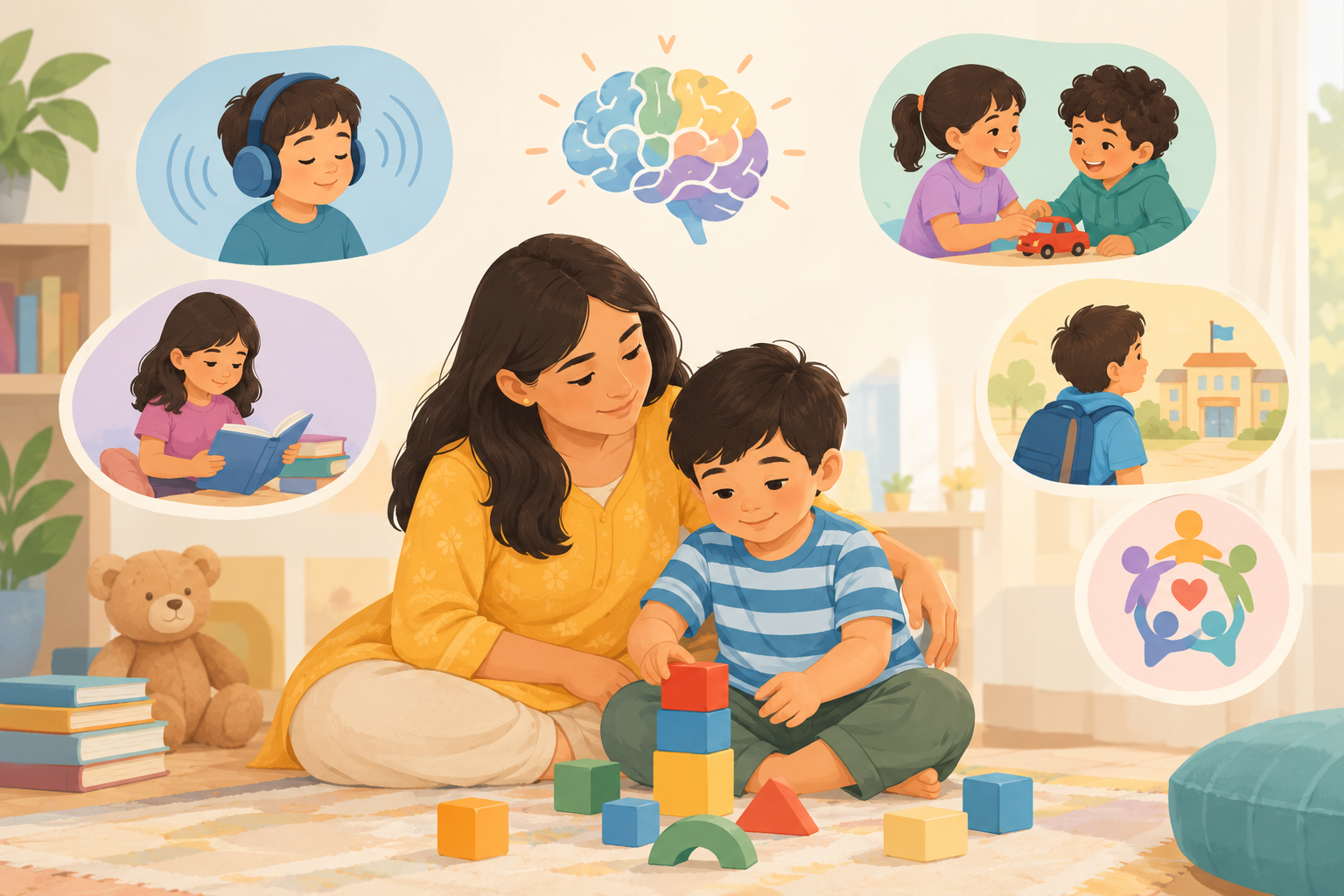
Your child seems 'different' with sensory experiences. Some children are deeply sensitive to sounds, textures, or lights that other children barely notice. Rather than trying to push through these reactions, a neurodiversity-affirming approach asks: what is my child's sensory world like? Can I adjust our environment — quieter mealtimes, softer fabrics, a warning before loud sounds — to help them feel safe? Noticing these patterns is the first step.
Your child's communication style is unique. Perhaps your 2-year-old communicates more through gesture, pointing, or pulling you toward things than through words. Perhaps they have their own way of expressing joy or frustration. Rather than measuring this against a rigid checklist, a neurodiversity-affirming lens asks: how is my child communicating, and how can I meet them there? Building on what they already do — responding warmly to their gestures, narrating your shared world — is powerful early support.
Your child learns at their own pace. Some children master certain skills early and take longer with others. A child who can do a 24-piece puzzle but hasn't started pretend play yet, or who loves music but finds new social situations overwhelming, is showing you a profile — a unique pattern of strengths and challenges that is worth understanding, not flattening into a single label.
Understanding vs. labeling: why structured observation isn't the same as a diagnosis
What parents worry about: 'If I get my child assessed, will they be labeled forever?'
This is the worry we hear most often, and it is completely understandable. In India, there is real social weight attached to any suggestion that a child is "different." The fear is that once a word is attached to your child, it will follow them — into school, into family conversations, into their own sense of who they are.
But here is what research actually shows about what structured assessment does for families.
What research shows: structured understanding helps parents see strengths, not just challenges
A large study by Hasslinger and colleagues (2026) evaluated how parents experienced a digital assessment report based on the WHO International Classification of Functioning framework — the same framework that underpins Fairy Tales' FAIRY assessment. The findings were striking. Over 91% of caregivers rated the report as accurate for their child's strengths, and over 92% found it accurate for their child's challenges. Crucially, around half reported increased awareness of their child's strengths — not just their difficulties — and more than half reported a greater ability to use those strengths in daily life. Parents of autistic children reported some of the largest gains in awareness.
This is what good structured assessment actually does. It doesn't hand you a verdict. It hands you a map.
A label says: this is what your child is.
A map says: here is where your child is right now — their strengths, their challenges, what helps and what gets in the way — and here is how to support them from here.
The difference between a label and a map: how assessment can empower, not alarm
A systematic review of parental perspectives on early screening found that parents are broadly in favour of early identification — not because they want a diagnosis, but because they want information and they want to act early, when support is most effective (Dounavi & Koldas, 2024). The same review found that healthcare providers play a crucial role in empowering parents through clear, compassionate communication — not alarming them with verdicts.
Can I support my child without a formal diagnosis?
Yes — and family-centred, asset-based support works independently of a label
The short answer is yes. A qualitative study of mothers of young children at risk for autism spectrum disorder found that what made the biggest difference in early intervention was not the diagnostic label — it was the approach. When practitioners took an asset-based attitude, when they provided family choice and collaboration, and when they communicated supportively, families made real progress and mothers felt genuinely competent (Coogle & Hanline, 2014). The label was not the turning point. The relationship, the support, and the focus on what the child could do — that was.
What research from a culturally proximate context tells us about parental empowerment
A study from Iran — a cultural context with many similarities to India in terms of family structure, social stigma around disability, and the central role of mothers as caregivers — found that a family-centred short course for parents of children with autism significantly reduced parental stress, improved emotional wellbeing, and helped parents shift from emotional coping to practical, problem-focused strategies (Samadi, McConkey & Kelly, 2012). Importantly, these changes were sustained for up to 15 weeks after the course ended, and they were attributed largely to parents feeling more empowered and better supported by one another. The diagnosis didn't change. The support did.
Noticing strengths alongside challenges: what a neurodiversity-affirming lens looks like at home
Research on resilience in autistic children identifies positive parenting as one of the key protective factors that can offset the impact of early adversity and stress (Kuenzel & Duerden, 2024). You don't need a formal diagnosis to be a positive, affirming parent. You need to observe your child with curiosity rather than anxiety — noticing what they love, what they find hard, what environments help them settle, and what routines give them confidence.
Try this: for one week, keep a simple note on your phone. Each day, write one thing your child did that surprised or delighted you, and one thing that seemed hard for them. At the end of the week, you'll have the beginning of a real developmental picture — one that belongs to your child, not to a category.
When should I seek formal assessment or support?
You're not alone in wondering — and wondering is the right first step
Research on how families of young children with developmental differences make decisions about support found that parents rely heavily on both formal and informal sources of information — and that the internet is a primary resource (Dinora & Bogenschutz, 2018). If you're reading this article, you're already doing exactly what the research says parents do: gathering information, building a framework, trying to understand before you decide.
That's not avoidance. That's wisdom.
When structured assessment can help
If you find yourself wondering whether your child's development is on track — if the worry is persistent rather than passing, if you're noticing patterns across multiple areas (communication, social connection, sensory responses, movement), or if you simply want a clear picture rather than an anxious guess — then a structured developmental check is worth considering. Not because something is wrong, but because understanding is always better than uncertainty.
India's RBSK programme exists to make this kind of structured check part of routine child healthcare. And tools like Hidden Hum — Fairy Tales' parent-led early screening platform, built on RBSK standards — are designed to give you a developmental baseline in under six minutes, from your own home, without a waiting room or a referral queue.
Assessment is information-gathering, not a verdict
A good assessment, done well, should answer three questions: What are my child's strengths? What do they need support with? And what can I do at home, starting now? If an assessment doesn't answer those three questions, it hasn't finished its job.
When you do seek support, ask your paediatrician or developmental specialist to explain what they're looking for and why. Ask what the findings mean for your child's daily life — not just what category they fall into. And remember: the goal of structured understanding is to give you more tools, not to take away your confidence as a parent.
Be in Charge
Developmental differences can be quiet — often hidden in everyday moments. Knowing how your child is developing early gives you more opportunity to support them.
Know today, through your child's RBSK developmental markers. Objective, from home, in 6 minutes.
Every child seen. Every mother heard. Every step supported.
Neurodiversity-affirming parenting isn't a technique or a programme. It's a way of seeing your child — clearly, warmly, and completely. It means holding space for both their strengths and their challenges without collapsing them into a single word. It means trusting your own observations while also being open to structured support when you need it. And it means knowing that understanding your child is always the right first step — whether or not a formal assessment follows.
You already know your child better than anyone. What a neurodiversity-affirming approach gives you is a framework to trust what you see, act on what you notice, and get support without fear.
If you'd like a structured starting point, Hidden Hum's short developmental check — built for families, grounded in RBSK standards, and completable from home in under six minutes — is designed for exactly this moment. Not as a verdict. As a beginning.
We know your little one is a gem — and you are a fantastic parent too.
Frequently asked questions
What does neurodiversity-affirming parenting actually mean?
It means shifting from a framework of "what is wrong with this child" to "how does this child experience the world, and what do they need to flourish." A widely used clinical framework, CARES, breaks this into Collaborative Understanding, Accessibility, Recognizing Intersectionality, Empowerment, and Strengths Recognition.
Will getting my child assessed mean they get labeled forever?
Research on parent experiences with structured developmental assessment reports found over 91% of caregivers rated the report accurate for their child's strengths, and over half reported increased awareness of their child's strengths, not just challenges. A good assessment functions as a map of where your child is, not a permanent label.
Can I support my neurodivergent or differently-developing child without a formal diagnosis?
Yes. Research on early intervention found that what made the biggest difference for families was not the diagnostic label itself, but an asset-based approach, family choice, collaboration, and supportive communication from practitioners. Mothers reported feeling genuinely more competent through the approach, independent of the label.
How common are autism, ADHD, and other neurodevelopmental differences?
Research estimates autism is currently identified in approximately 1 in 100 people globally, meaning children with differently wired brains are present in nearly every school, neighbourhood, and extended family.
Sources: Kuenzel & Duerden (2024); Zaks (2025); Woods, Brook & Angoff (2025); Hasslinger et al. (2026); Dounavi & Koldas (2024); Coogle & Hanline (2014); Samadi, McConkey & Kelly (2012); Dinora & Bogenschutz (2018). This article is educational and does not replace assessment by a qualified clinician.
Hidden Hum is part of the Fairy Tales Wellbeing family — a non-diagnostic, RBSK-aligned early skills profiler helping parents track developmental milestones from birth to 6 years.