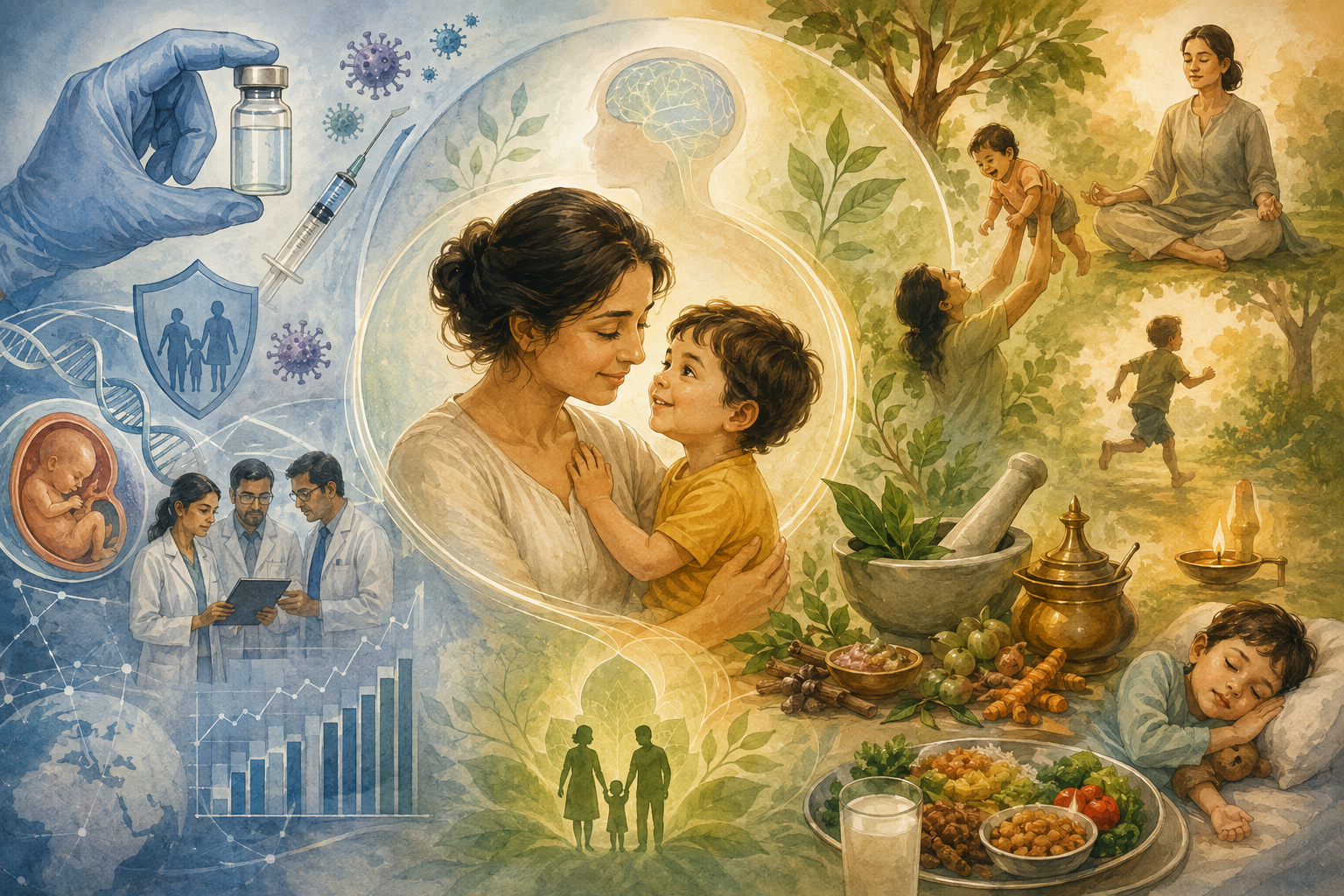
For many parents, the question is not simply whether the MMR vaccine protects against measles, mumps and rubella. It is whether introducing something into a young child's developing body could have consequences beyond protection from infection.
That concern became particularly powerful after a 1998 paper claimed a connection between the MMR vaccine and autism. The paper was subsequently found to be seriously flawed and fraudulent, retracted by The Lancet, and its author was struck off the UK medical register. But the question it raised has persisted — because autism is a complex neurodevelopmental condition, and because the timing of MMR vaccination overlaps with the age at which developmental differences often become more visible.
So what does the evidence actually tell us — and how does an Ayurvedic understanding of host resilience add another perspective?
First, what do we know about autism?
Autism spectrum disorder (ASD) is not understood today as the result of one single cause. Modern genetics has identified hundreds of variants associated with autism, with different combinations of inherited variants, rare variants and de novo genetic changes contributing to susceptibility. Some of these affect genes involved in neuronal development, chromatin regulation, synaptic function and plasticity. A 2022 analysis of 42,607 autism cases identified 60 genes with significant evidence of involvement, illustrating the considerable genetic heterogeneity of ASD.
This matters when discussing vaccines. A child's genetic susceptibility, if present, exists before an MMR injection is given. A vaccine cannot create a de novo genetic variant that was already present in the child's genome. At the same time, genetics does not mean that every aspect of neurodevelopment is genetically predetermined. Modern research increasingly investigates how genetic susceptibility interacts with developmental and environmental factors.
One area with substantial scientific interest is maternal immune activation during pregnancy. Research has associated maternal infection, inflammation, autoimmune disease and other inflammatory states with increased risk of neurodevelopmental disorders in offspring. Experimental work also suggests pathways involving inflammatory signalling, epigenetic regulation and microglial development.
But this is an important distinction: evidence that immune processes can influence neurodevelopment is not evidence that childhood vaccination causes autism.
What does the MMR evidence actually show?
The MMR-autism hypothesis has now been tested in multiple countries and through different study designs.
One of the strongest studies is the Danish nationwide cohort study involving 657,461 children. Researchers examined whether MMR vaccination was associated with autism, including whether it might affect children considered more susceptible because of familial or other autism risk factors. The adjusted hazard ratio for autism among vaccinated versus unvaccinated children was 0.93 (95% CI 0.85–1.02) — meaning no statistically significant increase in risk. Importantly, the study found no support for the idea that MMR triggered autism specifically in susceptible subgroups, or that cases clustered after vaccination.
This is consistent with earlier Danish research involving more than 537,000 children, which also found no increased risk of autism following MMR vaccination.
A 2014 meta-analysis combined five cohort studies involving more than 1.25 million children and five case-control studies involving nearly 10,000 children. It found no association between vaccination and autism, and specifically no association between MMR and autism.
The Cochrane review of MMR/MMRV safety, covering 138 studies and more than 23 million children, similarly found no evidence of increased autism risk. Its analysis of two studies involving approximately 1.19 million children produced a rate ratio of 0.93 (95% CI 0.85–1.01).
The WHO's most recent evidence review, covering research published through August 2025, reached the same conclusion. Of 31 primary studies examining vaccines and autism or thiomersal-containing vaccines, the more methodologically rigorous studies and five meta-analyses did not support a causal association. Studies suggesting an association were judged to have very low strength of evidence and high risk of bias.
"There is an important distinction between 'some studies have reported an association' and 'the evidence demonstrates causation.' The latter has not been established."
But MMR is an immune intervention. Does that matter?
Yes — but it needs to be understood correctly. Vaccination works precisely because it engages the immune system. The MMR vaccine introduces attenuated measles, mumps and rubella viruses, allowing the immune system to develop specific protection without the child experiencing the diseases themselves.
The question therefore isn't whether MMR changes immune activity. It does. The question is whether that immune response can produce a harmful alteration in neurodevelopment. At present, high-quality epidemiological evidence does not demonstrate that it does.
This is also why the broader evidence concerning immune involvement in autism should not be conflated with vaccine causation. Research into maternal immune activation concerns a different exposure, occurring during pregnancy, when the fetal brain and immune system are developing in a very different biological environment.
Where Ayurveda offers a different lens
Ayurveda approaches health from a fundamentally different starting point. Rather than defining protection primarily through exposure to a particular antigen, Ayurvedic thought places considerable emphasis on Vyadhikshamatva — the capacity to resist disease and limit its severity. Contemporary Ayurvedic scholarship describes this through concepts including Bala, Ojas, Agni and Prakriti, alongside nutrition, lifestyle, mental state and other determinants of physiological resilience.
This is sometimes presented as though Ayurveda simply rejects vaccination. That is not an accurate representation of the Ayurvedic literature. Modern Ayurvedic authors have explicitly discussed vaccination and immunization, including comparisons with traditional preventive concepts such as Lehana. A 2008 paper specifically examined "Prevention, vaccination and Ayurveda," while a later review argued that Ayurveda contains concepts relevant to immunization.
At the same time, Ayurveda's emphasis is different: the state of the host matters. The Ayurvedic framework asks questions such as:
- What is the child's overall strength, or Bala?
- How is nutrition and digestion functioning?
- What is the child's constitution and developmental state?
- What factors may be weakening or supporting resilience?
- How does the body respond to disease and recover from it?
This does not prove that vaccines are harmful, nor does it establish that concepts such as Ojas are biological equivalents of modern immunity. Those would be claims beyond the evidence. But it does offer parents a valuable conceptual distinction:
Protection against a specific infection and cultivation of overall physiological resilience are not necessarily the same thing.
Modern vaccination addresses the first. Ayurveda places much greater emphasis on the second.
Does that mean a resilient child does not need vaccination?
No. This is where the two frameworks should not be falsely made interchangeable.
A child with good nutrition, sleep, general health and physiological resilience can still contract measles. Ayurvedic approaches to host resilience have not been demonstrated to provide the pathogen-specific protection produced by MMR vaccination. Conversely, vaccination does not replace the fundamentals of healthy development.
A child can be appropriately vaccinated and still benefit from good nutrition, sleep, physical activity, emotional security, healthy routines and attentive developmental monitoring. These approaches can therefore be viewed as addressing different dimensions of health, rather than as mutually exclusive alternatives.
What about genuine vaccine risks?
Balanced information also means acknowledging that vaccines are not completely free of adverse effects. The Cochrane review found a small increased risk of febrile seizures following MMR/MMRV vaccination. It estimated an attributable risk of approximately one additional febrile seizure per 1,150–1,700 doses. It also found a small risk of immune thrombocytopenic purpura. Importantly, it found no evidence of increased autism or encephalitis.
This is what informed consent should look like: not "vaccines are perfectly harmless," but rather known risks are weighed against known benefits.
MMR provides substantial protection against three infections that can themselves cause serious complications. The Cochrane review found one dose approximately 95% effective against measles, and two doses approximately 86% effective against mumps, with substantial protection against rubella as well.
So what should a parent conclude?
The evidence today supports several conclusions simultaneously.
- First: there is no convincing evidence that MMR causes autism. Large cohorts, meta-analyses and systematic reviews have repeatedly failed to demonstrate the association.
- Second: autism has a complex biological basis involving genetic susceptibility and developmental processes. Research into environmental and immune influences remains important.
- Third: immune involvement in neurodevelopment — particularly maternal immune activation during pregnancy — is a legitimate area of research, but it should not be converted into evidence that childhood vaccination causes ASD.
- Fourth: Ayurveda contributes a different and potentially valuable framework by asking not only what exposure does the body receive? but also what is the state and resilience of the host?
And finally, vaccination and developmental surveillance do not have to be opposing ideas. A parent can choose evidence-based vaccination while continuing to pay close attention to development. If a child shows changes in communication, social engagement, movement, play or behaviour after vaccination, the observation deserves to be taken seriously — but the timing alone cannot establish that the vaccine caused it.
The most responsible position is therefore neither blind reassurance nor fear. It is informed observation, evidence-based vaccination, attention to the child's individual health and resilience, and ongoing developmental monitoring. Because protecting a child's health is not only about preventing infection — it is also about understanding the child in front of us, early, continuously, and without dismissing either parental observations or scientific evidence.
Be in Charge
Developmental differences can be quiet — often hidden in everyday moments. Knowing how your child is developing early gives you more opportunity to support them.
Know today, through your child's RBSK developmental markers. Objective, from home, in 6 minutes.
Frequently asked questions
Does the MMR vaccine cause autism?
No. A Danish nationwide cohort study of 657,461 children found an adjusted hazard ratio of 0.93 for autism among vaccinated versus unvaccinated children — no statistically significant increase in risk. This is supported by a 2014 meta-analysis of over 1.25 million children, a Cochrane review covering more than 23 million children, and a WHO evidence review through August 2025, none of which found evidence of a causal link.
Where did the idea that MMR causes autism come from?
The claim originated from a 1998 paper that was later found to be seriously flawed and fraudulent. It was retracted by The Lancet, and its author was struck off the UK medical register. Subsequent large-scale research across multiple countries has not supported the original claim.
What actually causes autism, if not vaccines?
Autism has a complex biological basis involving genetic susceptibility and developmental processes. A 2022 analysis of 42,607 autism cases identified 60 genes with significant evidence of involvement. Research also examines maternal immune activation during pregnancy as a factor, which is distinct from childhood vaccination.
Does Ayurveda have a perspective on vaccination?
Ayurveda does not simply reject vaccination. Modern Ayurvedic scholarship has explicitly discussed vaccination and immunization, including comparisons with traditional concepts like Lehana. Ayurveda's distinct emphasis is on Vyadhikshamatva — the body's overall capacity to resist and recover from disease — as a complement to, not a replacement for, pathogen-specific protection from vaccines.
Are there any real risks associated with the MMR vaccine?
Yes. The Cochrane review found a small increased risk of febrile seizures following MMR vaccination, estimated at approximately one additional case per 1,150 to 1,700 doses, along with a small risk of immune thrombocytopenic purpura. It found no evidence of increased autism or encephalitis risk.
Sources: Hviid et al. (2019), Annals of Internal Medicine (Danish cohort, 657,461 children); Madsen et al. (2002), NEJM; Taylor et al. (2014), Vaccine (meta-analysis); Di Pietrantonj et al. (2021), Cochrane Database of Systematic Reviews (MMR/MMRV safety); WHO vaccine safety evidence review (2025); autism gene-discovery analyses (2022, 42,607 cases); Ayurvedic immunization literature (2008 onward). This article is educational and does not constitute medical advice; vaccination decisions should be made with your paediatrician.
Hidden Hum is part of the Fairy Tales Wellbeing family — a non-diagnostic, RBSK-aligned early skills profiler helping parents track developmental milestones from birth to 6 years.