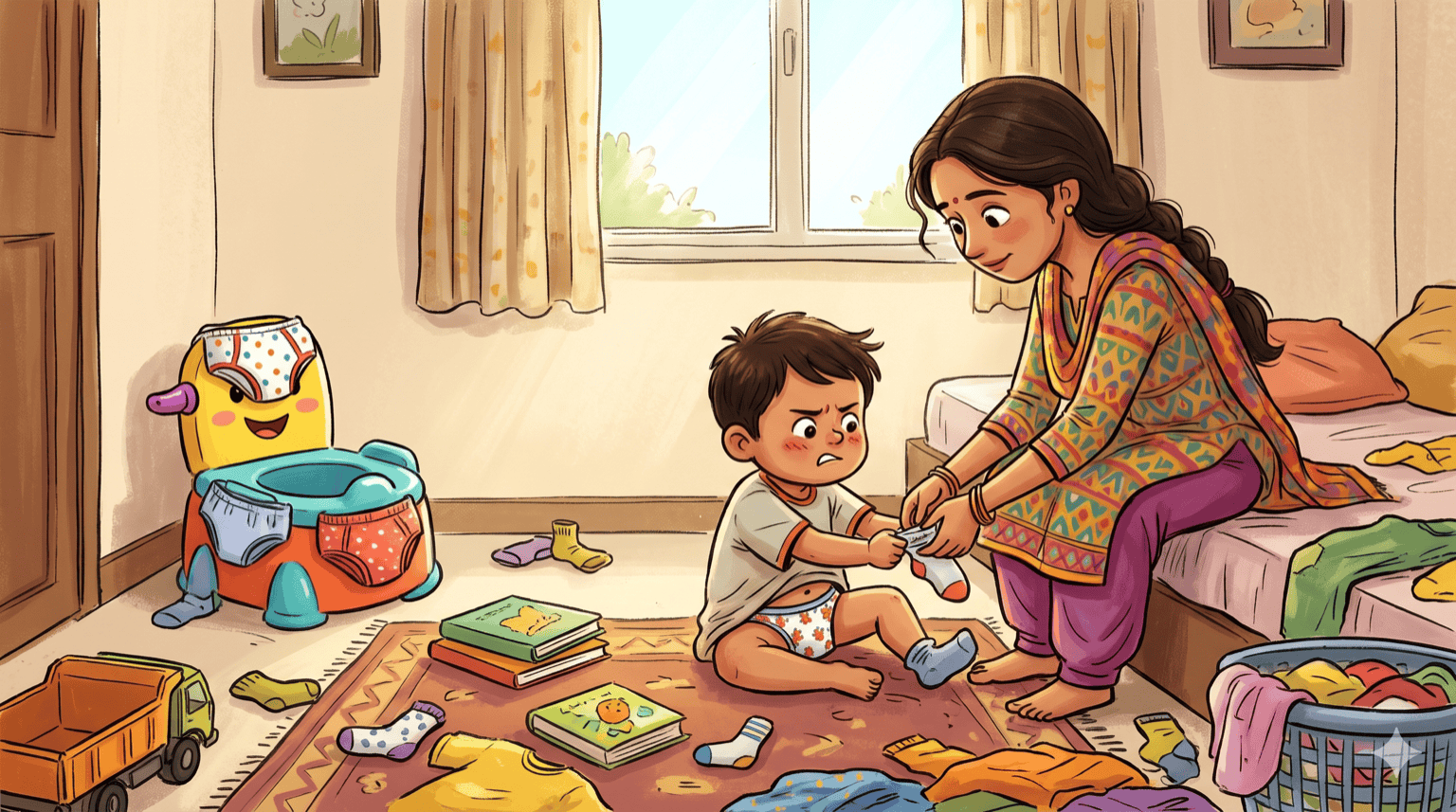
Potty training is one of the most popular parenting questions there is — asked year-round, by parents of toddlers at every stage. Somewhere between a relative's comment and a nursery admission form, it starts to feel like there's one correct age your child is supposed to hit. There isn't.
Toilet training readiness is the point at which a child shows the physical, cognitive and behavioural signs needed to begin learning to use the toilet — a pattern of signals, not a fixed age, that typically emerges between 18 and 36 months.
What age should a child be potty trained?
Most children show readiness between 18 and 36 months. A longitudinal study found most children don't master the readiness skills until after their second birthday, and the normal range for individual skills can span as much as a year. Girls achieve nearly all toilet-training skills earlier than boys. Most children are successfully trained around age 3 or shortly after, and may still need help with wiping until 4 or 5.
Signs your toddler is ready
Readiness tends to show up as a cluster of small behaviours, not one dramatic sign:
Follows simple instructions
Walks confidently, follows basic instructions, and is aware of a full bladder or rectum.
Dislikes being soiled
Shows discomfort with a soiled nappy — wanting it changed rather than ignoring it.
Can stay dry and undress
Stays dry for two hours or more, and can pull pants down and back up on their own.
Shows interest in the toilet
Watches, asks questions about, or wants to sit on the toilet or potty.
A review of the literature found no consensus on which readiness signs to use, so look for a pattern across several of these — not just one.
Does starting early make training faster?
Not reliably. In a study of 406 children, intensive training started at a younger age was linked to a longer training period, and there was no clear benefit to starting intensive training before 27 months for most children. A separate study of 409 children found children trained with an early structured approach finished at a similar age to those trained with a child-focused approach.
"Training should go slowly and allow for periods of disinterest or negativity — overly aggressive routines risk dysfunctional voiding."
Waiting forever isn't ideal either. A meta-analysis of 10 studies with 24,121 participants suggested that toilet training started after 24 months may raise the prevalence of bladder dysfunction, though the authors call the findings preliminary.
Is it normal for a 3-year-old not to be potty trained?
Usually, yes. Many healthy three-year-olds are not fully toilet trained, and toilet learning spans a window from about two and a half to four. Daytime bladder control develops most naturally between ages 3 and 5, and night-time dryness can take until 6 or 8 and still be normal. Many 3-year-olds wet the bed at night at least once a month.
Accidents don't mean failure. They can continue for months after training seems complete, even at three or four. But frequent accidents in a three-year-old that aren't diminishing may signal a physical or developmental problem worth mentioning to your doctor.
Why your neighbour's child trained earlier
Timing isn't a race you're losing. Readiness timing varies with sex, race, socioeconomic factors and cultural norms. Non-Western nations complete toilet training much earlier, so the "right age" depends on what each family means by "trained."
"Compare your child to their own progress, not to the child next door."
At what age do kids dress themselves?
Dressing follows its own, equally wide, timeline:
| Age | Typical dressing skill |
|---|---|
| Around 1 year | Removes socks and pushes arms through sleeves |
| Around 2 years | Removes shoes and simple items of clothing |
| By 3 years | Puts on socks and shoes, zips jackets, does up large buttons and puts on t-shirts — though may still need help |
| By 4 years | Zips jackets, buttons shirts and puts on socks; many 5-year-olds are still learning to tie shoes |
| By 5 years | Usually dresses without help or supervision |
There's no set age. Some toddlers are keen to dress themselves and others show no interest at all.
Toddler won't get dressed? What helps
Refusing to get dressed is not your fault and not evidence of a "difficult" kid.
Teach undressing first
It's an easier skill than dressing, so it builds confidence before the harder part.
Choose forgiving clothing
Elasticated pants and simple t-shirts help. Encourage your toddler to sit on the floor so they can balance.
Pick clothes with clear cues
Look for an obvious front-and-back difference, so there's less guesswork and fewer frustrated do-overs.
Step in only when truly needed
Let them struggle a little before helping — that's where the skill actually gets built.
When to look closer at potty training and dressing delays
Look at the whole pattern. Some children with sensory sensitivities need support coping with the feel of clothes, and some with motor difficulties need help with the physical skills of dressing.
In one study, almost 50% of preschool children with autism showed a significant delay in self-care functioning. Another analysis found children with autism were much more likely to be delayed in reaching daytime dryness. Sensory processing difficulties may predict self-care skills in young autistic children. This isn't a diagnosis.
"Chaining" — breaking a task into small, achievable steps — helps children learn to dress or use the toilet without being overwhelmed by the whole sequence at once.
Worth a closer look if:
By 3 or 4, your child still won't dress or use the toilet on their own — especially if it comes alongside other signs of developmental delay, such as limited speech or a poor response to people outside the family. Speak to your doctor.
Ask before you worry: ParentQ
Most potty training and dressing questions don't need a clinic visit.
ParentQ by Fairy Tales lets you ask a developmental paediatrician privately. Type your question or record a voice note, and add a photo or short video if it helps. You get preliminary guidance and can ask follow-ups in the same thread. Your first query is free.
It isn't for emergencies, but it spares you the waiting room for "is this normal?" moments.
Chat with Dr SreetamaTrack it with Hidden Hum
For a structured picture of self-care alongside communication, motor and sensory skills, Hidden Hum — Fairy Tales' parent-led early skills screening — takes under six minutes from home. It's a baseline to bring to your paediatrician, not a diagnosis.
Start Hidden Hum →Frequently asked questions
What is the best potty training age?
Most children show readiness between 18 and 36 months, and readiness matters more than age.
How do I know my toddler is ready for potty training?
Look for interest in the toilet, two-plus hours of dryness and pulling pants down and up.
Is it normal for a 3-year-old not to be potty trained?
Yes, many healthy three-year-olds are not fully trained.
When do children stay dry at night?
Night-time dryness can take until 6 or 8 and still be normal.
What age do kids dress themselves?
Usually without help by around 5, with zips and laces coming last.
Sources: Toilet Training: Common Questions and Answers (American Family Physician, 2019); Sequential acquisition of toilet-training skills: a descriptive study of gender and age differences in normal children (Pediatrics, 2002); Relationship between age at initiation of toilet training and duration of training: a prospective study (Pediatrics, 2003); Delayed toilet training association with pediatric lower urinary tract dysfunction: a systematic review and meta-analysis (Journal of Pediatric Urology, 2020); Toilet Training Readiness Scale for 0–5-Year-Old Children (Children, 2024); What toilet-training strategy is most effective and prevents fewer adverse events? (Paediatrics & Child Health, 2008); Toilet Training Readiness (Parenting Science); Potty Training Delays in Toddlers and Solutions (Banner Health); Toilet Training (Kaiser Permanente Health Encyclopedia); Are Accidents Normal or the Sign of a Problem? (HealthyChildren.org, American Academy of Pediatrics); When to Start Potty Training: Signs Your Child Is Ready (Pampers); Potty Training Readiness Signs (Care.com); My 3-Year-Old Cannot Use the Toilet Yet — Is That a Concern? (Pinnacle Blooms Network); Getting Dressed (Raising Children Network); Toddler Development: Getting Dressed (Pregnancy, Birth & Baby, Australia); Developmental Dressing Skills (CHOC Children's Hospital); Developing Dressing Skills (Valley View Hospital, Pediatric Advisor); Using the Assessment of Motor and Process Skills and the Pediatric Evaluation of Disability Inventory to Assess Self-Care Performance Among Preschool Children With Autism Spectrum Disorder (American Journal of Occupational Therapy, 2022); The Relationship between Sensory Processing Patterns and Self-Care Skills in Children with Autism Spectrum Disorder (Iranian Journal of Child Neurology, 2026); Teaching Self-Help Skills (Beyond Autism). This article is educational and does not replace assessment by a qualified clinician.