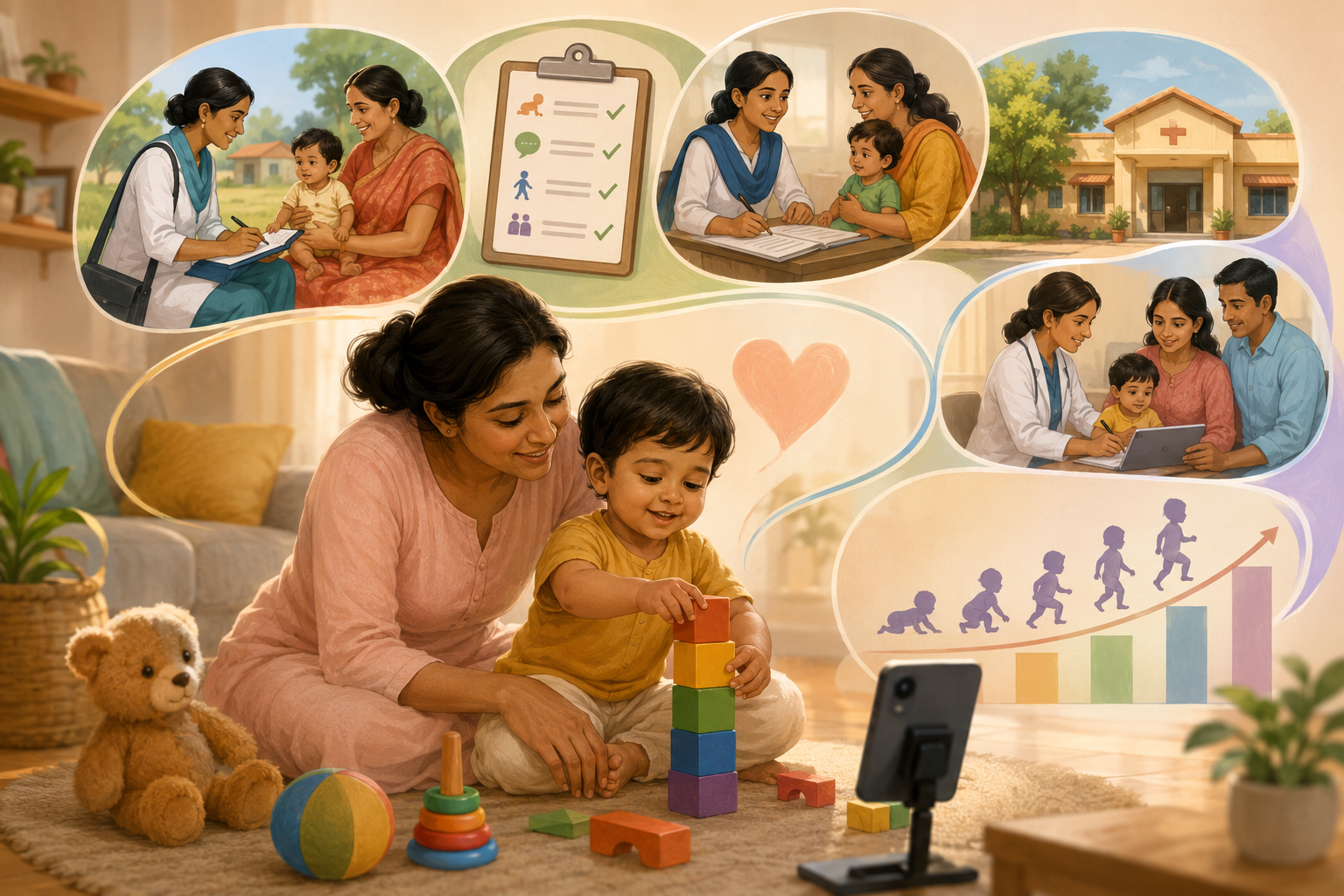
Have you ever watched your child play and felt a small, nagging worry? You're not alone — and that worry deserves more than a rushed reassurance. It deserves a proper look.
India has a national programme designed to give every child exactly that. It's called the Rashtriya Bal Swasthya Karyakram (RBSK) — the Government of India's answer to the question every parent quietly asks: Is my child developing the way they should be?
Worried right now? Hidden Hum is a free, 6-minute, RBSK-aligned developmental check you can do from home. Start it here →
What is RBSK?
Launched by the Ministry of Health and Family Welfare, RBSK screens children from birth to 18 years — with the greatest impact in the first six years, when the brain is most plastic. It marks a national shift from simply keeping children alive to helping them truly thrive (Singh et al., 2015).
RBSK screens for the 4 Ds: Defects, Diseases, Deficiencies, and — the one most parents care about — Developmental Delays, including Autism Spectrum Disorder (Prabhu et al., 2021; Khound et al., 2025). That covers how your child moves, communicates, learns, and connects. At Fairy Tales, we call this the fourth pillar of child health.
How reliable is it?
Very. A validation study across primary health centres in Bengaluru (262 children, aged 0–3) tested the RBSK tool against the globally trusted Ages and Stages Questionnaire. RBSK showed 96.4% sensitivity, 97.0% specificity, and 97.0% accuracy (Santhosh et al., 2026).
In plain terms: when RBSK says your child needs a closer look, it's very likely right — and when it says development is on track, you can take real comfort in that.
Why early screening matters
The earlier a developmental difference is spotted, the earlier support can begin — and the bigger the impact. International research shows that saving children's lives isn't enough on its own; children with developmental differences need early, family-centred support to reach their potential (Smythe et al., 2020).
And your instincts count. Research across India found that parents' concerns — captured through structured tools — are meaningfully linked to real developmental differences (Sheel et al., 2024).
"Your worry isn't anxiety. It's data — and it deserves a structured response."
How RBSK works in practice
RBSK reaches children where they are, through Mobile Health Teams visiting Anganwadi centres, schools, and communities, plus Primary Health Centres (PHCs). A trained health worker observes your child and asks you about their movement, language, and social development — no special equipment, no clinic required.
If a concern is flagged, your child is referred to a District Early Intervention Centre (DEIC) for a closer assessment (Prabhu et al., 2021).
What if a concern is identified?
First, hold onto this: a screening result is not a diagnosis. It's a signal that your child deserves a closer look — like an unusual reading on a growth chart. It means let's understand this better, not something is wrong.
From there, early intervention — giving your child the right tools, at the right time, in a nurturing environment — is what makes the difference (Smythe et al., 2020).
It's never about fixing your child or changing who they are. It's about helping them participate fully in the world around them.
The real-world gap — and how to close it
RBSK is a strong programme, but access is uneven. In Chhattisgarh, only about a third of referred children actually reached a DEIC, and 73% of parents cited lost daily wages as a barrier to follow-up (Prabhu et al., 2021). Travel, waiting times, and out-of-pocket costs stop many families — especially in Tier 2 and Tier 3 cities — from getting the deeper look their child needs (M R and K R, 2025).
That's the gap home-based screening was built to close.
Beyond RBSK: a deeper look from home
RBSK is a population-level screening net — designed to catch children who need a closer look, not to build a full individual profile. If your child has been flagged, or you simply want to understand more, a comprehensive developmental assessment is the natural next step. Think of it as three layers of one journey:
- RBSK — India's national screening standard. The foundation.
- Hidden Hum — Fairy Tales' parent-led screening, built on RBSK standards, done from home in under six minutes. It sets a developmental baseline and Early Skills Profile — the bridge between your worry and a clinical picture.
- FAIRY — our video-based, clinician-reviewed assessment across eight domains and twelve age groups (grounded in the WHO ICF-CY framework and DSM-5), delivered as a Well-Being Guide reviewed by a developmental paediatrician or clinical psychologist.
A child is most themselves at home, in familiar routines — so a naturalistic, home-based assessment often captures what they actually do, not what they'll perform for a stranger in a clinic. And it removes the distance-and-cost barriers that hold so many families back.
The next step is yours
If you have a quiet worry about your child's development, the most powerful thing you can do is take one structured step. You don't have to sit with it alone.
Hidden Hum — free, 6 minutes, RBSK-aligned, from home — isn't a test. It's a calm, structured conversation about your child's development. Every child deserves to be seen. Every mother deserves to be heard.
Frequently asked questions
What is the full form of RBSK?
RBSK stands for Rashtriya Bal Swasthya Karyakram, the Government of India's National Child Health Programme. It screens children from birth to 18 years for the 4 Ds — Defects, Diseases, Deficiencies, and Developmental Delays, including autism spectrum disorder.
Is RBSK screening free?
Yes. RBSK is a Government of India programme delivered free of cost through Anganwadi centres, Primary Health Centres, and Mobile Health Teams that visit communities and schools.
How reliable is the RBSK developmental screening tool?
Very reliable. A validation study in Bengaluru tested the RBSK tool against the Ages and Stages Questionnaire and found 96.4% sensitivity, 97.0% specificity, and 97.0% overall accuracy — placing it among the most reliable community-level screening tools available.
What happens if my child is flagged during RBSK screening?
A screening result is not a diagnosis. If a concern is identified, your child is referred to a District Early Intervention Centre (DEIC) for a closer assessment and, where needed, early intervention support.
Sources: Singh et al. (2015), The Indian Journal of Pediatrics; Santhosh et al. (2026), Journal of Health Science and Prevention; Prabhu et al. (2021), Current Medical Issues; Khound et al. (2025), Indian Pediatrics; Smythe et al. (2020), International Health; Sheel et al. (2024), Children; M R and K R (2025), International Journal of Health Sciences and Research.
Hidden Hum is part of the Fairy Tales Wellbeing family — a non-diagnostic, RBSK-aligned early skills profiler helping parents track developmental milestones from birth to 6 years.