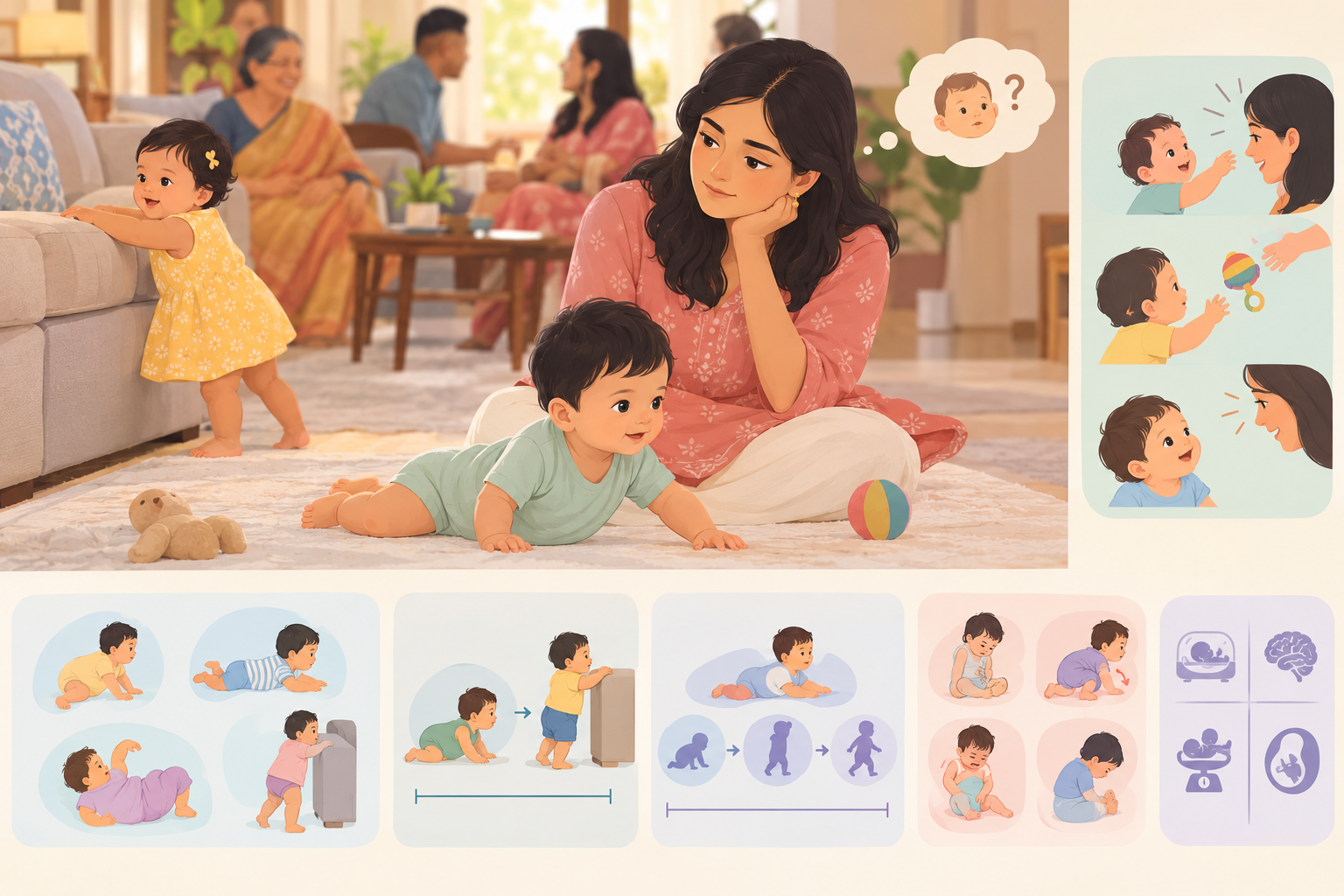
You're at a family gathering, and you watch another baby — roughly the same age as yours — pull herself up against the sofa and cruise confidently along its edge. Your own little one is still figuring out how to get from tummy to sitting, or maybe just beginning to rock on all fours. Your heart does a quiet lurch. Is something wrong? Am I missing something?
First: take a breath. You are not missing anything. You are paying attention — and that is exactly the right thing to do. The 9–15 month window is one of the most variable periods in all of early motor development, and the research on babies in Asian populations makes this especially clear. Here is what the science actually says — and what is genuinely worth watching for.
What's typical? The 9–15 month motor window
Crawling comes in many forms — and some babies skip it entirely
Most parents picture the classic hands-and-knees crawl. But babies reach the same destination by very different routes: some bottom-shuffle, some commando-crawl on their tummies, some roll purposefully across a room, and some skip crawling altogether and move straight to pulling up and walking. What matters developmentally is not the style of movement but the fact that your baby is actively exploring and shifting their body through space.
A large longitudinal study of Japanese children found significant natural variation in the timing and sequence of gross motor milestones — including crawling — with some infants achieving later milestones without following the expected crawling step at all (Kimura-Ohba et al., 2011). This is not a warning sign. It is a documented feature of typical development.
Pulling to stand — when it typically happens, and the wide range of 'when'
Pulling to stand is a genuinely significant motor event. Research by Atun-Einy and Scher (2016) describes it as a discrete developmental milestone — one that involves not just leg strength but postural control, balance, and the coordination of multiple muscle groups working together. It is a big deal for a small body.
Most babies achieve this somewhere in the 9–12 month range, but the window is wide. A study of healthy full-term Thai infants — an Asian population whose developmental norms are more relevant to Indian families than Western reference charts — found considerable inter-individual variability in gross motor skill timing across the first 14 months, even among babies with no health concerns (Tupsila et al., 2020). Your baby's timeline is their own.
What research from Asian babies shows about natural variation
This point is worth sitting with, because many parents in India compare their babies to Western milestone charts that may not reflect our population's natural range. The Thai normative data (Tupsila et al., 2020) and the Japanese longitudinal findings (Kimura-Ohba et al., 2011) both document that healthy babies in Asian contexts show meaningful spread in when they achieve crawling, pulling to stand, and walking. A recent review of factors influencing gross motor skill acquisition also found that environment, opportunity for floor play, and individual physical factors all shape the pace of motor development (Sangkarit & Tapanya, 2024).
In other words: the range is real, and your baby is likely within it.
Is my baby a late bloomer, or is there something to watch?
Late bloomers are real — and they catch up
The honest answer to "is my baby just a late bloomer?" is: very often, yes. The natural variability documented across Asian populations means that a baby who is not yet crawling confidently at 11 months, or not yet pulling to stand at 13 months, is frequently within the typical range. Comparing your baby to the fastest movers at playgroup is a little like comparing the first child in a class to read with the whole class — the range is wide, and most children arrive at the same destination.
What's actually different: patterns matter more than single milestones
Here is a genuinely reassuring reframe from the research: what clinicians look for is not whether a single milestone arrived on a particular date, but whether a baby is making progress across a pattern of skills over time. Allen and Alexander (1992), in a landmark study on using gross motor milestones to identify infants at developmental risk, found that tracking a sequence of milestone attainment across multiple visits — rather than flagging any single milestone as late — gave a much clearer picture of whether a baby needed closer attention.
One milestone arriving a few weeks later than average is rarely the story.
A consistent pattern of delayed progress across several milestones is what warrants a closer look.
Motor delay and communication — what the research says about autism risk
If you have come across the phrase "motor signs of autism" and felt a spike of anxiety, you are not alone — and you deserve a clear, honest answer. Research by Bhat, Galloway, and Landa (2012) found a relationship between early motor delay and later communication delay in infants at elevated risk for autism. This is real evidence, and it is worth knowing about.
But here is the equally important context: motor delay on its own is not a sign of autism. The research describes a pattern — motor delay alongside emerging differences in social engagement, communication, and responsiveness — not a single isolated milestone. A baby who is late to crawl but is socially engaged, responds to their name, makes eye contact, babbles, and reaches for you is showing a very different picture from a baby where multiple domains are developing differently together.
Why your baby's overall responsiveness matters more than crawling timing
This is the heart of it. Watch the whole baby, not the single milestone. Is your baby curious about the world? Do they look at your face when you speak? Do they reach for objects, show things to you, respond to their name? These social and communicative behaviours, developing alongside motor skills, tell a richer story than crawling timing alone.
Red flags worth a closer look
None of the following are reasons to panic — they are simply signs that a conversation with your paediatrician would be worthwhile.
Signs that go beyond slow crawling
Watch for: noticeably low muscle tone (a baby who feels unusually floppy when held), significant asymmetry in how your baby uses their arms or legs (consistently favouring one side), apparent discomfort or pain when moving, or a baby who seems to have lost a skill they previously had. These are different from simply being a late mover.
Intrinsic risk factors to mention to your paediatrician
Research examining gross motor delay in babies aged 6–24 months in an Asian clinical context identified several intrinsic risk factors worth flagging: prematurity (birth before 37 weeks), perinatal asphyxia (oxygen difficulties around birth), low birth weight, and certain structural differences noted at birth (Hanrahan & Mangunatmadja, 2019). None of these mean your baby will have a delay — they are simply useful context to mention, so your paediatrician has the full picture.
Getting a clearer picture at home
If you've read this far and you're still unsure whether what you're seeing is ordinary variation or something to understand more carefully, the most useful next step is structured observation — not comparison with the baby at the next table. Watch your baby across a few ordinary days: are they making steady progress, however slow — more time on their tummy, more weight-bearing on their legs, more interest in pulling up on furniture? Are they socially engaged, responsive, and curious alongside their motor development? That pattern, described clearly, is exactly what a paediatrician needs to hear.
India's RBSK (Rashtriya Bal Swasthya Karyakram) framework includes gross motor development as part of routine developmental monitoring, the same way growth and hearing are checked — not something reserved for when a problem is already suspected. Hidden Hum, Fairy Tales' parent-led early developmental baselining tool, is built on these RBSK standards and takes under six minutes to complete from home. It gives you a structured developmental baseline across all eight domains — including gross motor skills alongside social and communication development — so that what you're noticing becomes a clear picture, not a private worry carried alone until the next paediatrician visit.
Be in Charge
Motor development differences can be quiet — often hidden in everyday moments. Knowing how your child is developing early gives you more opportunity to support them.
Know today, through your child's RBSK developmental markers. Objective, from home, in 6 minutes.
Most babies who are slow to crawl or pull to stand at 12 months are simply moving on their own timeline — one that research on Asian infants shows is genuinely, normally wide. What matters is the whole picture: steady progress over time, and a baby who stays curious, responsive, and engaged with you along the way. That family-gathering comparison does not need an answer tonight. It needs exactly what you're already doing — watching closely, with patience instead of panic.
We know your little one is a gem — and you are a fantastic parent too.
Frequently asked questions
Is it normal for a baby to not crawl the classic hands-and-knees way?
Yes. Babies reach the same destination through very different routes — bottom-shuffling, commando-crawling, rolling, or skipping crawling entirely to go straight to pulling up and walking. A large longitudinal study of Japanese children found significant natural variation in the timing and sequence of gross motor milestones, including some infants skipping the crawling step altogether without it being a warning sign.
When do babies typically pull themselves up to stand?
Most babies pull to stand somewhere in the 9 to 12 month range, but the window is wide. A study of healthy full-term Thai infants found considerable variability in gross motor skill timing across the first 14 months, even among babies with no health concerns.
Does being late to crawl mean my baby has a developmental delay?
Not on its own. Research shows what matters is a pattern of progress across multiple milestones over time, rather than any single milestone arriving late. A baby who is slow to crawl but is socially engaged, makes eye contact, responds to their name, and reaches for you is showing a different picture than a baby with delays across several domains together.
Is motor delay linked to autism?
Research has found a relationship between early motor delay and later communication delay in infants at elevated risk for autism, but motor delay alone is not a sign of autism. The pattern researchers describe involves motor delay alongside emerging differences in social engagement, communication, and responsiveness — not an isolated late milestone.
Sources: Kimura-Ohba et al. (2011); Atun-Einy & Scher (2016); Tupsila et al. (2020); Sangkarit & Tapanya (2024); Allen & Alexander (1992); Bhat, Galloway & Landa (2012); Hanrahan & Mangunatmadja (2019). This article is educational and does not replace assessment by a qualified clinician.
Hidden Hum is part of the Fairy Tales Wellbeing family — a non-diagnostic, RBSK-aligned early skills profiler helping parents track developmental milestones from birth to 6 years.