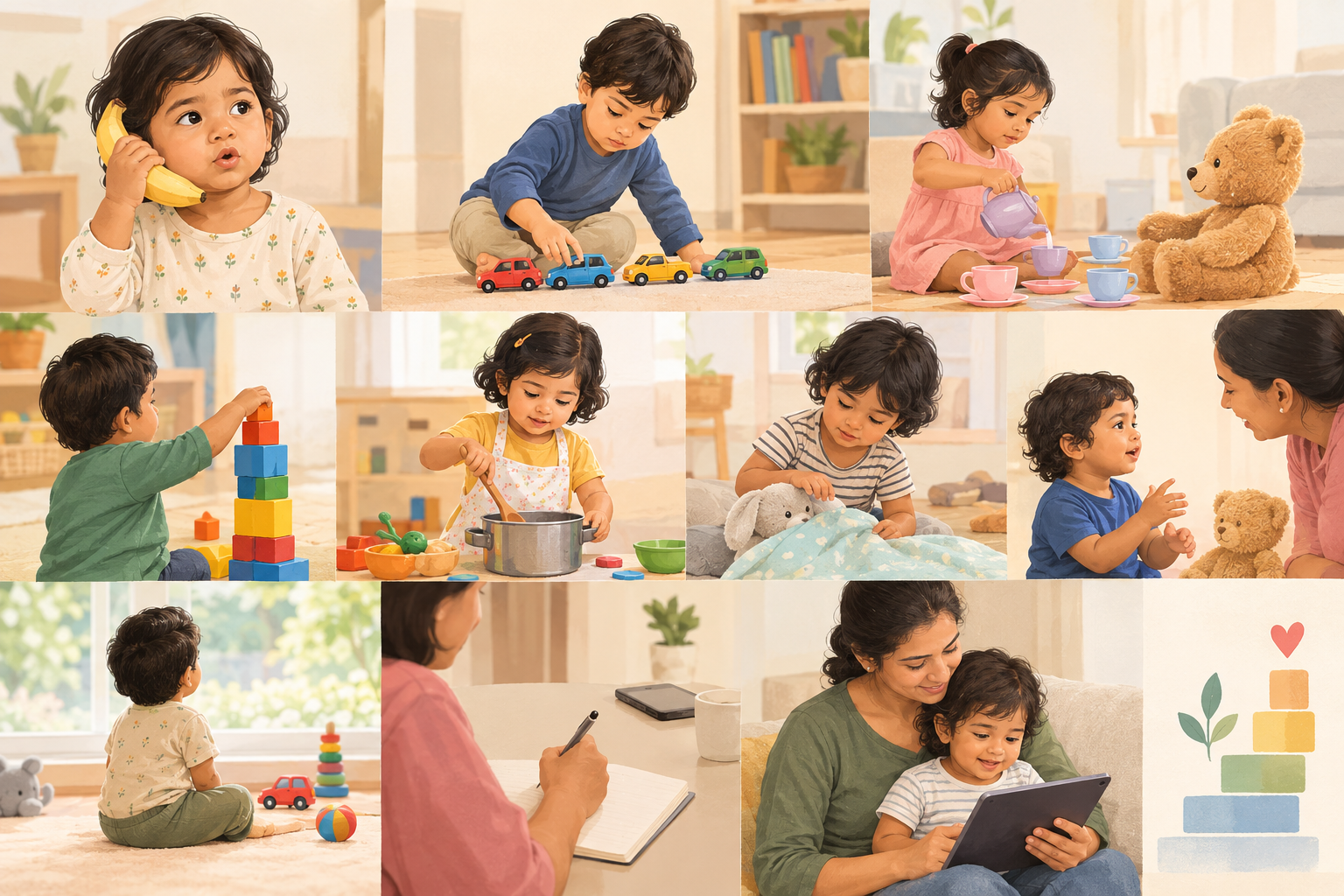
Your two-year-old picks up a banana, holds it to their ear, and says "hello" with complete seriousness. Or maybe they line up their toy cars in a perfect row and show zero interest in the pretend tea party you've laid out. Either way, you find yourself wondering: is this what a two-year-old is supposed to be doing? And if you've been comparing notes with a neighbour whose child is already narrating elaborate stories, that wondering can quietly turn into worry.
You are not alone in asking this question — and you deserve a clear, grounded answer. Here is what the research actually says about cognitive and play development at 24–30 months, what India's national screening standard looks for at this age, and how to make sense of what you see at home — without a clinic visit, without alarm, and without labels.
What cognitive skills should your 2-year-old be showing?
Pretend and symbolic play: the big cognitive milestone at 2 years
If there is one developmental story that defines the second year of life, it is the emergence of pretend play — and it is a bigger deal than it might look. Around 24 months, most toddlers begin to show what researchers call symbolic or pretend play: using one object to stand in for another, acting out familiar routines, or giving their toys a life of their own. That banana-as-phone moment is not silliness — it is your child demonstrating that they can hold a mental image of something (a phone) and map it onto a different object (a banana). That is abstract thinking, beginning right there on your kitchen floor.
Research on the developmental progression of pretend play describes it as unfolding in recognisable steps: early pretence involves simple, familiar actions (pretending to drink from an empty cup); by around 24 months, children extend pretend actions to dolls or soft toys (feeding a doll, putting it to sleep); and by 30 months, simple role play and sequential pretend scenarios begin to appear (Thompson & Goldstein, 2019). You might see your child pretend to cook, then serve the food, then wash up — a small narrative, played out with total conviction.
Why does this matter so much cognitively? Because pretend play and executive function — the cluster of mental skills that includes working memory, flexible thinking, and self-regulation — are meaningfully linked. A recent meta-analysis found a significant positive relationship between pretend play and children's executive function (Li & Zhang, 2026). A companion study focusing specifically on the toddler period found that parent-reported pretend play was associated with executive function skills even at this early age (Kelly, Constien & Downes, 2026) — suggesting that what you observe during free play at home is genuinely informative about how their thinking is developing. Pretend play, in other words, is not an "extra" — it is cognitive work.
Other cognitive skills emerging at 2 years
Pretend play does not develop in isolation. A clinical review of cognitive developmental milestones describes the 24-month period as a time when toddlers are also developing the ability to follow simple two-step instructions, understand basic cause and effect, engage in simple problem-solving (working out how to open a container, fitting shapes into a sorter), and sustain brief focused attention on activities that interest them (Wilks, Gerber & Erdie-Lalena, 2010).
Language and play are also deeply intertwined at this age. Research examining the relationship between play and language milestones found the two develop in close parallel — advances in play are linked to advances in communication, and vice versa (Orr, 2021). So when your two-year-old names the objects in their play, narrates what their toy is doing, or asks you to join in, they are exercising both cognitive and language skills simultaneously.
In Indian clinical settings, symbolic behaviour — the ability to use objects and gestures representationally — is assessed as part of communication screening from as early as 24 months. A study published in Indian Pediatrics examined the accuracy of a symbolic behaviour and communication screening tool used in a child developmental clinic, underscoring that symbolic play is considered a meaningful clinical marker in the Indian paediatric context at this age (Mehta, Suman & Noorani, 2025).
Typical variation: there is a wide range
Here is something important to hold onto: the range of what is typical at 24–30 months is genuinely wide. Some children are imaginative early and elaborate; others are more interested in physical exploration, cause-and-effect toys, or repetitive play with vehicles or blocks. Temperament, personality, and the play environment all shape how pretend play looks — and how visible it is to you.
What matters more than the exact timing is whether your child is engaged — with objects, with you, with the world — and whether that engagement is growing. A curious, responsive, learning child, even if their play looks different from the child next door, is almost certainly on a typical path.
How to spot imaginative play at home
What to look for in your child's play
You do not need a checklist or a clinic to observe your child's cognitive development. The richest information comes from watching them in ordinary moments — during free play, during meals, during bath time. Here is what to notice:
- Simple pretend scenarios: feeding a doll, putting a soft toy to bed, stirring an imaginary pot
- Symbolic substitution: using a block as a phone, a cup as a hat, a stick as a spoon — the object stands in for something else
- Social play: playing alongside you or with you, not just alone; showing you what they have made or done
- Sequential actions: two or three pretend steps in a row (cook → serve → eat)
These are the building blocks of pretend play that research identifies as emerging in the 24–30 month window (Thompson & Goldstein, 2019).
What India's RBSK standard says about this age
India has a national framework for developmental monitoring that most parents have never heard of — and it is worth knowing about. The Rashtriya Bal Swasthya Karyakram (RBSK) is the Government of India's programme for community-based screening and early intervention for developmental disabilities, designed to bring structured developmental monitoring into routine child healthcare at population level (Kar et al., 2020). It is not a specialist clinic programme — it is designed to be part of everyday child health, the same way growth monitoring and vaccination are.
Under this framework, the 24–30 month age band is a recognised screening window. Developmental paediatricians working within RBSK-aligned practice look for the kinds of symbolic and communicative behaviours described above — not as a test to pass or fail, but as a structured way of understanding where a child is and what support, if any, might help them thrive. The value of this approach is that it normalises developmental monitoring: it is not something that happens only when something is wrong — it is something every child deserves, as part of routine care.
How to observe without pressure
The best developmental information comes from natural play, not from sitting your child down and asking them to perform. Watch during the moments when they are absorbed and unselfconscious. Notice what they do when you are not directing them. If you see something interesting — a new pretend scenario, a new word, a new problem they've solved — jot it down. A few specific examples will tell your paediatrician far more than a general impression.
When to pay closer attention
Developmental signals worth monitoring
Most two-year-olds are well within the typical range, and most parental worries at this age resolve on their own. But there are some signals worth bringing to your paediatrician's attention — not because they mean something is definitely wrong, but because early understanding is always better than late uncertainty. Research on the developmental progression of pretend play identifies the complete absence of symbolic understanding as a more meaningful signal than simply being at the slower end of the typical range (Thompson & Goldstein, 2019). Specifically, it is worth paying closer attention if, by 30 months, your child:
- Shows no pretend play at all — no feeding toys, no pretend actions, no symbolic substitution
- Has no interest in toys or objects beyond mouthing, spinning, or lining them up in a fixed way
- Does not respond to your play attempts or narration — no eye contact, no joining in, no showing you things
- Has significant language concerns alongside play concerns — since play and language develop together, a gap in both at once is worth noting (Orr, 2021)
Distinguishing typical variation from developmental signals
A child who is slow to warm up to pretend play, or who strongly prefers one type of play (vehicles, water, blocks), is not showing a developmental signal — they are showing a preference. Temperament matters enormously at this age, and a quieter, more observational child may simply be taking in the world before they act it out.
What is worth monitoring is not a preference or a slower timeline — it's a complete absence of symbolic understanding or social engagement.
The child who does not seem to understand that objects can represent other things, or who does not seek to share their experience with you at all.
If you are noticing something in this territory, the most useful thing you can do is describe it specifically to your paediatrician — with examples from real play moments at home. Parent-reported observations are clinically meaningful: an India-based study on parent-reported developmental screening tools found that parents' specific concerns about cognitive development were significantly associated with developmental status in their children, supporting the value of structured parent report (Sheel, Suárez & Marsh, 2024).
Why early observation matters
Early understanding is not a label. It is clarity — for you, and for the professionals who support your child. The RBSK framework exists precisely because India's national health system recognises that early identification, within routine child healthcare, leads to better outcomes for children and families (Kar et al., 2020). Structured observation at home, described clearly to your paediatrician, is a meaningful contribution to that process.
What to do if something seems different
Structured observation at home
If you are noticing something that feels different — or if you simply want a clearer picture of where your child is — the most useful starting point is structured observation. Watch your child during free play for a few days. Note what pretend actions you see (or don't see), how they respond when you join their play, what they do with familiar objects, and how they communicate with you during play. These observations, described specifically, are exactly what a developmental paediatrician needs. You do not need to frame this as a problem. You can simply say: here is what I see at home, and I want to understand what it means.
Getting a clear picture: Hidden Hum screening
If you want a structured starting point before your next paediatrician visit — or simply want to understand your child's developmental profile across multiple domains — Hidden Hum is designed for exactly this moment. In under six minutes, it establishes a developmental baseline and an Early Skills Profile across eight developmental domains. It is built on India's RBSK standards, is parent-led and home-based, and is designed to fit into your routine — not replace your paediatrician, but give you and them a clearer, structured picture to work from. No clinic visit. No infrastructure barriers. Just a calm, structured look at where your child is right now.
Be in Charge
Cognitive and play differences can be quiet — often hidden in everyday moments. Knowing how your child is developing early gives you more opportunity to support them.
Know today, through your child's RBSK developmental markers. Objective, from home, in 6 minutes.
Talking to your paediatrician
When you speak to your paediatrician, bring your observations — specific examples of play, language, and attention from the past week or two. Ask: Is what I'm describing typical for this age? What should I be watching for over the next few months? Developmental monitoring is the fourth pillar of child health — as important as growth, hearing, and vision checks — and your paediatrician is your partner in it. You are not raising a concern; you are doing exactly what a thoughtful, engaged parent does.
When to seek further assessment
Signs that warrant a closer look
If, by 30 months, you are seeing a persistent absence of pretend play or symbolic understanding, a significant gap between your child's language comprehension and their play engagement, or concerns across more than one area — attention, social engagement, sensory responses, and play — it is worth asking your paediatrician about a more thorough developmental evaluation. Trust your instinct. You know your child better than anyone. If something feels different, that feeling is worth taking seriously — not because it means something is wrong, but because a thorough evaluation gives you clarity, and clarity is always better than uncertainty.
What FAIRY assessment covers
For families who want a comprehensive picture, Fairy Tales' FAIRY assessment is a video-based, home-based evaluation covering eight developmental domains: motor, communication, social, sensory, cognitive, self-help, behaviour, and feeding. Activities are simple and home-based — recorded as short videos in your child's familiar environment — and reviewed by a developmental paediatrician or clinical psychologist. The result is a Well-Being Guide: a detailed picture of your child's developmental profile, with specific recommendations and next steps. This is naturalistic observation — your child at home, in their element, not performing for a stranger in a clinic.
Next steps after assessment
If your child's profile suggests they would benefit from support, the next step is connection — to early intervention services and therapists near you. Fairy Tales' intervention platform helps you explore, connect, and begin, covering speech and language, occupational, physical, social, cognitive, and feeding therapy. And ongoing reassessment means you can track your child's progress over time, not just capture a single moment.
Your two-year-old is in the middle of one of the most remarkable cognitive leaps of their life. Whether they are already narrating elaborate tea parties or still working out what to do with a toy cup, they are learning — and so are you. The most powerful thing you can do right now is watch them with curiosity, describe what you see with confidence, and reach out when you want a clearer picture. You are already doing the most important part.
We know your little one is a gem — and you are a fantastic parent too.
Frequently asked questions
What is the biggest cognitive milestone for a 2-year-old?
Pretend or symbolic play is considered the defining cognitive milestone at this age. Around 24 months, most toddlers begin using one object to represent another — like holding a banana to their ear as a phone — demonstrating early abstract thinking. By 30 months, simple role play and sequential pretend scenarios typically emerge.
Does pretend play actually relate to my child's thinking skills?
Yes. A meta-analysis found a significant positive relationship between pretend play and children's executive function — the skills involving working memory, flexible thinking, and self-regulation. Research specific to toddlers found parent-reported pretend play was associated with executive function even at this early age.
What if my 2-year-old shows no interest in pretend play?
A slower timeline or a strong preference for other types of play, like vehicles or blocks, is typically just a preference, not a concern. Research identifies the complete absence of symbolic play by 30 months — no feeding toys, no pretend actions, no symbolic substitution — as a more meaningful signal worth discussing with your paediatrician.
What does India's RBSK standard look for in 2-year-olds?
The Rashtriya Bal Swasthya Karyakram (RBSK) recognises 24 to 30 months as a key developmental screening window. Developmental paediatricians working within RBSK-aligned practice look for symbolic and communicative behaviours like pretend play, as part of routine child healthcare rather than a specialist-only concern.
Sources: Thompson & Goldstein (2019); Li & Zhang (2026); Kelly, Constien & Downes (2026); Wilks, Gerber & Erdie-Lalena (2010); Orr (2021); Mehta, Suman & Noorani (2025), Indian Pediatrics; Kar et al. (2020); Sheel, Suárez & Marsh (2024). This article is educational and does not replace assessment by a qualified clinician.
Hidden Hum is part of the Fairy Tales Wellbeing family — a non-diagnostic, RBSK-aligned early skills profiler helping parents track developmental milestones from birth to 6 years.