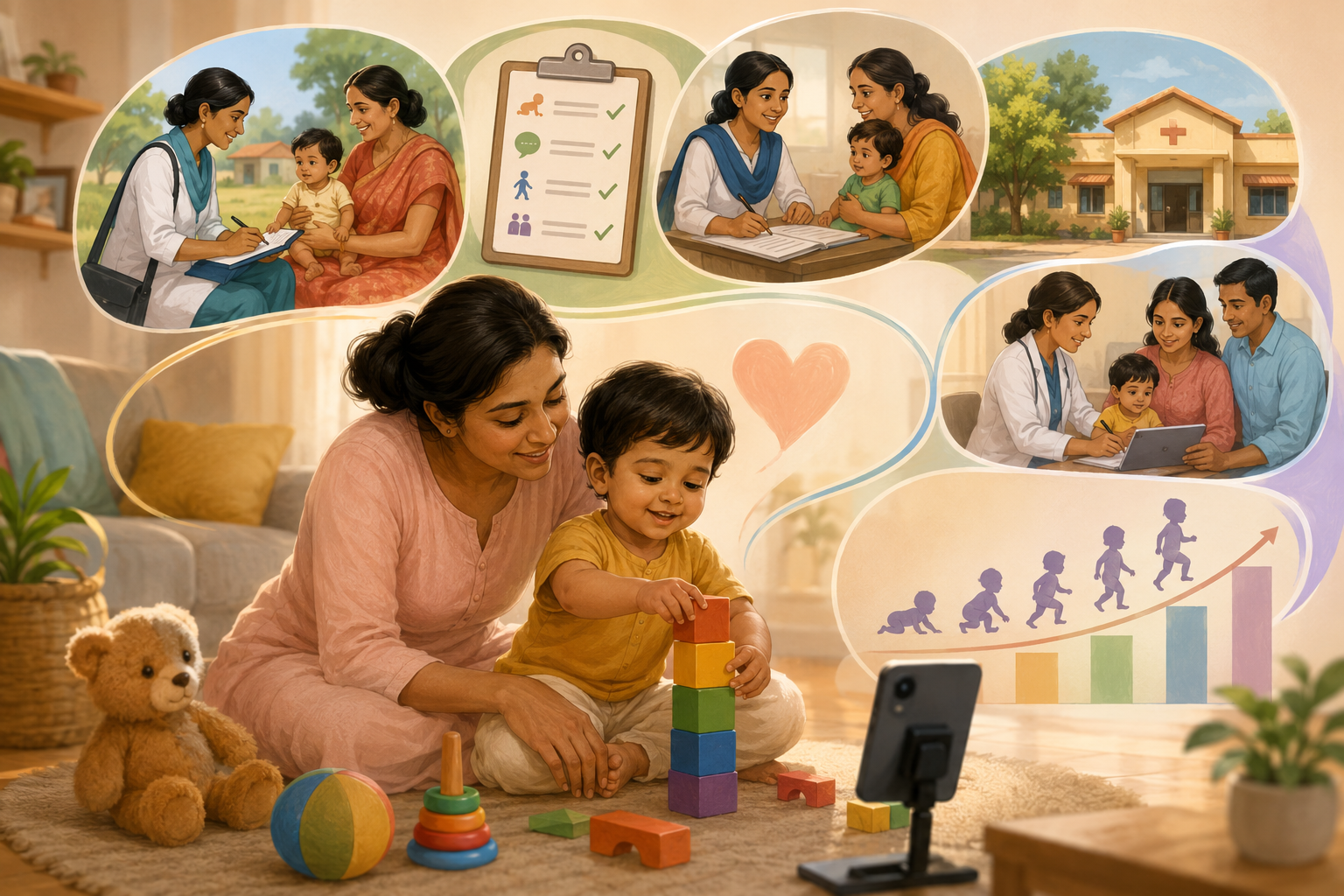
You spent weeks preparing for that appointment. You wrote down every concern, every moment that made you pause. And then your two-and-a-half-year-old walked into the clinic — and became a completely different child. Quieter than usual. Compliant in ways they never are at home. Or the opposite: so overwhelmed by the unfamiliar room that they shut down entirely. The clinician was kind, but you left with a nagging feeling: that wasn't really my child.
If this sounds familiar, you are not imagining it — and you are not alone. Research consistently shows that parents of children with early developmental concerns often feel dismissed or unheard after clinic visits, and that the behaviour a child shows in an unfamiliar setting can look very different from what they show at home (Schmidt et al., 2024). The good news is that this gap is not a flaw in your child, or in you. It is a well-understood clinical phenomenon — and it is exactly why home-based, naturalistic developmental assessment exists.
This article explains what the research says about where children really show who they are, whether home-based assessment is clinically rigorous enough to trust, and what a structured home-based process can capture that a single clinic appointment simply cannot.
Why your child seems like a different kid at the clinic (and that's not your imagination)
The 'clinic effect' — what happens when your child steps into an unfamiliar room
Think about the last time you had to perform in an unfamiliar environment — a job interview, a new doctor's office. You probably weren't quite yourself either. For a two- or three-year-old, the effect is amplified many times over. A new room, a stranger asking them to do things, fluorescent lights, unfamiliar smells — all of it activates a child's stress response. The spontaneous play, the chatter, the social reach toward a familiar face: it all recedes. What the clinician sees is a child in a state of mild-to-moderate stress, not a child in their natural developmental habitat.
This is not a new observation. Parents have been reporting it for decades, and researchers have taken it seriously. A study examining parent perspectives on laboratory and clinic-based child assessments found that parents consistently identified a meaningful gap between how their child behaved in structured clinical settings and how they behaved in familiar environments at home — raising important questions about the ecological validity of single-session clinic observations (Lo, Vroman & Durbin, 2015). Ecological validity is the clinical term for whether a test actually measures what a child does in real life, rather than what they do under artificial conditions.
Ecological validity: where children really show who they are
The concept matters enormously for developmental assessment. If a child's communication, social engagement, sensory responses, and play skills are being evaluated, the most accurate picture comes from seeing those skills in the context where they naturally occur — at the breakfast table, during bath time, in the middle of a game with a sibling. Home environments are where children are most themselves: regulated, comfortable, and free to show their full range of abilities and challenges.
This insight underpins decades of research into naturalistic observation. As far back as 1979, researchers developing structured home observation methods demonstrated that reliable, objective coding of child and family behaviour is entirely achievable in home settings — and that home-based behaviour captures dimensions of a child's functioning that structured clinical settings simply do not elicit (Steinglass, 1979). The methodology has only grown more sophisticated since then.
Is home-based assessment clinically rigorous? What the evidence shows
The accuracy question: how home-based assessment compares to clinic visits
This is the question every thoughtful parent asks — and the research gives a clear, reassuring answer. A 2025 study published in the Journal of Developmental & Behavioral Pediatrics examined in-home tele-assessment for autism in toddlers aged 18 to 42 months, comparing home-based assessment directly against in-person clinic evaluation. The results were striking: diagnostic outcomes agreed between home-based and in-person evaluation in 94% of cases, with a kappa of 0.82 — a strong level of agreement by clinical standards (Gangi et al., 2025). In other words, what a well-structured home-based assessment finds is, in the overwhelming majority of cases, what a clinic visit would find.
Home-based and in-person evaluation agreed in 94% of cases (kappa 0.82). Just as importantly, very few caregivers reported challenges with the technology — the process was not just accurate, but accessible for real families.
Reliability over time: multiple observations vs one clinic snapshot
A single clinic appointment is, by definition, a snapshot — one moment in time, in one setting, with one set of conditions. Home-based assessment, by contrast, can draw on observations across multiple moments, routines, and days. The same 2025 study found strong test-retest reliability for home-based assessment scores across two separate administrations (intraclass correlation coefficient = 0.85), confirming that structured home observation produces consistent, dependable results — not a one-off impression (Gangi et al., 2025).
This matters because development at age two and three is genuinely variable. A child who is tired, hungry, or having an off day will present differently from a child who is rested and at ease. A home-based process that captures behaviour across multiple contexts gives a clinician a far richer and more representative picture than any single appointment can.
Parent-led observation is an established clinical method — not a lesser substitute
There is a long and rigorous tradition of parent-completed developmental assessment in clinical research. Landmark work by Bricker, Squires and colleagues established the validity and reliability of parent-completed questionnaire systems for evaluating developmental concerns in young children — demonstrating that what parents observe and report is clinically meaningful data, not anecdote (Bricker et al., 1988). Subsequent research confirmed these tools are effective across a wide range of families, including those in low- and middle-income contexts — directly relevant to the Indian setting, where accessible, parent-led tools are essential (Squires et al., 1998).
Parents are not being asked to diagnose their child. They are being asked to do what they already do every day: observe their child carefully. A structured assessment process turns those observations into clinically useful data, reviewed by a qualified professional.
What home-based assessment captures that a single clinic visit cannot
Naturalistic behaviour: your child in familiar routines
Consider what a clinician sees when your child is assessed at home, in the middle of their morning routine. They see how your child responds when they are comfortable — the way they move through a familiar space, how they initiate play, how they react when something doesn't go their way. These are the behaviours that matter clinically — and they are the ones most likely to be suppressed or distorted in an unfamiliar clinic room. Research on home observation methods has consistently shown structured, reliable assessment is achievable in home settings, capturing contextual and behavioural dimensions that clinic-based observation misses (Steinglass, 1979).
Authentic communication and social skills
For parents of two- and three-year-olds with concerns about communication or social development, this is especially important. A child who uses ten words at home may produce none in a clinic. A child who makes rich eye contact with a parent may avoid it entirely with a stranger. The social and communicative behaviours that are most diagnostically relevant are also the most context-sensitive — they emerge most reliably in familiar, low-stress environments.
Caregivers who have participated in home-based developmental assessments consistently report that the process felt more representative of their child's actual abilities — and that it helped them feel seen and supported in a way clinic visits often did not (Schmidt et al., 2024). That sense of being truly seen is not just emotionally important; it is clinically important, because it means the assessment is capturing real behaviour.
Sensory responses and regulation
Sensory responses — how your child reacts to sounds, textures, lights, and transitions — are among the most environment-dependent behaviours in early development. A child overwhelmed by the sensory environment of a clinic may appear flat or unresponsive. The same child at home, in a familiar sensory landscape, may show a completely different profile. Home-based assessment captures these responses in the context where they actually occur and matter most.
How home-based assessment works (and why it's aligned with India's RBSK standard)
The three-step process
A well-designed home-based assessment is not a parent filling in a form and hoping for the best. It is a structured, multi-step process. At Fairy Tales Wellbeing, the FAIRY assessment works in three stages: a preliminary assessment (a questionnaire combined with a set of key activities), an advanced assessment (short videos of simple home-based activities recorded by the parent), and a clinician review (a developmental paediatrician or clinical psychologist reviews the observations and produces a comprehensive Well-Being Guide). The parent provides the observations; the clinician provides the interpretation.
This model — parent observation plus professional review — is precisely what the research supports. Telehealth-delivered, caregiver-mediated approaches have been shown to be acceptable, feasible, and associated with positive outcomes for families of children with early developmental concerns, with particular advantages in accessibility for families who face barriers to in-person clinic visits (Pacione, 2022). In India, where specialist developmental paediatricians are concentrated in major cities and waiting lists can stretch for months, this accessibility advantage is not a minor convenience — it is a fundamental equity issue.
Your role as the expert observer
One of the most consistent findings in the research on home-based assessment is how much parents' observations matter — and how much parents themselves value being taken seriously as observers. Caregivers in research studies have described the experience of being heard and validated through home-based assessment as genuinely transformative, particularly after experiences of feeling dismissed or unheard in clinical settings (Schmidt et al., 2024).
You have watched your child every day for two or three years. You know their rhythms, their triggers, their moments of joy and difficulty. A structured assessment process gives that knowledge a clinical framework — turning what you see into something a clinician can work with. As Fairy Tales' founder has put it, the goal is to give mothers a voice: a safe space where what you have noticed about your child is taken seriously and turned into meaningful, structured understanding.
RBSK alignment: India's national standard supports this approach
India's Rashtriya Bal Swasthya Karyakram (RBSK) — the Government of India's national programme for early identification of developmental concerns — is built on the principle that developmental monitoring should be systematic, accessible, and integrated into routine child healthcare. The programme recognises that developmental screening cannot rely solely on specialist clinic visits; it must reach children where they are.
Home-based, parent-led assessment — when clinically structured and professionally reviewed — is entirely aligned with this vision. It brings developmental monitoring into the everyday lives of families, rather than requiring them to navigate specialist referral pathways that may be geographically or financially out of reach. This is why development is the fourth pillar of child health. Fairy Tales' Hidden Hum screening tool is built on RBSK standards, and the FAIRY assessment is grounded in the WHO ICF-CY framework and powered by DSM-5 — ensuring that what happens at home is clinically aligned with the frameworks that matter most.
Be in Charge
Developmental differences can be quiet — often hidden in everyday moments. Knowing how your child is developing early gives you more opportunity to support them.
Know today, through your child's RBSK developmental markers. Objective, from home, in 6 minutes.
Is home-based assessment right for your child? Questions to ask yourself
When home-based assessment is the right first step
Home-based assessment is particularly well-suited to situations where: your child has had a clinic assessment that felt incomplete or unrepresentative; you are on a waiting list for a specialist appointment and want structured information now; you are in a location where specialist developmental paediatricians are not easily accessible; or you simply want a thorough, clinically grounded picture of your child's development before deciding on next steps.
If your child is two to three years old and you have noticed things that concern you — about their communication, social engagement, sensory responses, or play — a structured home-based assessment gives you a way to get clinically meaningful answers without waiting months for a clinic slot.
When you might want both: home-based plus clinic evaluation
Home-based assessment and clinic evaluation are not mutually exclusive. For some children, both are valuable — the home-based process provides the naturalistic, contextually rich picture, while a clinic visit adds specific standardised measures that require in-person administration. The research supports this complementary approach: home-based assessment achieves strong agreement with clinic findings in the great majority of cases (Gangi et al., 2025), and where differences emerge, they are often clinically informative in themselves. If your child's home-based assessment raises specific concerns, the clinician reviewing it will guide you on whether additional in-person evaluation is recommended. You will never be left without a clear next step.
What to expect: timeline and what you'll get
With FAIRY, the process is designed to be manageable for a real family with a real two- or three-year-old. The preliminary assessment takes a short, focused time. The home activities are simple, everyday interactions — not tests your child needs to pass. The clinician review produces a Well-Being Guide: a comprehensive picture of your child's behavioural patterns, developmental profile across eight domains, and recommended next steps. Not a label. Not a verdict. A structured understanding — and a pathway forward.
From observation to understanding to action
Reading your assessment report
A good assessment report does not tell you what is wrong with your child. It tells you how your child is developing — across communication, social engagement, motor skills, sensory processing, cognition, and more — and where they might benefit from additional support. The WHO ICF-CY framework, which underpins FAIRY, is explicitly designed to capture functioning and participation across domains, not simply to identify deficits. The question it asks is not "what is wrong?" but "how is this child engaging with their world, and what would help them thrive?"
If your child needs support
If the assessment identifies areas where your child would benefit from support, that is not a reason to panic — it is a reason to act, and to act early. Research consistently shows that early identification and intervention leads to better outcomes for children with developmental variations. The assessment gives you and your support team — paediatrician, therapist, and you — a clear, structured picture to work from. Fairy Tales' intervention platform connects families with speech and language, occupational, physical, social, cognitive, and feeding therapists across India, so that understanding translates directly into support.
If everything looks typical
If the assessment shows that your child's development is progressing well, that is genuinely reassuring information — not a dismissal of your concerns, but a structured answer to them. Development is not static; children change rapidly between two and three years old. A baseline assessment now gives you a reference point, and reassessment at a later stage can track how your child is growing across all domains.
When to seek additional help beyond home-based assessment
Red flags that warrant timely evaluation
While home-based assessment is a powerful first step, there are situations where timely professional evaluation is important. If your two- or three-year-old has no words at all, has lost skills they previously had, shows no interest in other people or in play, or if you have a strong gut feeling that something significant needs attention — please talk to your paediatrician. These are not reasons to alarm yourself, but they are reasons to seek structured answers promptly. Trust what you are seeing.
Building your support team — including you
The most effective support for a child with developmental variations comes from a team — and you are the most important member of that team. Research on caregiver-mediated approaches consistently shows that parents who are informed, supported, and actively involved produce better outcomes for their children (Pacione, 2022). A home-based assessment process that centres your observations and your knowledge of your child is not just more accurate — it is more empowering.
Your instinct matters
You picked up this article because something in you said: I want to understand my child better. That instinct is worth honouring. The research is clear that parent-reported observations are clinically valid, that home-based assessment is clinically rigorous, and that the familiar environment of home captures more authentic developmental behaviour than a single clinic appointment (Bricker et al., 1988; Gangi et al., 2025; Lo et al., 2015).
Your home is not a lesser substitute for a clinic room. For a two- or three-year-old, it is the best assessment room there is. If you would like to take a first, structured step, Hidden Hum — Fairy Tales' short developmental check built on India's RBSK standards — takes under six minutes and gives you an Early Skills Profile you can trust. And if you are ready for a deeper look, FAIRY's three-step, home-based, clinician-reviewed assessment is there when you need it. Every child deserves to be seen as they really are — and you, as their parent, are the person who sees them most clearly of all.
Frequently asked questions
Is home-based developmental assessment as accurate as an in-person clinic evaluation?
Research published in 2025 comparing in-home tele-assessment for autism in toddlers aged 18 to 42 months against in-person clinic evaluation found diagnostic outcomes agreed in 94% of cases, with a kappa of 0.82 — a strong level of clinical agreement.
Why does my child behave differently at the clinic than at home?
Unfamiliar environments activate a child's stress response, suppressing the spontaneous play and social behaviour clinicians need to see. Research on ecological validity has found a consistent gap between how children behave in structured clinical settings versus familiar environments at home.
Are parent observations reliable enough for a developmental assessment?
Yes. Landmark research established the validity and reliability of parent-completed developmental questionnaires as clinically meaningful data, not anecdote. This has been confirmed across a wide range of family contexts, including low- and middle-income settings.
Does home-based assessment give consistent results, or does it vary each time?
Research found strong test-retest reliability for home-based developmental assessment scores across two separate administrations, with an intraclass correlation coefficient of 0.85 — confirming consistent, dependable results rather than a one-off impression.
Sources: Gangi et al. (2025), Journal of Developmental & Behavioral Pediatrics; Schmidt et al. (2024); Lo, Vroman & Durbin (2015); Steinglass (1979); Bricker et al. (1988); Squires et al. (1998); Pacione (2022). This article is educational and does not replace assessment by a qualified clinician.
Hidden Hum is part of the Fairy Tales Wellbeing family — a non-diagnostic, RBSK-aligned early skills profiler helping parents track developmental milestones from birth to 6 years.