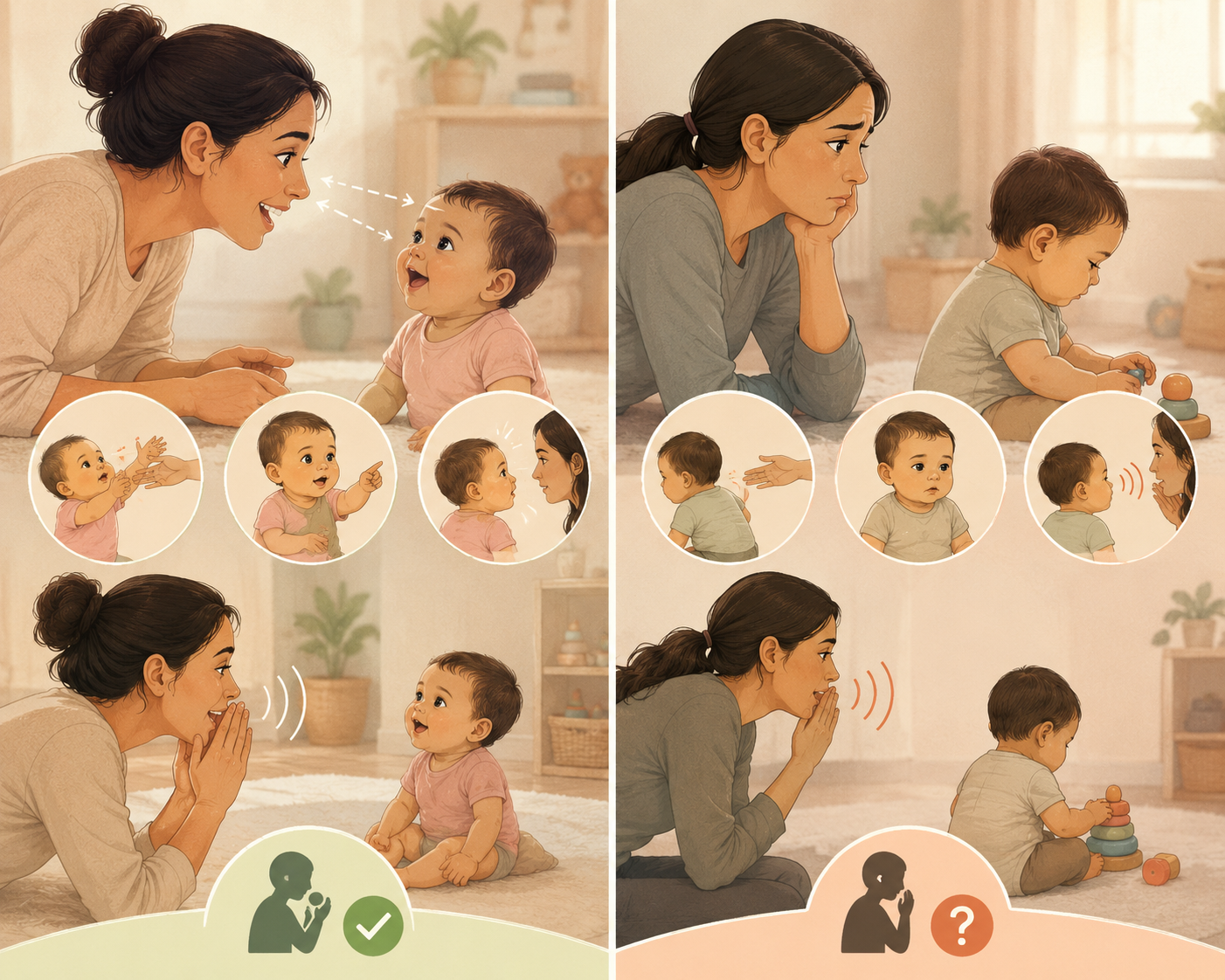
If you have found yourself watching your baby a little more carefully lately — noticing that she doesn't always look up when you call her name, or that she seems less interested in your face than you expected — you are not overreacting. You are paying attention. And paying attention, it turns out, is one of the most clinically useful things a parent can do.
This article is for you: the parent of a 7–10 month old who has a quiet feeling that something is worth understanding more carefully, who has probably been told to "wait and see," and who wants a clear, honest answer about what is typical at this age, what is worth monitoring, and what you can do right now — from home, without waiting for a clinic appointment.
What is typical eye contact and social attention at 6–10 months?
The timeline: when babies start showing joint attention
Here is something reassuring to know first: the social skills you are watching for are genuinely emerging during these months — they are not fully formed yet, and there is real variation in when they appear.
A recent longitudinal study that followed infants monthly between 6 and 10 months found that 44% of babies had already begun producing what researchers call "joint attention bids" — looking toward a caregiver's face while also vocalising or making a communicative expression — by 6 months. By 9 months, 92% of infants had done so (Salter & Carpenter, 2025). These bids emerged gradually and with increasing consistency, meaning a baby who isn't doing this clearly at 6 months may well be doing it by 8 or 9 months.
So if your 7-month-old isn't yet reliably catching your eye and "sharing" a moment with you, that is within the range of typical. But if you are approaching 9 or 10 months and this still feels absent or very inconsistent, that is worth paying closer attention to.
What 'making eye contact' really looks like at this age
At this age, eye contact is not a steady, prolonged gaze — it is a quick, purposeful look. Your baby glances at your face to check in, to share excitement about a toy, or to see how you are reacting to something. It is fleeting, social, and communicative. It is the beginning of what researchers call joint attention: the ability to share focus on something in the world with another person.
What is not typical — and what a prospective longitudinal study tracking children from infancy to age seven found to be meaningful — is a consistent pattern of reduced interest in direct gaze and eyes during infancy. That study found reduced interest in faces and eyes in infancy was associated with differences in adaptive behaviour at age four and social cognition at age seven (Zhou, Siddiqui & Rutherford, 2025). This does not mean every baby who looks away is on a different developmental path — it means the pattern, observed over time, carries information worth taking seriously.
Reaching, gesturing, and responding to your voice
Alongside eye contact, watch for reaching and gesture. By around 9–12 months, most babies are reaching toward caregivers, beginning to point or show objects, and responding to their name and familiar voices. A population-based prospective study found gesture scores were the key social-communication measure that differentiated children with ASD from typically developing children as early as 12 months (Veness et al., 2011). Gestures — reaching, showing, pointing — are your baby's first vocabulary, and they matter just as much as sounds.
Responding to your voice is also part of this picture. When you call your baby's name from across the room, does she turn? Does she pause what she is doing? Consistent non-response to her name — not just occasionally, but as a pattern — is worth noting.
Typical variation: every baby's timeline is a little different
Babies are not uniform. Some are naturally more social and face-oriented; others are more interested in objects and the physical world. Temperament, environment, and the amount of face-to-face interaction a baby has all play a role. A single moment of not looking up, or a few days of seeming less engaged, is not a signal. What matters is the consistent pattern across many interactions over time.
What might be worth paying closer attention to?
Early markers that research shows are worth monitoring
Reduced interest in faces and direct gaze
A consistent pattern of reduced interest in faces and direct gaze — not an occasional distracted moment, but a general tendency — is one of the signals prospective research has found to be associated with differences in social-cognitive development (Zhou, Siddiqui & Rutherford, 2025). If your baby rarely seeks your face, rarely makes that quick checking-in glance, or seems to look through you rather than at you, that pattern is worth documenting and discussing.
Not reaching toward you or responding to your name
A large prospective cohort study following 501 high-risk and 180 low-risk infants from 6 to 18 months found that features associated with autism spectrum differences were identifiable from 6 months and began to clearly differentiate infants by 12 months (Zwaigenbaum et al., 2021). Among the most consistent early markers identified in community-based surveillance research were reduced eye contact and pointing — the very gestures that signal a baby is trying to connect and share (Barbaro & Dissanayake, 2012). If your baby is not reaching toward you, not pointing or showing, and not consistently responding to her name, these are worth noting — not as a verdict, but as information.
Atypical ways of exploring objects
This one surprises many parents. A prospective study of 12-month-old infants found those later diagnosed with an autism spectrum condition showed significantly more spinning, rotating, and unusual visual exploration of objects — such as holding a toy very close to their eyes or inspecting it from unusual angles — compared to other infants (Ozonoff et al., 2008). If your baby seems more interested in the way an object moves or looks than in sharing it with you, that is worth noticing alongside the social signals.
Not responding to your voice or familiar sounds
Responding to a familiar voice — turning toward you, pausing, brightening — is a social and communicative behaviour, not just a hearing one. If your baby consistently does not respond to your voice, her name, or familiar sounds in a way that feels interactive and social, that pattern is worth discussing with a professional. (A hearing check is always the sensible first step.)
Why these matter
These signals matter not because they confirm a diagnosis — they do not — but because the 6–12 month window is genuinely meaningful for early identification. Research consistently shows developmental differences in social attention, gesture, and object exploration are detectable in this period, and that early identification creates the best opportunity for early support (Zwaigenbaum et al., 2021; Barbaro & Dissanayake, 2012).
Monitoring is not diagnosing. Every child develops along their own timeline, and many babies who show some of these patterns in the first year develop entirely typically.
What monitoring does is give you — and any professional you work with — a clearer, more structured picture, so that if support is needed, it begins early rather than after years of waiting.
Your instinct matters — what you see at home counts
Parents' observations are clinically important
If you have been told to "wait and see" and your instinct says something is worth paying attention to, here is what the research says: your instinct is clinically important. A prospective cohort study comparing parent-reported early signs with clinician observations during brief office visits found that parent-reported symptoms were better able to differentiate between children with and without ASD at both 12 and 18 months than clinician observations made during a short appointment (Sacrey et al., 2018). Parents see their children across hundreds of everyday moments — feeding, bath time, play, waking up — and that continuous, naturalistic observation captures behaviours a 15-minute clinic visit simply cannot.
Why 'wait and see' may miss what you're noticing
A South Asian cross-sectional study found the majority of parents had poor knowledge of developmental red flags across social, motor, and language domains, and that paediatricians were the primary — but often insufficient — source of information about developmental milestones (Kumar et al., 2024). This is not a criticism of paediatricians; it reflects the reality that a brief well-child visit cannot replicate what a mother observes across weeks and months at home. "Wait and see" is sometimes appropriate, but it should never mean "ignore what you are seeing."
How to document what you're seeing
You do not need special equipment. For the next week, simply notice and jot down:
- Does your baby look at your face when you talk to her?
- Does she reach toward you, or toward objects she wants?
- Does she turn when you call her name?
- Does she show you things — holding up a toy, making a sound to get your attention?
- How does she explore objects — does she share them with you, or is she absorbed in them alone?
These observations, recorded across several days, give you something concrete to share with a professional — and they are exactly the kind of naturalistic, home-based information research shows is most clinically informative.
What to do next: getting a clear picture from home
Structured observation in everyday routines
The most authentic picture of your baby's development comes from everyday life — not a clinic room where she may be tired, overwhelmed, or simply not herself. Watching how she interacts during a bath, a meal, or a play session on the floor gives you — and any professional reviewing that information — a far richer picture than a single snapshot.
India's national developmental monitoring standard (RBSK)
India has a national programme — the Rashtriya Bal Swasthya Karyakram (RBSK), backed by the Government of India and the Ministry of Health and Family Welfare — that establishes developmental monitoring as a standard part of child healthcare, not an optional extra. RBSK frames development as something every child deserves to have systematically checked, alongside growth, hearing, and vision — the fourth pillar of child health. If you are wondering whether your concern is "worth" raising, the answer from India's own national health standard is: yes, it is.
Hidden Hum: a 6-minute parent-led screening aligned with RBSK
If you want a clearer, structured picture right now — from home, without a waiting list — Hidden Hum is Fairy Tales Wellbeing's parent-led early screening tool, built on RBSK standards and designed to take under six minutes. It establishes a developmental baseline and an Early Skills Profile across the domains that matter at your baby's age. It is not a diagnosis. It is structured understanding — a way of turning what you are already observing into a clear, clinically grounded picture.
Be in Charge
Social and communication differences can be quiet — often hidden in everyday moments. Knowing how your child is developing early gives you more opportunity to support them.
Know today, through your child's RBSK developmental markers. Objective, from home, in 6 minutes.
What happens after screening
If Hidden Hum identifies areas worth looking at more closely, the next step is a fuller developmental assessment — not a label, but a thorough evaluation. Fairy Tales' FAIRY assessment is video-based, home-based, and reviewed by a developmental paediatrician or clinical psychologist. It is designed to understand your child's developmental profile across eight domains, and to give you a Well-Being Guide with concrete next steps — not a verdict.
When to seek more detailed guidance
Red flags that warrant a developmental paediatrician's evaluation
If you notice a consistent pattern of several of the following, it is worth talking to a developmental paediatrician — not because something is definitely wrong, but because early evaluation is always the right call when a parent has a persistent concern:
- Rarely or never makes eye contact during social interactions
- Does not reach toward caregivers or familiar people
- Does not respond to her name by 9–10 months
- Does not babble or make communicative sounds
- Shows very limited interest in faces compared to objects
- Explores objects in repetitive, unusual ways (spinning, rotating, unusual visual inspection) rather than showing or sharing them
Community-based surveillance research found that eye contact and pointing were the most recurring and discriminating early markers across the first and second year of life (Barbaro & Dissanayake, 2012). These are not reasons to panic — they are reasons to seek a structured evaluation early, when support is most effective.
How to access developmental assessment in India
You can begin with your paediatrician and ask specifically about a developmental assessment referral. You can also access a structured assessment directly through Fairy Tales Wellbeing's FAIRY platform — a clinician-reviewed, home-based process that does not require a referral or a clinic visit.
What to expect from a thorough evaluation
A good developmental evaluation is not a verdict. It is a structured way of understanding your child's unique profile — where she is thriving, where she might benefit from support, and what that support could look like. The goal is never a label. It is a clearer picture, and a pathway forward.
You know your baby. You have been watching her, noticing her, and wondering — and that attentiveness is exactly what she needs. If your instinct says something is worth understanding more carefully, trust it. Getting a structured picture is not overreacting. It is the most loving thing you can do.
Frequently asked questions
When should a baby start making eye contact and joint attention bids?
A longitudinal study found that 44% of babies had begun producing joint attention bids — looking at a caregiver's face while vocalising — by 6 months, rising to 92% by 9 months. This means a baby not doing this clearly at 6 months may well be doing it by 8 or 9 months.
What does normal eye contact look like in a 6-10 month old baby?
At this age, eye contact is a quick, purposeful look rather than a steady gaze — your baby glances at your face to check in, share excitement, or see your reaction. This is the beginning of joint attention: sharing focus on something with another person.
Is reduced eye contact in babies a sign of autism?
Reduced eye contact alone is not diagnostic, but a consistent pattern is worth monitoring. Research found reduced interest in faces and eyes in infancy was associated with differences in adaptive behaviour at age four and social cognition at age seven. Community-based surveillance research also identified eye contact and pointing as among the most consistent early markers across the first two years.
Should I trust my own observations about my baby's eye contact and social behaviour?
Yes. A prospective cohort study found that parent-reported symptoms were better able to differentiate between children with and without ASD at both 12 and 18 months than clinician observations made during brief office visits. Parents observe their babies across hundreds of everyday moments that a short clinic visit cannot capture.
Sources: Salter & Carpenter (2025); Zhou, Siddiqui & Rutherford (2025); Veness et al. (2011); Zwaigenbaum et al. (2021); Barbaro & Dissanayake (2012); Ozonoff et al. (2008); Sacrey et al. (2018); Kumar et al. (2024). This article is educational and does not replace assessment by a qualified clinician; if you have concerns, start with a hearing check and speak with your paediatrician.
Hidden Hum is part of the Fairy Tales Wellbeing family — a non-diagnostic, RBSK-aligned early skills profiler helping parents track developmental milestones from birth to 6 years.