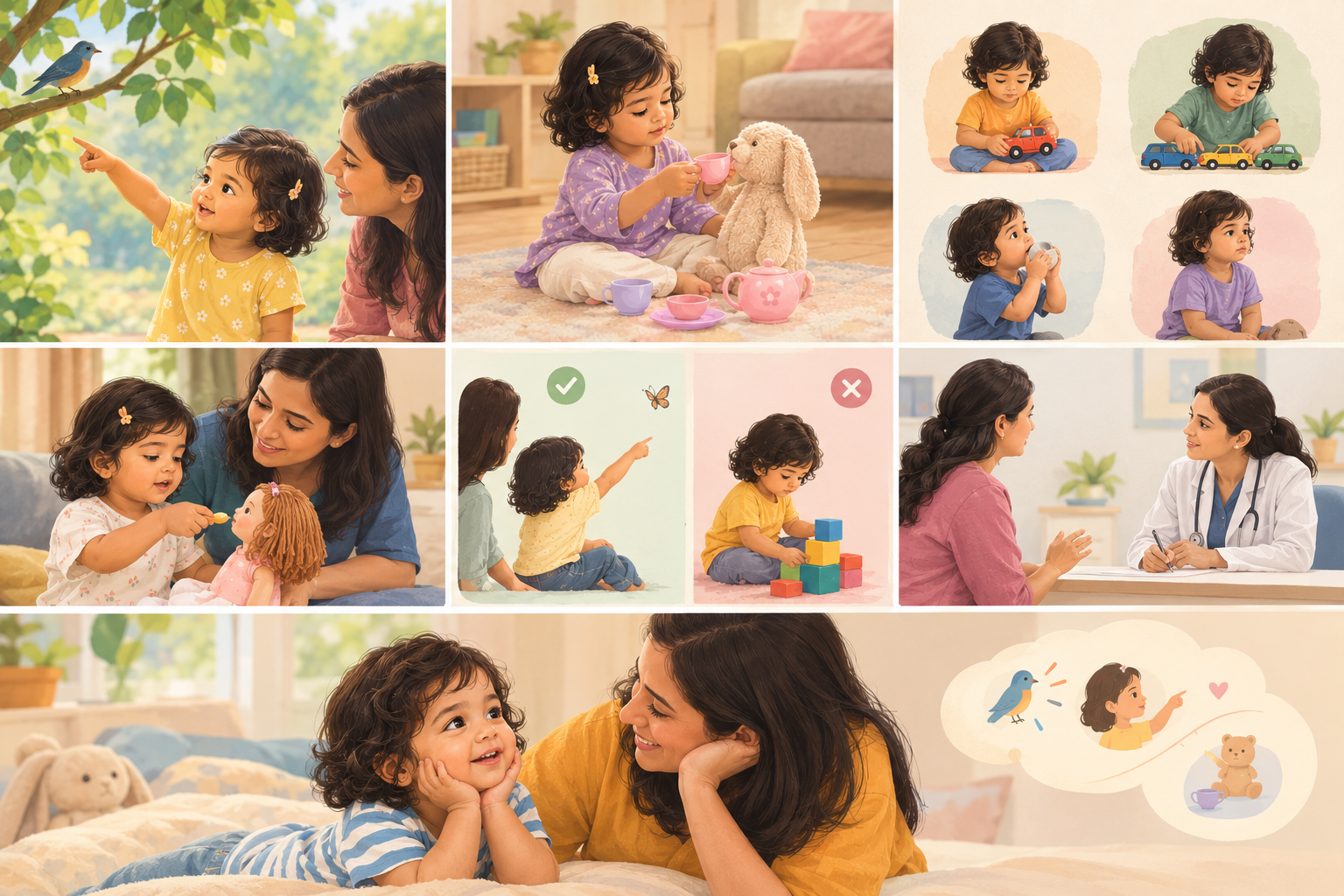
You've probably noticed it in quiet moments — at the park when a dog trots by, or at home when you pull out a favourite toy. Other toddlers stretch out a little finger, eyes wide, turning to their parent as if to say: did you see that? Your 26- or 28-month-old doesn't quite do that. And the pretend play — feeding a doll, stirring an imaginary cup of chai, making a block "drive" across the floor — hasn't really appeared either. You're not panicking. But you're wondering. Is this just who she is? Or is it something worth mentioning to a doctor?
First: the fact that you're asking this question is exactly right. You know your child better than anyone. And what you're noticing — the absence of pointing to share something, and the absence of pretend play — are two of the most clinically meaningful early developmental signals researchers have studied. This article will walk you through what these skills are, what the research says about when they typically emerge, when their absence is worth taking seriously, and what calm, practical steps you can take right now.
What are pointing and pretend play — and why do they matter?
Joint attention and declarative pointing: sharing the world with you
Pointing comes in two flavours, and only one of them is the milestone we're talking about here. Imperative pointing — jabbing a finger at a biscuit to request it — is about getting something. Declarative pointing — stretching a finger toward a bird on the window ledge and looking back at you — is about sharing something. That second kind is what researchers call a joint attention behaviour: your child is coordinating her attention with yours, inviting you into her experience.
Joint attention is defined as the ability to coordinate attention with another person around a shared point of reference (Montagut-Asunción et al., 2022). It sounds simple, but it rests on something profound: your toddler understands that you have a mind, that you can look where she looks and feel what she feels about it. That's the beginning of social understanding.
Symbolic play: pretend, imagination, and representation
When a toddler picks up a banana and holds it to her ear like a phone, or wraps a cloth around a teddy and pats it to sleep, she's doing something cognitively remarkable. She's using one thing to represent another — the foundation of symbolic thought. This is what researchers call symbolic or pretend play, and it draws on the same representational abilities that underlie language, imagination, and eventually, understanding other people's perspectives (Charman, 1997).
Why these two skills are so closely linked
Joint attention and pretend play are not separate milestones that happen to appear around the same time. Research suggests they are developmentally intertwined: early impairments in joint attention are thought to lead to impoverished development of the representational abilities that underlie pretend play (Charman, 1997). In other words, the little finger pointing at the dog and the little hand feeding the doll are both expressions of the same growing capacity — your child's ability to connect with you and with the world of ideas.
What's typical at 2 years? The range of normal
Pointing milestones: what the research tells us
A large prospective study following children from 8 months through to age four found that gesture scores — including pointing — were already differentiating groups of children by 12 months, and remained a significant marker at 24 months (Veness et al., 2011). By the time most children reach their second birthday, declarative pointing — showing you things to share interest — is well established. It typically emerges in the second year of life and is considered a core prelinguistic communication skill.
India's national developmental monitoring standard, RBSK (Rashtriya Bal Swasthya Karyakram), includes joint attention and gesture as explicit markers in the 2-year milestone set — meaning India's own paediatric framework already recognises these as skills every child deserves to be checked for, not optional extras.
Pretend play milestones: what the research tells us
Symbolic play typically begins to emerge in the second year of life and becomes richer and more varied through ages two and three. A 2023 diagnostic study found that symbolic play equivalent age is a meaningful clinical marker — children whose symbolic play is significantly behind their chronological age show a different developmental profile from those whose play is on track (Chang et al., 2023). By 24 to 30 months, most children are engaging in at least simple pretend sequences: feeding a doll, making a toy animal "walk," or stirring an imaginary pot.
Every child develops at their own pace — but there's a range we watch for
Development is not a single line. Some children are quieter, more observant, less demonstrative — and that is real variation. But "personality" and "developmental difference" are not the same thing, and the research gives us a meaningful window to watch. The absence of both declarative pointing and pretend play by 24–30 months is not something to dismiss as temperament alone. It's worth a closer look.
What matters is not whether your child hits either milestone on an exact date — it's whether she is reaching toward you and toward the world of ideas at all. A child who shares, points, pretends, and invites you in — even a little late — is almost certainly on a typical path.
When should you pay closer attention? Red flags, not verdicts
Rarely or never points to show you things
The key distinction is between pointing to request ("I want that") and pointing to share ("Look at that butterfly!"). If your toddler points to get things but rarely or never points to share her delight or curiosity with you, that's the pattern worth noting. A landmark study by Charman and colleagues found that absence of joint attention behaviours — including showing and pointing to share interest — was one of the earliest distinguishing features in infants later identified with autism (Charman et al., 1997).
No pretend play or imaginative play by 24–30 months
If your 26- to 30-month-old has shown no signs of pretend play — no feeding a doll, no "driving" a toy, no pretending a block is something else — that's a pattern the research takes seriously. A randomised controlled trial confirmed that delays in both joint attention and symbolic play are core developmental concerns in young children, distinct enough to be targeted separately in intervention (Kasari et al., 2006). The absence of pretend play is not just a "play style" difference — it reflects the underlying representational capacity that the research consistently links to social-communicative development.
Limited response to your pointing or gestures
It's not only about whether your child points to you — it's also about whether she follows your pointing. When you say "look at that!" and point across the room, does she follow your gaze and finger? Responding to joint attention bids from others is as developmentally significant as initiating them. Research found that responding to joint attention at 12 months was specifically linked to autism risk markers at 18 months (Montagut-Asunción et al., 2022), and a prospective eye-tracking study confirmed that joint attention abilities at 12 months predicted socio-communicative development at 24 months (Costanzo et al., 2025).
Why these matter: what the research tells us
Taken together, the research paints a consistent picture. Gesture scores at 24 months were the single social communication characteristic that could differentiate children with ASD from other groups in a population sample (Veness et al., 2011). Symbolic play scores are significantly lower in children with ASD compared to children with developmental language disorder, making pretend play a meaningful clinical marker in its own right (Chang et al., 2023). Structured screening tools that include joint attention and symbolic communication items have been validated for detecting developmental concerns from as early as 9 to 24 months (Wetherby et al., 2008).
What's worth attention is not a quieter child or a slightly later start — it's the absence of sharing altogether.
The child who points to get, but never to show. Who plays with objects, but never pretends. Who doesn't follow your finger when you say "look."
Important: noticing these is not a diagnosis — it's the first step to understanding
Please hold this gently. Noticing that your child rarely points or hasn't started pretend play does not mean she has autism or any other condition. Many children who show these patterns at 26–30 months go on to develop typically with or without support. What the research tells us is that these are signals worth paying attention to — not verdicts. The goal of noticing is understanding, and the goal of understanding is support.
What to do if you've noticed this
Trust your observation — you know your child best
Fairy Tales was founded on a simple truth: mothers have something important to say about their children. Your observation — quiet, uncertain, not yet raised with a doctor — is valid. You don't need to be sure before you speak up. You just need to have noticed. Your instinct is data, and it deserves to be taken seriously.
Bring it up at your next paediatrician visit
You don't need a dramatic conversation. You can simply say: "I've noticed she doesn't really point to show me things, and I haven't seen much pretend play yet. Is that something we should look at?" That's enough. A good paediatrician will take it seriously. If yours doesn't, it's okay to ask again or seek a second opinion. Developmental monitoring is the fourth pillar of child health — as important as growth, hearing, and vision.
Getting a clear picture: Hidden Hum screening
If you'd like a structured starting point before that appointment, Hidden Hum — Fairy Tales' parent-led developmental baselining tool, built on RBSK standards — takes under six minutes and gives you an Early Skills Profile across eight developmental domains, including social communication and play. It's not a diagnosis. It's a starting point for a much more informed conversation, from home, in your child's natural environment.
Be in Charge
Pointing and pretend-play differences can be quiet — often hidden in everyday moments. Knowing how your child is developing early gives you more opportunity to support them.
Know today, through your child's RBSK developmental markers. Objective, from home, in 6 minutes.
When to seek help: clear guidance, not alarm
If your child shows several of these signs together
If your 26- to 30-month-old rarely points to share interest, has no pretend play, doesn't follow your pointing, and perhaps also has limited eye contact or is not yet using words to communicate — these signs together, rather than any one in isolation, are worth bringing to a developmental paediatrician promptly. Not urgently in a frightening way, but promptly in a caring way. The research is clear that early identification significantly improves outcomes (Costanzo et al., 2025).
What resources and tools are available
In India, your first port of call is a structured developmental screen from home before that appointment. Hidden Hum takes under six minutes and gives you an Early Skills Profile you can bring to any paediatrician conversation. It's not a diagnosis — it's a starting point for a much more informed conversation, one grounded in your child's actual developmental markers rather than a general impression.
How a structured assessment can help
A thorough developmental assessment — like Fairy Tales' FAIRY assessment, built on the WHO ICF framework and powered by DSM-5 — looks at your child across eight developmental domains, in her natural home environment, through activities she does every day. It is not a clinical verdict. It is a Well-Being Guide: a detailed picture of her behavioural patterns, developmental needs, and recommended next steps. The goal is always understanding and support — never a label. And if support would help, the next step is connection to early intervention near you.
The bottom line
You noticed something. That matters enormously. The research is consistent: declarative pointing and pretend play are among the most meaningful early developmental signals we have, and their absence at 26–30 months is worth taking seriously — not with alarm, but with calm, structured attention.
Development is the fourth pillar of child health, as deserving of systematic monitoring as growth, hearing, and vision. And you, as a parent, are the most powerful force in your child's early development — not because you need to fix anything, but because you are the one who sees her every day, who knows when something feels different, and who can take the first step toward understanding.
If you'd like a clear picture from home, Hidden Hum's short developmental check is a calm, structured place to start. Not a guess. Structured understanding — for you and your little one.
We know your little one is a gem — and you are a fantastic parent too.
Frequently asked questions
What's the difference between pointing to request and pointing to share?
Imperative pointing — jabbing a finger at a biscuit to request it — is about getting something. Declarative pointing — pointing at a bird and looking back at you — is about sharing an experience. Declarative pointing is the joint attention behaviour researchers consider clinically significant when assessing 2-year-olds.
When should a toddler start pretend play?
Symbolic or pretend play typically begins to emerge in the second year of life and becomes richer through ages two and three. By 24 to 30 months, most children engage in at least simple pretend sequences, such as feeding a doll or making a toy animal walk.
Why are pointing and pretend play studied together?
Research suggests joint attention and pretend play are developmentally intertwined, with early impairments in joint attention thought to lead to impoverished development of the representational abilities that underlie pretend play. Both reflect the same growing capacity to connect with others and the world of ideas.
Does the absence of pointing and pretend play mean my child has autism?
No — noticing these patterns is not a diagnosis. Many children who show these patterns at 26 to 30 months go on to develop typically. Research shows these are signals worth paying attention to, particularly when several appear together alongside limited eye contact or language, and are worth discussing with a paediatrician rather than something to self-diagnose.
Sources: Charman et al. (1997); Charman (1997); Veness et al. (2011); Chang et al. (2023); Kasari et al. (2006); Montagut-Asunción et al. (2022); Costanzo et al. (2025); Wetherby et al. (2008). This article is educational and does not replace assessment by a qualified clinician.
Hidden Hum is part of the Fairy Tales Wellbeing family — a non-diagnostic, RBSK-aligned early skills profiler helping parents track developmental milestones from birth to 6 years.