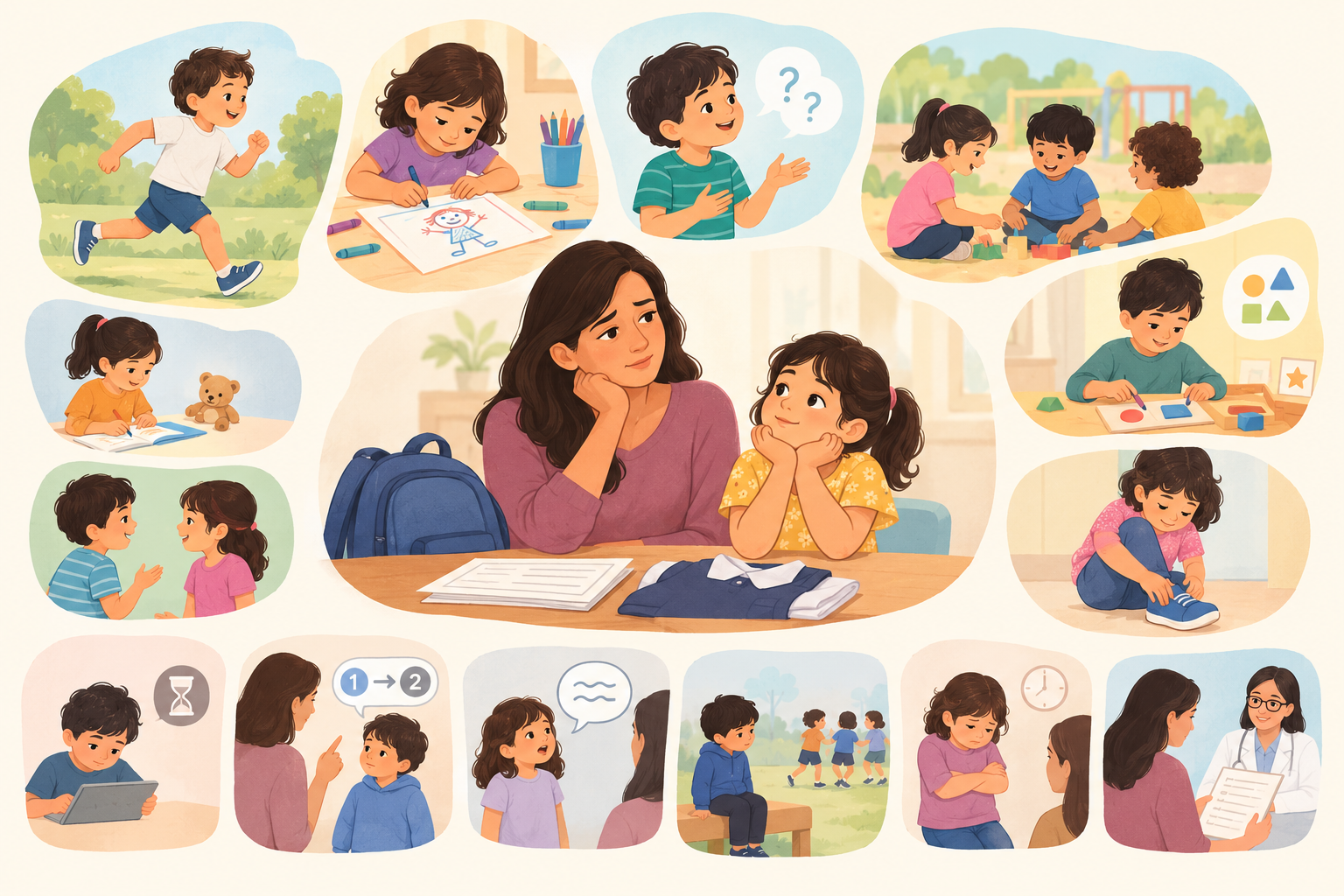
School admission season in India arrives with a particular kind of quiet anxiety. You've filled in the forms, bought the uniform, and told your four-year-old that something exciting is coming. But in the back of your mind, a question keeps surfacing: is she actually ready? Not ready in the way the school brochure means — but ready in the way that matters. Can he follow a two-step instruction without you repeating it three times? Does she join in when other children play, or does she hang back? Is his speech clear enough for a teacher who doesn't know him the way you do?
You've probably heard "every child is different" more times than you can count. And it's true — but it isn't always helpful. What you're looking for isn't reassurance without substance. You want to know, specifically and honestly, what a four-year-old is typically doing — and what's genuinely worth a closer look. This guide is written for exactly that moment.
What should your 4-year-old be able to do before school?
The key developmental domains at age 4
Development at four isn't a single skill — it's a conversation between several domains happening at once. Rather than a rigid checklist, think of these as broad territories worth observing in your child's everyday life.
Gross motor: Most four-year-olds can run, jump, climb stairs with alternating feet, and balance briefly on one foot. They're building the physical confidence that lets them navigate a school playground without constant adult support.
Fine motor: Holding a crayon or pencil with a reasonable grip, cutting roughly along a line with child scissors, and drawing a recognisable person with a head and at least two features — these are the kinds of fine motor skills that support early writing readiness.
Language: By four, most children are speaking in sentences of four to six words, asking "why" and "how" questions with genuine curiosity, and being understood by unfamiliar adults most of the time. Storytelling — recounting what happened at the park, or narrating a pretend game — is emerging.
Social-emotional: Four-year-olds are beginning to play cooperatively with other children (not just alongside them), take turns, and manage small frustrations without always dissolving. They're also developing a sense of their own feelings and beginning to name them.
Cognitive: Sorting objects by colour or shape, understanding concepts like "more" and "less", following a short story, and recognising their own name in print are all typical at this age.
Self-care: Independently using the toilet, washing hands, putting on shoes (even if the buckle is still tricky), and managing a lunchbox are the practical skills that make a school day manageable.
What you might notice at home
The most useful observations don't happen during a test — they happen during breakfast, at the park, and in the ten minutes before bath time. A four-year-old who is developing well will generally be able to hold attention on a preferred activity for around ten to fifteen minutes, follow a two-step instruction ("put your shoes on and then come to the table"), and engage in back-and-forth conversation — asking questions, listening to answers, and responding. In play, you'll see imaginative scenarios, some negotiation with siblings or friends, and the beginning of rule-following in simple games.
None of this needs to be perfect. What you're looking for is a general pattern across these areas — not a single skill in isolation.
How to observe your child: a parent-led approach
You know your child best
Here's something the research confirms: your observations as a parent are genuinely valuable clinical data. A 2024 study published in Children assessed the accuracy of parent-report tools — specifically the Parents' Evaluation of Developmental Status (PEDS) and its companion Developmental Milestones scale — in distinguishing children with typical development from those with developmental differences in India. The findings support what many developmental paediatricians already know: parents who are given a structured framework to report their concerns can identify developmental differences with meaningful accuracy (Sheel, Suárez & Marsh, 2024).
This matters because it reframes the question. You are not guessing. When you notice that your child struggles to follow instructions, or that her speech is harder to understand than her peers', or that he becomes overwhelmed by transitions — you are observing something real. The goal is to give that observation a structure.
What to look for in everyday moments
Rather than running a formal test, try watching your child across four everyday windows over a week:
Attention span: During a favourite activity — drawing, building blocks, a puzzle — how long does your child stay engaged before drifting? During a less preferred activity, like tidying up, how do they respond to your instruction?
Response to instructions: Give a two-step direction in a calm moment ("Get your water bottle and sit at the table"). Does your child follow both steps, or does the second step get lost? Occasional forgetting is normal; consistent difficulty is worth noting.
Language use: Listen to how your child tells you about their day, or narrates a pretend game. Are sentences mostly complete? Can an unfamiliar adult — a neighbour, a shopkeeper — understand what your child is saying most of the time?
Peer interaction: At a park or family gathering, watch how your child approaches other children. Do they join play, even imperfectly? Or do they consistently withdraw, or become distressed in group settings?
Emotional regulation and transitions: How does your child handle the shift from a preferred activity to a less preferred one — say, leaving the playground to come home? Some protest is entirely typical. Prolonged distress that's difficult to settle, or extreme anxiety about new situations, is worth discussing with your paediatrician.
What might suggest your child needs support?
When to seek guidance
None of the following is a diagnosis — and noticing one of these things in isolation is rarely cause for concern. But if you're seeing a consistent pattern across several areas, it's worth a conversation with your child's paediatrician:
- Persistent difficulty following two-step instructions, even in calm, familiar settings
- Speech that is frequently unclear to people outside the immediate family — by four, most children are understood by strangers most of the time
- Very limited engagement with other children — not shyness, but a consistent lack of interest in or awareness of peers
- Significant difficulty with transitions — extreme distress that is hard to settle when routines change
- Intense anxiety about school or new situations that goes beyond typical nervousness and affects daily life
- A noticeable gap between what your child understands and what they can express in language
If you're seeing several of these together, the right response isn't alarm — it's structured understanding.
One item on its own is usually just a difference in pace or temperament.
Several items together, persisting across settings, is what's worth a structured conversation — not a guess.
This doesn't mean something is wrong
Children develop along different timelines and in different ways. Noticing that your child needs support in one or two areas before school is not a verdict on your child — or on you as a parent. It's information.
Getting a clear picture before school starts
If you've read this far and recognise a few of your own observations in this checklist, the next useful step isn't worry — it's a structured look. India's RBSK (Rashtriya Bal Swasthya Karyakram) programme exists precisely because the Government of India recognises that school-readiness checks shouldn't depend on a parent's guesswork or a single rushed conversation at admission time — they should be a routine part of child healthcare, the same as a growth or hearing check.
Hidden Hum, Fairy Tales' parent-led early developmental baselining tool, is built on these RBSK standards and takes under six minutes to complete from home. Before your next paediatrician visit — or before the school term starts — it gives you a structured developmental baseline across all eight domains covered in this checklist: gross motor, fine motor, language, social-emotional, cognitive, and self-care. It's not a test your child can fail. It's a clear, calm picture of where they are right now, so that whatever comes next — a quiet word with the school, a conversation with your paediatrician, or simply your own reassurance — is based on structured observation, not an anxious guess.
Be in Charge
School-readiness differences can be quiet — often hidden in everyday moments. Knowing how your child is developing early gives you more opportunity to support them.
Know today, through your child's RBSK developmental markers. Objective, from home, in 6 minutes.
School readiness isn't a single exam your child either passes or fails on the first day. It's a gradual, uneven unfolding across motor skills, language, emotions, and social connection — and your steady, specific attention to all of it is exactly what your child needs from you right now, whether or not anything turns out to need extra support.
We know your little one is a gem — and you are a fantastic parent too.
Frequently asked questions
What language skills should a 4-year-old have before starting school?
By four, most children speak in sentences of four to six words, ask "why" and "how" questions with genuine curiosity, and are understood by unfamiliar adults most of the time. Simple storytelling — recounting a park visit or narrating a pretend game — is also typically emerging.
Can my 4-year-old follow two-step instructions?
Most four-year-olds developing typically can follow a two-step instruction, such as "put your shoes on and then come to the table," in calm, familiar settings. Occasional forgetting is normal; consistent difficulty following two-step instructions even when calm is worth discussing with a paediatrician.
What social skills are typical for a 4-year-old before school?
Four-year-olds are beginning to play cooperatively with other children rather than just alongside them, take turns, manage small frustrations without always dissolving, and show some negotiation with siblings or friends during play.
How accurate are parent observations in identifying developmental concerns?
A 2024 study assessing parent-report tools, including the Parents' Evaluation of Developmental Status, in India found that parents given a structured framework to report concerns can identify developmental differences with meaningful accuracy — supporting that parental observations are genuine clinical data, not guesswork.
Sources: Sheel, Suárez & Marsh (2024), Children. This article is educational and does not replace assessment by a qualified clinician.
Hidden Hum is part of the Fairy Tales Wellbeing family — a non-diagnostic, RBSK-aligned early skills profiler helping parents track developmental milestones from birth to 6 years.