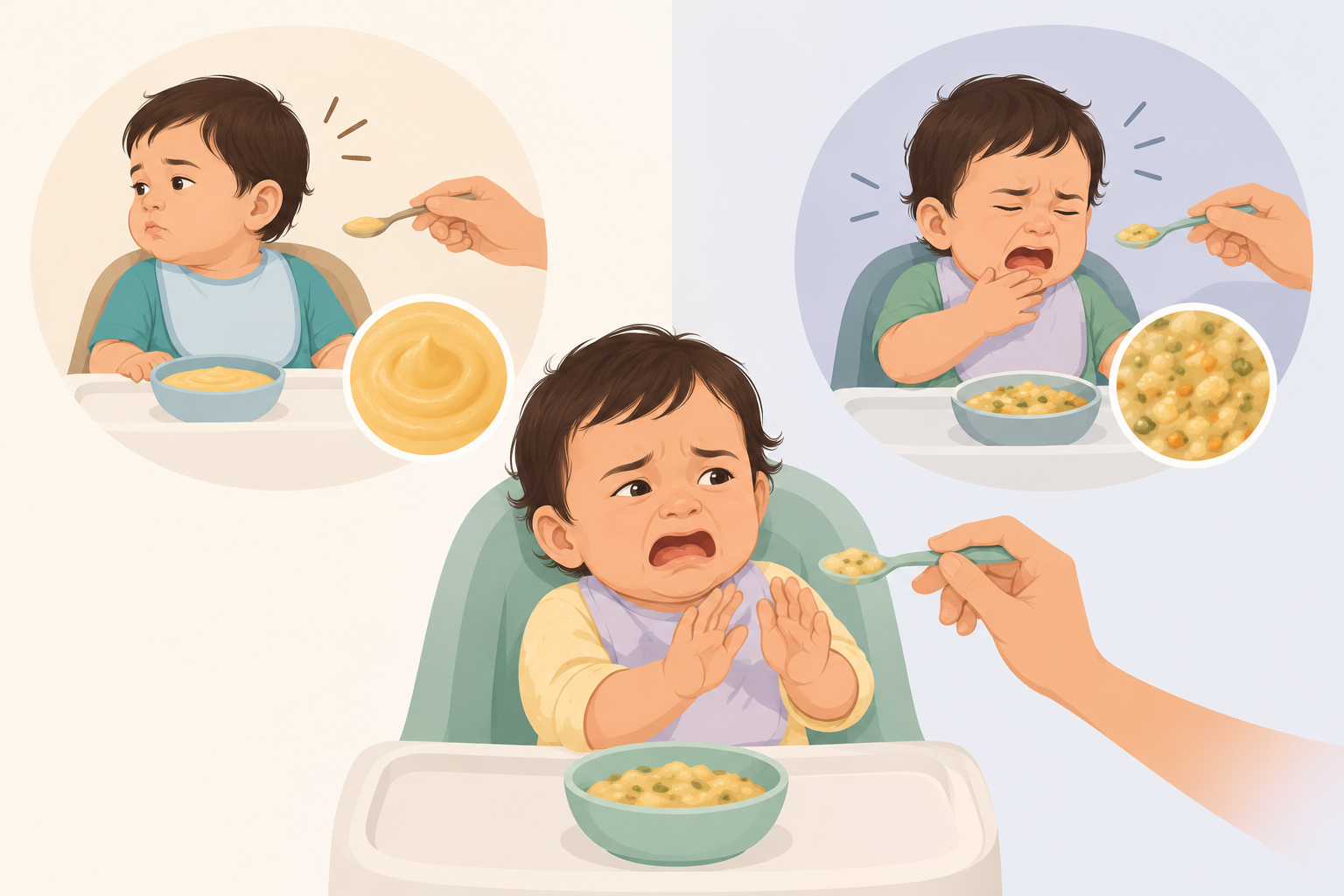
You've mashed the banana perfectly. You've thinned the dal to what feels like silk. And still — the moment a tiny lump appears, your eight-month-old gags, turns away, or dissolves into tears. You've been told, more than once, "all babies are fussy." But something in you says this is different. It isn't about the taste. It isn't about hunger. It feels like your baby is experiencing the food itself in a way that is genuinely overwhelming for them.
You may be right. And your instinct deserves a proper answer — not a dismissal. This article is for you: a mother in the thick of weaning, noticing something specific about how her baby meets the world through their mouth, and wanting to understand it clearly and calmly before deciding what to do next.
What does texture progression look like in the first year?
The 6–12 month texture journey: from smooth purées to mashed solids
Texture introduction in the first two years of life is not just about food — it is a developmental process in its own right. A multidisciplinary panel of feeding experts, drawing on global guidelines and developmental research, has proposed a framework that organises food textures into five main groups: liquids, purées, mashed solids, chewable solids, and combination foods (Delaney et al., 2025). Each category is defined not just by what the food looks like, but by the specific oral motor skills a child needs to manage it safely.
For a baby between six and twelve months, the expected journey moves broadly from smooth, cohesive purées toward thicker, lumpier mashed textures — a progression that is gradual, not sudden. This matters because the research is clear: the absence of a standardised understanding of what is age-appropriate has historically made it difficult to distinguish typical texture development from something that warrants closer attention (Delaney et al., 2025).
In India, where weaning typically begins at six months in line with WHO and Indian paediatric guidance, most parents are navigating this transition with very little information about what the texture journey is actually supposed to look like — and almost none about what it means when a baby struggles with it. If your baby is also refusing solids more broadly after breastfeeding, it's worth understanding how texture and appetite concerns can overlap.
What oral motor skills should you see at 8 months?
By around eight months, a baby is typically developing the tongue force and tongue control needed to manage thicker, slightly lumpy textures — moving food around the mouth, mashing soft solids against the palate, and beginning to practise the early stages of chewing (Delaney et al., 2025). These are not skills that arrive overnight. They build gradually as the baby gets more practice with varied textures.
This is worth holding onto: some resistance to new textures during this window is part of the learning process. The mouth is doing genuinely new work. The question is not whether your baby finds lumps challenging — many do — but how they respond, and whether that response seems to go beyond the expected adjustment.
Fussy eating or sensory sensitivity? How to tell the difference
What is typical fussy eating? (And why it's not a concern)
Fussy eating in infancy and early childhood is genuinely common. Research tracking children over time has found that fussy eating and maternal feeding practices influence each other in an ongoing, bidirectional way — a baby's reluctance shapes how a parent responds, and a parent's response in turn shapes the baby's behaviour at mealtimes (Mallan et al., 2018). This is a normal, dynamic relationship, not a sign that something is wrong with either the child or the parent.
Typical fussy eating tends to look like this: a baby who accepts a food one day and refuses it the next; who goes through phases of preferring certain flavours; who needs multiple exposures to a new food before accepting it. The refusal is inconsistent, and the baby is generally calm between attempts — they are not distressed by the presence of the food, only uninterested in eating it right now.
What is sensory-based texture refusal? (The signs to notice)
Sensory-based texture refusal looks and feels different. Here, the difficulty is not primarily about preference or appetite — it is about how the sensory properties of the food are being processed by the baby's nervous system. Research linking sensory processing to feeding disorders describes a pattern called oral defensiveness, where the mouth and oral cavity respond to certain textures, temperatures, or consistencies with what appears to be genuine distress — gagging, retching, pushing food away with force, or becoming highly agitated at the sight or smell of certain foods (Ryu, 2019).
The key distinction is that the reaction feels disproportionate and consistent. It is not "I don't want this today" — it is "this sensation is intolerable." A baby with sensory-based texture difficulty may accept a very narrow range of smooth purées and react with real distress to anything outside that range, even when they are hungry and the food is otherwise appealing.
Research also highlights that sensory-based food avoidance can involve distinct response patterns — including disgust or distaste reactions that go beyond simple dislike — and that these responses are clinically meaningful and worth understanding carefully (Sharp & Pederson, 2025).
How to know which one your baby has: an observation framework
You don't need a clinic to begin observing. Watch for these patterns over several mealtimes:
- Consistency: Does the refusal happen every time with lumpy or mixed textures, or only sometimes?
- Intensity: Is your baby mildly reluctant, or are they gagging, retching, or becoming visibly distressed?
- Range: Is your baby accepting a reasonable variety of smooth foods, or is the accepted range very narrow?
- Recovery: After a difficult mealtime, does your baby settle quickly, or does the distress linger?
None of these observations on their own are diagnostic. But together, they give you a much clearer picture of what you are actually seeing — and a much more useful conversation to have with your paediatrician.
Typical fussiness is inconsistent and calm — "not this, not today," with an easy recovery.
Sensory-based refusal is consistent and distressed — gagging or real agitation at the presence of a texture, even when hungry.
Understanding oral defensiveness and sensory processing in feeding
What is oral defensiveness? (And why it's about sensation, not taste)
Oral defensiveness is a term used in feeding therapy to describe heightened sensitivity in and around the mouth — a nervous system response that makes certain textures, temperatures, or oral sensations feel overwhelming rather than simply unfamiliar (Ryu, 2019). It is important to understand that this is not about taste. A baby with oral defensiveness may happily accept a smooth purée of the same ingredient that causes distress in a lumpy form. The flavour is the same. What has changed is the sensory demand — the texture, the particle size, the way the food moves in the mouth.
This distinction matters enormously, because it shifts the question from "why won't my baby eat this?" to "what is my baby's mouth telling their nervous system about this?" — and that is a much more useful question to be asking.
Is sensory-based feeding difficulty only in autism? (The answer may surprise you)
This is one of the most important things to understand, and one of the least discussed in Indian parenting spaces. Sensory processing differences and feeding difficulties are not exclusive to autism. Research investigating the relationship between sensory processing, oral skills, and feeding problems has found these patterns in both children with autism spectrum disorder and in typically developing children (Kolit & Şahin, 2025). Sensory-based texture refusal exists on a spectrum — it can be mild and manageable, or more significant and persistent — and it can occur in any child, regardless of whether they have a neurodevelopmental diagnosis.
Mothers of infants later diagnosed with autism have described noticing feeding difficulties — including challenges with complementary feeding — from very early on, often before any formal concerns were raised (Campbell et al., 2026). But the presence of feeding difficulty does not mean autism, and the absence of a diagnosis does not mean the feeding difficulty is not real or worth understanding. Your baby's experience of food is valid and worth taking seriously, whatever the underlying reason.
Why sensory processing matters for how your baby experiences food
Sensory processing is one of the eight developmental domains that shape how a young child engages with the world. When a baby's sensory processing is working smoothly, new textures are interesting — a little surprising, perhaps, but manageable. When sensory processing is more sensitive, the same texture can feel genuinely overwhelming. The baby is not being difficult. They are telling you, in the only language available to them, that something about this experience is too much.
Recognising this reframes the whole mealtime. It moves the question away from "how do I get my baby to eat this?" and toward "how do I help my baby feel safe enough to explore this?" — and that shift is where real progress begins.
What you can observe and try at home
How to observe your baby's texture response naturally
The most useful observations happen in ordinary mealtimes, not tests. Keep a simple mental note (or a quick voice memo after meals) of:
- Which textures your baby accepts without difficulty
- Which textures trigger gagging, distress, or strong refusal
- Whether the reaction is to the texture itself or to the overall mealtime context (tiredness, distraction, a new environment)
- Whether the range of accepted foods is gradually widening, staying the same, or narrowing
This kind of naturalistic observation — watching your baby in their own environment, in their own routine — gives you the richest picture of what is actually happening. It is also exactly the kind of information that is most useful to share with a paediatrician or feeding specialist.
Gentle exposure without pressure: a parent-led approach
Research on parent-led intervention for sensory-based feeding difficulty offers an encouraging finding: parents can be the primary agents of change. A study of children with feeding problems arising from sensory defensiveness found that when parents were supported to use a graduated exposure approach — gently and consistently introducing new textures alongside positive reinforcement, without pressure — children showed improvements in dietary variety over time, and parents reported fewer feeding difficulties (Dovey & Martin, 2012).
In practice, this might look like:
- Offering a tiny amount of a slightly lumpier texture alongside a familiar, accepted purée — not instead of it
- Letting your baby touch and explore the food with their hands before it goes near their mouth (sensory familiarity through touch can reduce oral defensiveness)
- Keeping mealtimes calm and low-pressure — distress at mealtimes can compound sensory sensitivity over time
- Celebrating any engagement with a new texture, however small — a touch, a sniff, a lick — as genuine progress
The key word in all of this is gradual. There is no rush, and pressure tends to make sensory-based feeding difficulty worse, not better (Dovey & Martin, 2012).
What changes might you see over time?
With consistent, gentle exposure and a low-pressure mealtime environment, many babies with mild-to-moderate sensory sensitivity do gradually expand their texture range. The research on graduated exposure suggests that responsiveness varies — some children move more quickly than others — and that earlier support tends to be associated with better outcomes (Dovey & Martin, 2012). This is not a reason to panic if your baby is eight months old; it is a reason to start paying attention now, and to seek guidance if you are not seeing gradual progress.
Be in Charge
Sensory and feeding differences can be quiet — often hidden in everyday moments. Knowing how your child is developing early gives you more opportunity to support them.
Know today, through your child's RBSK developmental markers. Objective, from home, in 6 minutes.
When to seek professional guidance
Red flags that warrant assessment (weight gain, extreme restriction, distress)
Most texture sensitivity in infancy is mild and responds well to patient, graduated exposure at home. But there are signs that warrant a conversation with your paediatrician sooner rather than later:
- Your baby is not gaining weight as expected, or their growth has plateaued
- The range of accepted foods is very narrow and not widening over weeks of gentle exposure
- Mealtimes are consistently highly distressing — for your baby, and for you
- Your baby gags or retches on textures that other babies their age manage without difficulty
- You notice the difficulty extending beyond food — strong reactions to touch, certain fabrics, or other sensory experiences
These are not reasons to alarm yourself. They are reasons to seek structured understanding rather than waiting and wondering. Research on pediatric feeding disorder makes clear that age-appropriate texture expectations matter — and that when a child is consistently outside those expectations, professional evaluation can make a meaningful difference (Delaney et al., 2025; Sharp & Pederson, 2025).
What a professional can help with (sensory assessment, feeding therapy)
A developmental paediatrician or feeding specialist can help you understand whether what you are seeing is within the range of typical development, or whether it reflects a sensory processing difference that would benefit from structured support. Sensory processing assessment in the context of feeding difficulty is a recognised clinical pathway — one that looks not just at what a child eats, but at how their nervous system is responding to the sensory properties of food (Ryu, 2019).
Feeding therapy, when indicated, is typically gradual, parent-inclusive, and grounded in exactly the kind of low-pressure graduated exposure described above — but with clinical guidance on pacing and technique. You are not handing your baby over to a stranger. You are getting support to do what you are already trying to do, more effectively. And if support would help, the next step is connection to early intervention — including feeding and occupational therapy — near you.
Where to start: screening and assessment options
If you are not sure whether what you are seeing warrants professional input, the most useful first step is a structured developmental check — one that looks at your baby's sensory processing alongside their other developmental domains, in the context of their age and stage.
Hidden Hum, Fairy Tales's parent-led early developmental baselining tool, is built on India's RBSK standards and takes under six minutes. It gives you a developmental baseline across all eight domains — including sensory processing — and helps you understand whether your observations point to something worth exploring further. It is not a diagnosis. It is structured understanding: a calm, clear picture of where your baby is right now, and what, if anything, deserves a closer look. For a deeper picture, Fairy Tales' FAIRY assessment is a clinician-reviewed, home-based evaluation across all eight developmental domains, including sensory and feeding.
You know your baby. You noticed something. That noticing matters — and it deserves more than "all babies are fussy." Developmental monitoring is the fourth pillar of child health, as deserving of attention as growth, hearing, and vision. Whether what you are seeing is typical fussiness or a sensory sensitivity worth supporting, the calm, structured path is the same: observe, support gently, and seek clarity when you need it.
We know your little one is a gem — and you are a fantastic parent too.
Frequently asked questions
What's the difference between fussy eating and sensory-based texture refusal in babies?
Typical fussy eating is inconsistent — a baby accepts a food one day and refuses it the next, and stays generally calm between attempts. Sensory-based texture refusal is different: the reaction is disproportionate and consistent, often involving gagging, retching, or real distress at the presence of certain textures, not just disinterest in eating them.
What textures should an 8-month-old baby be eating?
By around 8 months, babies are typically developing the tongue control needed to manage thicker, slightly lumpy textures, moving food around the mouth and beginning early stages of chewing. The expected journey moves gradually from smooth purées toward thicker, lumpier mashed textures.
Does sensory-based food refusal only happen in autism?
No. Research has found sensory processing differences linked to feeding difficulties in both children with autism spectrum disorder and in typically developing children. Sensory-based texture refusal exists on a spectrum and can occur in any child, regardless of a neurodevelopmental diagnosis.
When should I seek professional help for my baby's texture refusal?
Seek guidance if your baby isn't gaining weight as expected, their accepted food range is very narrow and not widening over weeks of gentle exposure, mealtimes are consistently highly distressing, or the sensitivity extends beyond food to touch or fabrics.
Sources: Delaney et al. (2025); Mallan et al. (2018); Ryu (2019); Sharp & Pederson (2025); Kolit & Şahin (2025); Campbell et al. (2026); Dovey & Martin (2012). This article is educational and does not replace assessment by a qualified clinician.
Hidden Hum is part of the Fairy Tales Wellbeing family — a non-diagnostic, RBSK-aligned early skills profiler helping parents track developmental milestones from birth to 6 years.