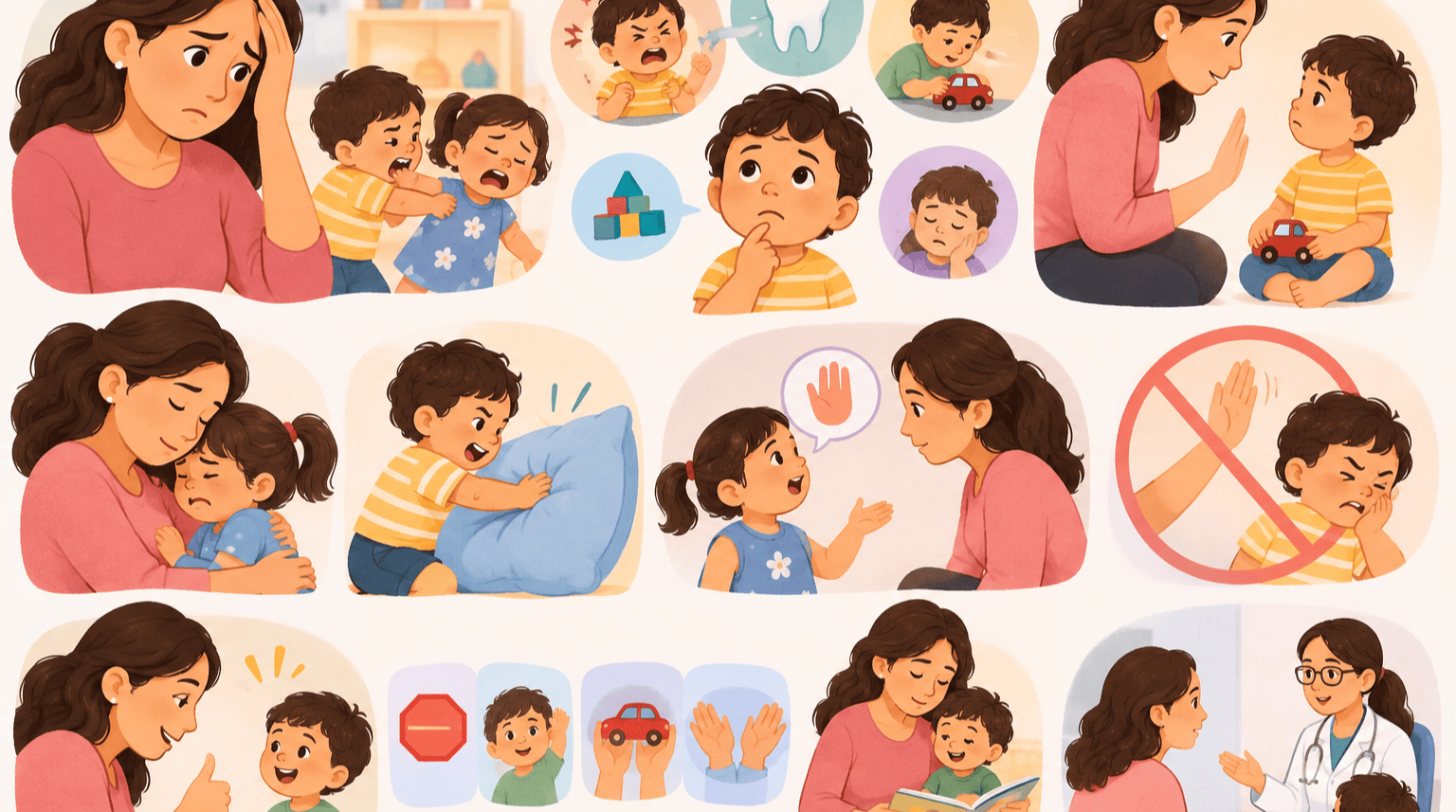
Toddler hitting and biting is common, it follows a predictable curve, and it's one of the most judged — and least discussed — parts of early parenting. Here's what research actually says about why it happens, what helps, and when it's worth asking for help.
Toddler aggression is physical behaviour like hitting, biting, pushing or scratching that peaks in frequency between ages 2 and 3 and typically declines as language and self-regulation develop. It's a normal, if difficult, stage of early development — not a character trait.
Is It Normal for a Toddler to Hit and Bite?
Yes. Physical aggression occurs in 12-month-olds, but significantly more in 24- and 36-month-olds. In a study of 2,223 children, frequency rose from age 1½ to 3½ and then declined until age 13. In a national Canadian study, most children followed a moderate trajectory that faded over time.
One researcher argues the real question isn't why children learn to be aggressive, but how they learn to inhibit it. That's your job at this age — teaching the brakes.
Biting follows the same pattern. It's most common between the first and second birthday and tends to lessen as language improves.
toddlers have been bitten at daycare at some point — biting at this age is close to universal, not a sign that something is wrong with your child or anyone else's.
Why Do Toddlers Hit and Bite?
They don't have the words yet
Toddlers can't tell you they're excited, angry, tired or overwhelmed, so frustration rooted in limited language often comes out physically.
Their bodies are still developing
Teething, developing oral-motor skills and ordinary sensory exploration all play a part in biting.
They're testing cause and effect
Many toddlers look genuinely surprised when the other child reacts loudly — they're learning what their actions do.
They're copying what they see
Toddlers imitate the people around them, and aggression modelled nearby raises the odds they'll use it too.
It worked, once
One child pushes another and takes the toy. If the other child cries and walks away, the aggressive child feels successful.
Basic needs, unmet
Hunger, tiredness, overstimulation and transitions all make a hit or a bite more likely in the moment.
The Language Link
Language and aggression are connected, though not as simply as "late talkers hit." In a population study following children from 17 to 72 months, the associations were modest and limited to the period when both are changing fastest — roughly 17 to 41 months. In 126 preschoolers, stronger language predicted less physical aggression, partly through better self-control.
Disruptive behaviour and language delay also tend to show up together early. As words grow, hitting and biting usually fade — which is why a toddler who hits a lot and says very little deserves a closer look.
What Helps in the Moment
Toddlers feel big feelings long before they can manage them, which is exactly why what you do right after a hit or a bite matters more than the behaviour itself.
Stay calm, keep it short
"Biting hurts" or "No hitting, hitting hurts" works better than a long explanation.
Comfort the other child first
Separate the two, then attend to the child who was hurt before you speak to your own child about what happened.
Offer a safe outlet
"You can't hit me, but you can hit the pillow" gives the feeling somewhere to go.
Don't label them "a biter"
A label can intensify the behaviour and lodge itself in a child's sense of who they are.
Act early
Step in at the first sign of frustration, before the hit — it's far easier to redirect than to undo.
Use distraction
Moving a toddler to another activity works well at this age, before frustration boils over.
What Doesn't Help
Never hit or bite back to show how it feels — that teaches aggression, not empathy. Spanking signals that hitting is okay. Until age 3, and sometimes later, children don't really understand the concept of punishment, so clear, calm limit-setting beats punishment every time. Avoid threats, and teach the alternative instead of just naming the problem.
Build the Skill: Words and Routine
Teach short phrases like "stop," "my turn," "help" and "all done," and practise them when everyone is calm, not mid-meltdown. Praise gentle behaviour when you see it — toddlers repeat whatever gets attention, so make sure the good moments get noticed too.
Parent training is the best-supported approach to children's disruptive behaviour. An analysis of parenting programmes found that less harsh verbal discipline and more consistent follow-through were the strongest ingredients. Not every programme works, though — a trial in Brazil produced small changes in parenting without reducing aggression, so consistency and fit matter as much as the method itself.
When to Ask for Help
Most hitting and biting settles by age 3 or 4.
Talk to your paediatrician if it:
- Continues past 3 or 4, is excessive, or is getting worse
- Is constant, escalating, or severely disrupts daily life
- Comes with very few words, sensory difficulties or extreme meltdowns
- Doesn't match the situation, or your child can't recover from it
Some frequently aggressive children need a developmental assessment, since delays in speech and language or neurodiversity can be related. If aggression has gone on for more than a few weeks and you can't cope, consult your paediatrician.
If your instinct says this is more than a phase, that's reason enough to ask — not something to second-guess.
Bring the Pattern, Not Just the Incident: ParentQ
Whether this is "normal" depends on details — how often, when, with whom, and what came right before. ParentQ by Fairy Tales lets you take those details to a real developmental paediatrician instead of guessing alone. Ask things like:
- "My 22-month-old bites at nursery but never at home. What does that mean?"
- "He hits when he's tired or can't get a word out. Should I worry about his speech?"
- "She's 3 and still bites. How do I know if it's more than a phase?"
Before you write, note what happened right before, who was involved, where and when it happened, and how you responded. Type it or record a voice note, and add a short video of how your child plays and communicates. You get preliminary guidance and can keep asking follow-ups in the same thread. The first query is free, and it isn't for emergencies or injuries.
Ask a Specialist
A hitting or biting pattern that's hard to explain in general terms? Ask a developmental paediatrician directly — privately, no appointment needed.
Watch It Fade With Hidden Hum
Hitting and biting usually decline as language and self-control grow, so the trend matters more than any single incident. Hidden Hum, Fairy Tales' parent-led early skills monitoring, takes under six minutes from home. Use it to track how your child communicates and plays over time, so you can see whether their skills are growing as the hitting fades. It isn't a diagnosis — it gives you and your paediatrician a baseline, and a trend.
Start Hidden Hum →Sources: Tremblay et al., 2018 (JAMA Network Open) · Alink et al., 2006, the early aggression curve · Canadian national trajectories study · Girard et al., aggression and language, 17–72 months · Language, aggression and self-regulation, 2021 · Disruptive behavior and language delay (PMC) · Language and anger regulation (PMC) · ZERO TO THREE: why toddlers bite · KidsHealth: stop biting · CHOC: why children bite · Cleveland Clinic: biting · Cleveland Clinic: toddler hitting · AACAP: fighting and biting · HealthyChildren.org (AAP): aggressive behavior · Parenting programme mediators (JAACAP) · Parenting programmes in Brazil (Prevention Science) · Behavioral parent training (CDC Stacks) · Care.com: toddler aggression · ParentData: hitting and biting. This article is educational and does not replace assessment by a qualified clinician.
Frequently asked questions
Is hitting normal for a toddler?
Yes. It rises through ages 2 to 3 and usually declines after.
Why does my toddler bite?
Common reasons include limited words, teething, curiosity, imitation and frustration.
At what age should biting stop?
Usually by 3 or 4, as language improves.
Should I hit or bite my child back?
No. It teaches the child to use aggression.
Does late talking cause hitting?
They are linked, mostly while both are changing fast, around 17 to 41 months.
When should I worry about toddler aggression?
When it continues past 3 or 4, is constant or escalating, or disrupts daily life.