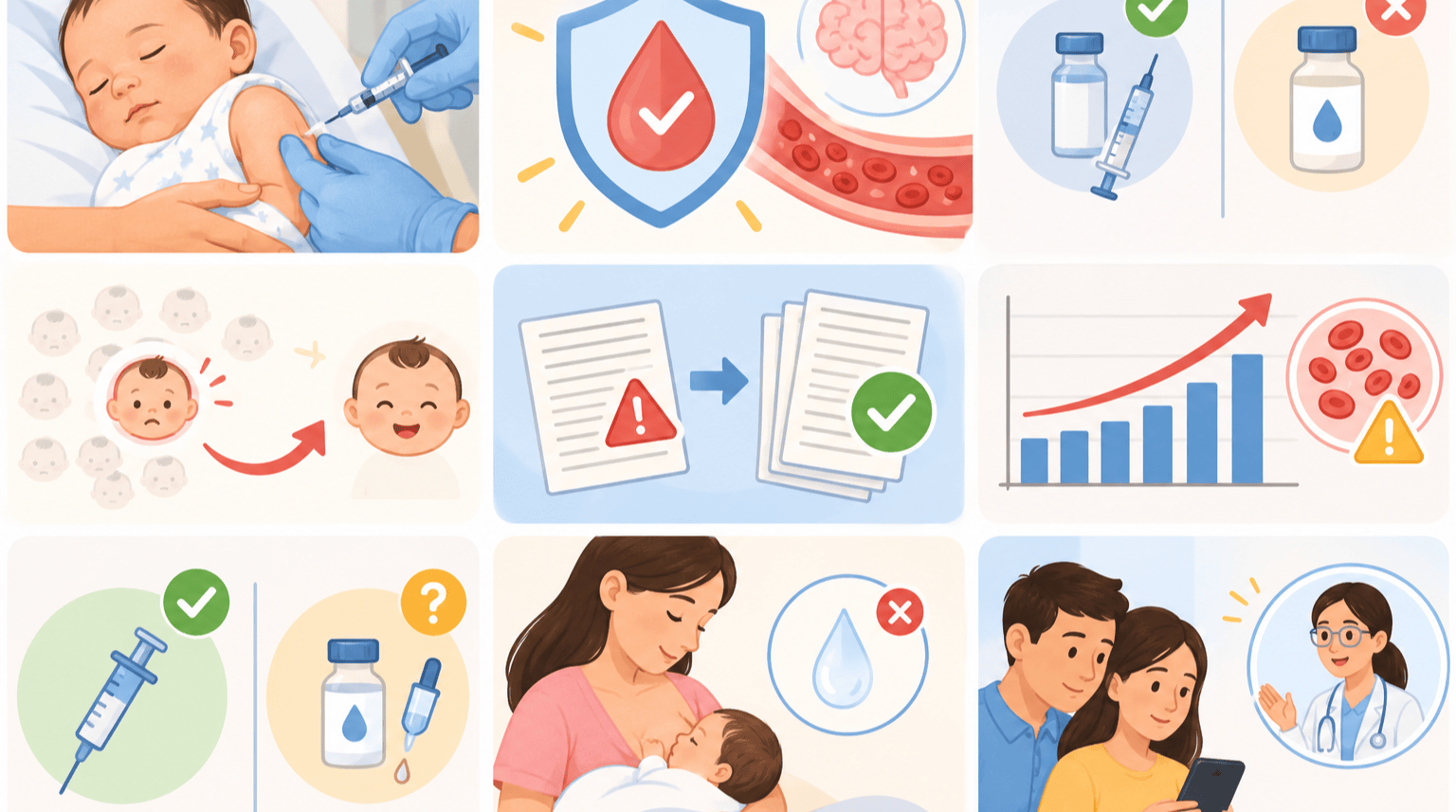
The vitamin K shot is a single injection given to newborns within hours of birth to prevent a rare but serious bleeding disorder. It is not a vaccine, and its recommendation hasn't changed — even as other parts of the childhood immunization schedule have.
If you've seen the news about vaccine schedule changes and found yourself wondering whether that includes the vitamin K shot too, you're asking exactly the right question — and the short answer is no, it doesn't. But the fact that you had to ask is itself worth taking seriously, not brushing past.
Here's what actually changed, what didn't, and what the evidence says — so you can make the call for your baby from a clear picture, not a confused one.
Why this feels different right now
In January 2026, the US CDC (Centers for Disease Control and Prevention) reduced the number of vaccines recommended for all children from 17 to 11. In late 2025, it also ended its universal recommendation for the newborn hepatitis B shot. Both of those were real, documented changes to federal vaccine policy, and if you're a new parent trying to keep track of what your baby is "supposed to" get, it's genuinely reasonable to wonder what else might be in question.
The vitamin K shot is one of the things people have started wondering about — but it was never part of that policy change, for a simple reason: it isn't a vaccine. It doesn't train your baby's immune system against a pathogen. It replaces a nutrient every baby is naturally born short on. The federal schedule changes were specifically about vaccines, and vitamin K sits in a different category entirely — one that wasn't reviewed, debated, or altered.
The honest version of this moment: broader confusion about what's still recommended is real and understandable. But this specific shot's evidence base, and the recommendation behind it, hasn't moved.
What this shot actually protects against
Babies are born with very little vitamin K, which blood needs in order to clot properly. Without a shot, that gap puts a baby at real risk of vitamin K deficiency bleeding (VKDB) — a rare but serious bleeding disorder, most dangerous when the bleeding happens inside the brain.
higher risk of a severe bleed in babies who don't get the shot, compared to babies who do. About 1 in 5 babies with a serious VKDB bleed does not survive it (AAP; CDC).
The American Academy of Pediatrics recommends every newborn receive a one-time vitamin K shot, ideally within six hours of birth. It isn't a precaution layered on top of good care — it's treated as a standard, baseline part of it, the same way a first weigh-in or a hearing check is.
Where the fear came from, and what happened next
The concern about this shot isn't something that appeared out of nowhere on social media. It traces back to a real 1992 study that reported a higher rate of childhood leukemia in babies who'd received a vitamin K injection — a legitimate finding, published in a legitimate journal, that understandably alarmed people at the time.
What happened next is the part that usually gets left out: four separate, large population studies — across Sweden, the United States, Germany, and the United Kingdom — tried to replicate that finding. None of them could. Current medical consensus, built on that larger body of evidence rather than the original single study, is that there is no link between the vitamin K shot and leukemia.
That's a meaningfully different story from "parents are being irrational." A real signal was found, it was investigated seriously and repeatedly, and it didn't hold up. Some current online claims reviving the leukemia concern are circulating again — but they're pointing back at the same 1992 finding that's already been tested and not confirmed, not at anything new.
What's happening to babies who don't get it
This isn't a theoretical debate anymore — there's current data on it. A JAMA study tracking more than 5 million infants found that the share of newborns not receiving the vitamin K shot more than doubled between 2017 and 2025, and refusals rose a further 57% in just the first half of 2026 alone.
| What the data shows | Finding |
|---|---|
| Refusal rate, 2017 vs. 2025 | More than doubled (3.1% → 6.8%) |
| Refusal rate, first half of 2026 | Up 57% in six months |
| VKDB cases, same period | Up roughly 350% |
| Babies diagnosed with VKDB | About 80% had not received the shot |
Doctors in multiple US hospitals have independently described the same pattern: more families declining the shot, and more infants arriving with bleeding — including bleeding in the brain — that the shot is specifically designed to prevent. This is the clearest real-world signal available right now on what happens when the decision shifts at scale.
Shot or drops — the honest trade-off
If needles for your newborn feel like the hardest part of this, it's worth knowing the actual trade-off rather than treating it as shot-versus-nothing.
A single oral dose of vitamin K is meaningfully less protective than the injection. A full oral course — multiple doses, given exactly on schedule over several weeks — comes much closer to matching the shot's protection, but no study has directly compared the two head-to-head in a clinical trial, so that closeness is inferred, not proven outright.
The real trade-off isn't "shot is good, drops are bad." It's a single dose with near-complete, one-time protection, versus avoiding the needle in exchange for protection that depends entirely on completing every scheduled dose, exactly on time, for weeks.
If a completed oral course is something you're considering instead of the shot, that's a conversation worth having directly with your baby's paediatrician — specifically about whether your situation makes it realistic to complete every dose without missing one.
Two things worth clearing up
Two misunderstandings come up often enough that they're worth naming directly. Breastfeeding does not provide a newborn enough vitamin K on its own — breast milk is naturally low in it, which is part of why the gap exists in the first place. And the vitamin K shot is not a vaccine, even though it's sometimes talked about alongside one; it doesn't work on the immune system at all, and vaccine-specific concerns don't actually transfer to it.
Still unsure? Ask a real doctor, privately
General information can only take a decision like this so far — it can't account for your baby's specific birth, your family's history, or what's actually making you hesitate. ParentQ lets you take the specific version of this question to a real, named paediatrician directly, instead of piecing together an answer from search results and social media.
You don't need to wait for a scheduled appointment. Describe exactly what's making you uncertain — a story you read, a specific risk factor, a missed dose if you've started an oral course — and ask plainly. The first query is free, and because it's asynchronous, you get a real answer without having to arrange a visit for one question.
Ask a Specialist
Still weighing the shot, the drops, or something specific to your baby's situation? Ask a real paediatrician directly — privately, no appointment needed.
Sources: American Academy of Pediatrics · HealthyChildren.org (AAP) · Yale Medicine · FactCheck.org · Texas Children's Hospital · The Conversation · Medscape · ProPublica · NIH Research Matters · CDC. This article is educational and does not replace a direct conversation with your baby's paediatrician.
Frequently asked questions
Did the vitamin K shot change along with the vaccine schedule?
No. It isn't a vaccine and wasn't part of the 2026 changes. Its recommendation and the evidence behind it are unchanged.
Why do newborns need a vitamin K shot?
Babies are born with very low vitamin K. Without the shot, they're roughly 80 times more likely to have a serious bleed, most often in the brain.
Does the vitamin K shot cause leukemia?
No. A 1992 study raised the question, but four later large studies couldn't replicate it. Current consensus is there's no link.
Is oral vitamin K as effective as the shot?
A single oral dose is meaningfully less protective. A fully completed multi-dose course comes closer, but depends entirely on not missing a dose.
Are vitamin K shot refusals actually increasing?
Yes — more than doubled since 2017, with a 57% jump in just the first half of 2026, alongside a roughly 350% rise in VKDB cases.