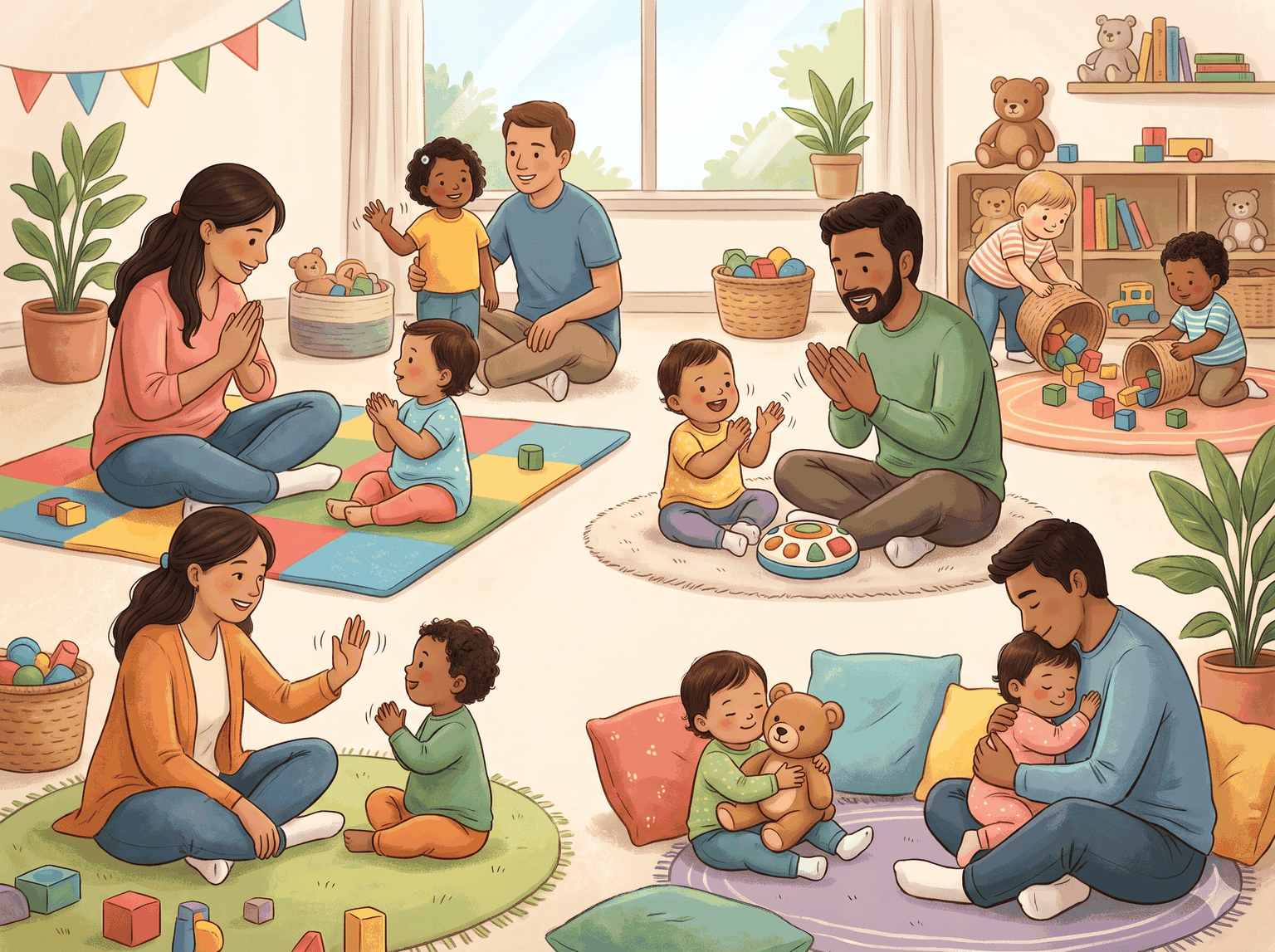
At 15 months, the big social skills are copying other children while playing, showing you an object they like, clapping when excited, hugging a stuffed toy, and showing you affection with hugs, cuddles or kisses. Most children — 75% or more — reach these by this age, alongside the babbling and early words most toddlers are building at the same time.
Your 15-month-old claps when the song ends, hugs their teddy, and watches another toddler tip toys out of a basket, then does the same. If you're wondering whether your child waves, copies a namaste, or shows enough affection, the answer is usually yes in their own way.
Here is what research and guidelines say about these social skills at 15 months, how to practise them, and when to ask for help.
What social skills should a 15-month-old have?
CDC social milestones for 15 months include copying other children while playing (like taking toys out of a container when another child does), showing you an object they like, clapping when excited, hugging a stuffed doll or toy, and showing you affection with hugs, cuddles or kisses. A milestone means most children, 75% or more, can do it by that age.
Waving is slightly earlier. CDC lists waving "bye-bye" at 12 months. By 15 months, waving or a namaste is best read as imitation: does your child copy gestures they see?
Clapping when excited
Clapping is a simple expressive gesture, and a happy one. CDC suggests singing songs with gestures like "Wheels on the Bus" and seeing whether your child tries the actions. In autism research, one early sign is not playing simple interactive games like pat-a-cake or peekaboo by 12 months. A child who claps late but loves games with you is showing the pattern you want.
Showing affection
Affection can look like hugs, cuddles, kisses, a head resting on your shoulder, or hugging a teddy. Hugging a stuffed doll is early caring play. Attachment research across many cultures finds secure attachment is the most common pattern worldwide, with core ideas supported in African and Asian samples, though context shapes how it's expressed.
In a survey of over 14,000 adults in 45 countries, hugging and kissing were reported most often with partners and children, yet expression varied with culture and personality. Your family's way of showing love counts.
Copying other children
At 15 months, copying peers is simple. Before 18 months, peer interactions are rare and uncoordinated, even though babies show interest in each other from 6 months. A 15-month-old tipping toys out of a basket because another child did is the milestone.
Imitation is how toddlers connect before they have words. Toddlers play reciprocal copying games, like repeating jumps or ball throws, as a kind of nonverbal conversation. This appears in diverse cultures. Within four months of beginning imitation games, toddlers start talking more with each other. Providing duplicate toys encouraged mimicry and more social interaction. This early copying is the seed of the parallel play most toddlers settle into by 30 months.
Easy ways to practise
- Wave, pause, wait. Make a big wave or namaste, then give them time to copy
- Try new objects. Ask "What do you do with a hat?" and put it on your head
- Sing action songs. Do the actions together
- Offer two of the same toy at playgroup
- Reward gentleness with affection. Teach gentle petting and respond warmly
- Skip screens. They aren't recommended under 2
When to talk to your doctor
Missing one milestone isn't alarming, since 25% of children aren't doing each yet. If your instinct says something feels off, that alone is reason enough to ask — but tell your doctor if your child isn't meeting several milestones or has lost skills. Worth raising:
- no pat-a-cake or interactive games by 12 months
- few or no gestures, such as not waving goodbye
- not showing you things they like by 15 months, or not pointing to show you something by 18 months
- rarely copying you, another child, or your gestures
In a study of 467 infants, those who later met autism criteria showed attenuated gesture growth between 12 and 24 months. Another study found imitation differences in children with autism as young as 24 months. These are patterns, not verdicts. Many children catch up, and the AAP recommends autism screening at 18 and 24 months or whenever you have a concern.
Bring real examples to a specialist: ParentQ
Social questions are easier when someone sees the moment. ParentQ by Fairy Tales lets you ask a developmental paediatrician privately. Ask things like:
- "My 15-month-old waves only when he feels like it, not when I wave first. Is that imitation?"
- "She claps but doesn't copy new gestures like namaste. Should I worry?"
- "He ignores the other kids at playgroup. Is that normal at 15 months?"
Before you write, note which gestures your child copies, whether they copy on request or on their own, whether they show you things, and how they respond to other children. Attach a short video of a gesture game (you wave or fold your hands, pause, wait) and of play near another child. You get preliminary guidance and can keep asking follow-ups in the same thread.
Ask a Specialist
Your first query is free. It isn't for emergencies.
Track social skills over time with Hidden Hum
Social skills build in steps: waving and pat-a-cake at 12 months, copying, clapping and affection at 15, and pointing to show you things by 18. Hidden Hum, Fairy Tales' parent-led early skills monitoring, takes under six minutes from home. Use it at 12, 15 and 18 months to see whether copying, gestures and showing are growing. It isn't a diagnosis, and it doesn't replace the autism screening your paediatrician offers at 18 and 24 months. It gives you structured observations and a trend.
Know Where Your Child Is Headed →Sources: CDC 15-month milestones · CDC milestones in action, 15 months · CDC 15-month checklist · Univ. of Michigan 15-month milestones · KidsHealth: 15 months · Understood: milestones for 1-year-olds · CDC autism signs and symptoms · Meltzoff: "Like me" foundation for social cognition · Meltzoff & Williamson: imitation and social-cognitive development · Deferred imitation in infancy, PMC · Peer imitation by toddlers, Hanna & Meltzoff · Eckerman on toddler imitation, Duke · Peer cooperation emerging in toddlerhood, PMC · Mimicry in 18-month-olds, core.ac.uk · Show, give and point gestures predict language, PMC · Gesture predicts language, Rowe & Goldin-Meadow · Gesture-rich world: Italian vs American children · Cross-cultural prelinguistic gesture development, Child Development 2021 · Sociocultural settings and deictic gestures, MPI · Liszkowski 2012, pointing across cultures · Cross-cultural attachment, Leiden · Attachment and culture, PMC · Affection through touch across cultures, SPSP · Imitation 12-24 months in infants at risk for ASD, PMC · Gesture growth in infants who develop autism, PMC · Imitation, joint attention and language, PMC · M-CHAT, Robins et al. 2001. This article is educational and does not replace assessment by a qualified clinician.
Frequently asked questions
What social milestones should a 15-month-old have?
Copying other children, showing you objects, clapping when excited, hugging a toy, and showing affection.
When should a baby wave bye-bye?
CDC lists waving at 12 months. By 15 months, many children copy waves and other gestures.
Is it normal for a 15-month-old not to clap?
Missing one milestone isn't alarming. Look at gestures and games overall.
Why does my toddler copy other children?
Imitation is how toddlers connect before they have words.
How can I teach my toddler to wave or namaste?
Do the gesture, pause, and wait. Repeat in songs and routines.
When should I worry about gestures and copying?
If your child uses few or no gestures, doesn't play interactive games, doesn't show you things, or has lost skills.



Imitating waving and namaste
Copying is how toddlers learn people. In Meltzoff's "like me" research, infants prefer a partner who behaves like them, and 14-month-olds smiled more at an adult who imitated their actions. Imitation is foundational in four areas of development: cultural learning, causal learning, social-emotional interaction, and understanding others as "like me." By 14 months, babies can imitate an action after a 24-hour delay.
Gestures also predict language. Children's gesture use at 14 months predicted vocabulary size at 42 months, and the objects a child pointed to predicted the words they later learned. Show and give gestures emerge before pointing.
Gesture forms vary by culture, but the link to language holds. Italian and American children had different gesture vocabularies, yet in both groups, gesture plus speech predicted two-word phrases. A study of 59 infants in three culturally distinct groups found no significant differences in gesture development. So whether your family waves, folds hands in namaste, or uses another greeting, copy the gestures used at home.