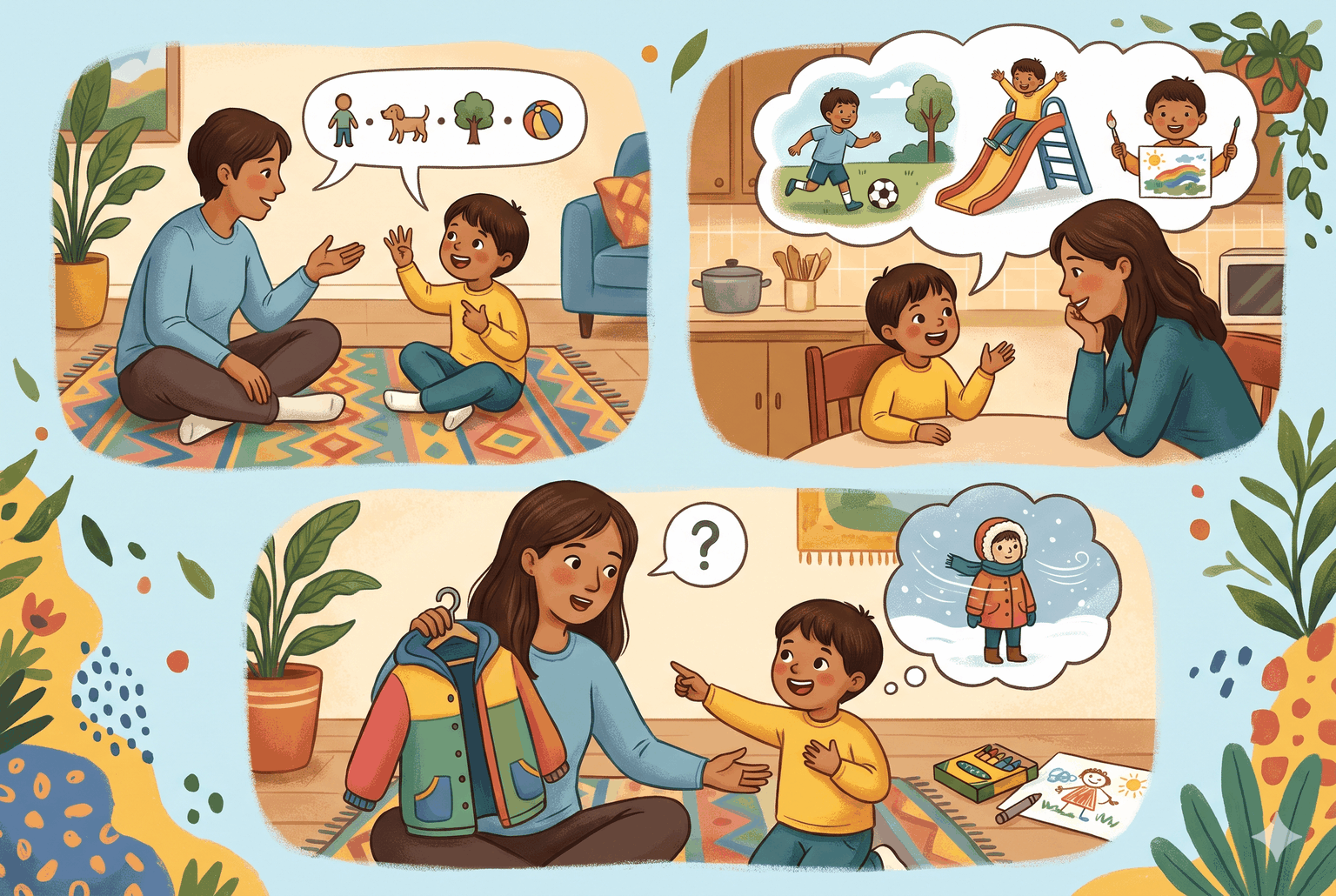
At 4, the three big speech milestones are using sentences of four or more words, talking about at least one thing that happened during the day, and answering simple questions like "What is a coat for?" Most children — 75% or more — reach all three by this age, alongside saying some words from a song, story or nursery rhyme.
Your 4-year-old chatters about dinosaurs but says "good" when you ask about nursery. Or they answer in short phrases and you wonder whether they should be further along.
At 4, three speech milestones stand out: sentences of four or more words, talking about something that happened during the day, and answering simple questions like "What is a coat for?" Here is what research and guidelines say about each, how to help, and when to ask a professional.
What speech should a 4-year-old have?
CDC language milestones for 4 years include saying sentences with four or more words, saying some words from a song, story or nursery rhyme, talking about at least one thing that happened during the day (like "I played soccer"), and answering simple questions like "What is a coat for?" or "What is a crayon for?" A milestone means most children, 75% or more, can do it by that age. Children born prematurely may reach milestones later.
Many 4-year-olds can also tell what comes next in a well-known story, and often lean on pretend play to practise new words and ideas alongside it.
Four-word sentences: what to expect
By 4, most children use sentences of at least four words, and many errors are still normal. Saying "I goed" is a common, developmentally appropriate grammar slip. Speech and language are different. A child can pronounce words clearly but struggle to build a four-word sentence, or the reverse.
Sounds matter too. A health-authority guide says 4-year-olds usually use p, b, m, d, n, h, w, g, k, f, t, ng and y correctly. Hearing problems can affect speech and language development, so hearing is part of any check.
Telling you about their day
Talking about the day is a skill built in conversation. Between ages 3 and 5, children can hold more detailed conversations about the past but still rely on adults for most of the structure and content.
How we talk about the past shapes it. Parents with a "highly elaborative" style ask open-ended "why" and "how" questions, follow their child's contributions, and keep adding detail. Their children tell more coherent, emotionally expressive stories. Teaching mothers this style led to more advanced personal narratives years later, and elaborative reminiscing was linked with stronger vocabulary. Yes/no questions give children less to work with than open "what" and "why" questions.
Culture shapes how families reminisce, because how a culture thinks about the self influences the content and structure of these conversations. Your family's storytelling style is a strength.
Why "What is a sweater for?"
This question suits how young children understand words. Preschoolers tend to define words by function. A coat is "to keep warm." Word definitions develop from functional and concrete to more abstract as children grow.
One theory holds that children's earliest word meanings rest on what things do, and questions like "What is it for?" matter to young children. Whether they use function can depend on the task and how much time they get, so a 4-year-old who pauses isn't failing.
Talk with your child, not at them
In a study of children aged 4 to 6, the number of back-and-forth conversational turns, not the number of words adults spoke, was linked to language skills and brain activity for language, whatever the family's income. When families increased turn-taking, children gained most. The brain-imaging link is correlational, but the intervention results support it.
- Ask open questions. "What was the best part?" beats "Was it fun?"
- Follow their lead. Add one detail and wait
- Ask at predictable times. Dinner or bedtime works
- Talk about the day in your home language. Make a "This Is Me" photo album to prompt memories
Bilingual children
Bilingual children meet basic language milestones within monolingual norms, but each language's vocabulary may be smaller than a monolingual child's, because input is divided. Bilingual children are both over- and under-identified for language disorder, because tests assume monolingual performance.
Assessment should consider both languages. Count what your child says in all their languages together, and tell the professional which languages are used and for how long.
When to talk to a professional
Developmental language disorder is common. In a UK study of children starting school, 7.58% had a language disorder of unknown origin, about two in a class of 30, and a Mandarin-speaking study found a similar 8.5%. Only 11% of those children met education targets, and many don't get services.
If your instinct says something feels off, that alone is reason enough to ask — but here's what's specifically worth raising. Raise it if your 4-year-old:
- doesn't use sentences of four or more words
- is hard for teachers or new adults to understand, or struggles with sounds like /k/, /g/, /f/ or /s/
- can't tell a simple story or answer simple questions
- can't follow two- or three-step directions
- is frustrated when talking, or has lost words or skills
Act early if your child isn't meeting milestones, and ask about screening.
Bring real examples to a specialist: ParentQ
Speech questions depend on what your child actually says. ParentQ by Fairy Tales lets you ask a developmental paediatrician privately. Ask things like:
- "My 4-year-old understands everything but speaks in 2-3 word phrases. Is that a delay?"
- "She says 'good' whenever I ask about nursery. Is that normal?"
- "We speak two languages at home. How do I know if he's on track?"
Before you write, jot down three of the longest things your child said this week, in each language, who understands them, which sounds are hard, and any ear infections. Record a short voice note or video of them talking. You get preliminary guidance and can keep asking follow-ups in the same thread.
Ask a Specialist
Your first query is free. It isn't for emergencies.
Track speech growth with Hidden Hum
Speech grows in steps. At 4, children use four-word sentences and mention one thing from their day. By 5, most speak in longer sentences and tell simple stories. Hidden Hum, Fairy Tales' parent-led early skills monitoring, takes under six minutes from home. Use it at 4 and again six months later to see whether sentences, storytelling and answers are growing. It isn't a diagnosis, and it doesn't replace a speech-language evaluation. It gives you structured observations and a trend.
Know Where Your Child Is Headed →Sources: CDC 4-year milestones · CDC milestones in action, 4 years · 4-year checklist, CDC · KidsHealth: 4 years · Understood: 4-year-old milestones · Alberta Health Services, Talk Box: 4 years · St. Jude: language 4-5 years · Parent-child reminiscing, Fivush et al. · Elaborative conversation, Loyola · Open-ended questions and memory, PMC · Parent-led reminiscing and oral narrative, Reading and Writing · How children define words, Gavriilidou · Definitions development · Form and function in early word meaning · Matching and naming by shape or function, Deák & Ray · Conversational turns, Harvard Graduate School of Education · Romeo et al. 2018 · Conversation intervention, MIT McGovern · Neuroplasticity and turn-taking RCT, PMC · Norbury et al. 2016, JCPP · UCL: two children in every class · How We Fail Children With DLD, LSHSS · DLD prevalence incl. Mandarin-speaking children · Assessing bilingual children for DLD · Bilingual delay assumptions, JSLHR 2023 · Bilingual development, PMC · Assessing bilingual children, PMC · Speech intelligibility 30-119 months, JSLHR · Expressable: when to worry · Speech Blubs: speech delays at 4. This article is educational and does not replace assessment by a qualified clinician.
Frequently asked questions
What speech should a 4-year-old have?
Four-word sentences, a few words from songs, talking about their day, and answering simple questions.
Should a 4-year-old speak in full sentences?
Yes. Most speak in sentences of four or more words.
Why can't my 4-year-old tell me about their day?
Storytelling is still adult-supported at this age. Ask open questions and add detail.
Why do 4-year-olds answer "What is a coat for?" by function?
Preschoolers define things by what they do.
How can I help my child talk more?
Have back-and-forth conversations, ask open questions, and follow their lead.
When should I worry about a 4-year-old's speech?
If they don't use four-word sentences, strangers can't understand them, or they've lost skills.