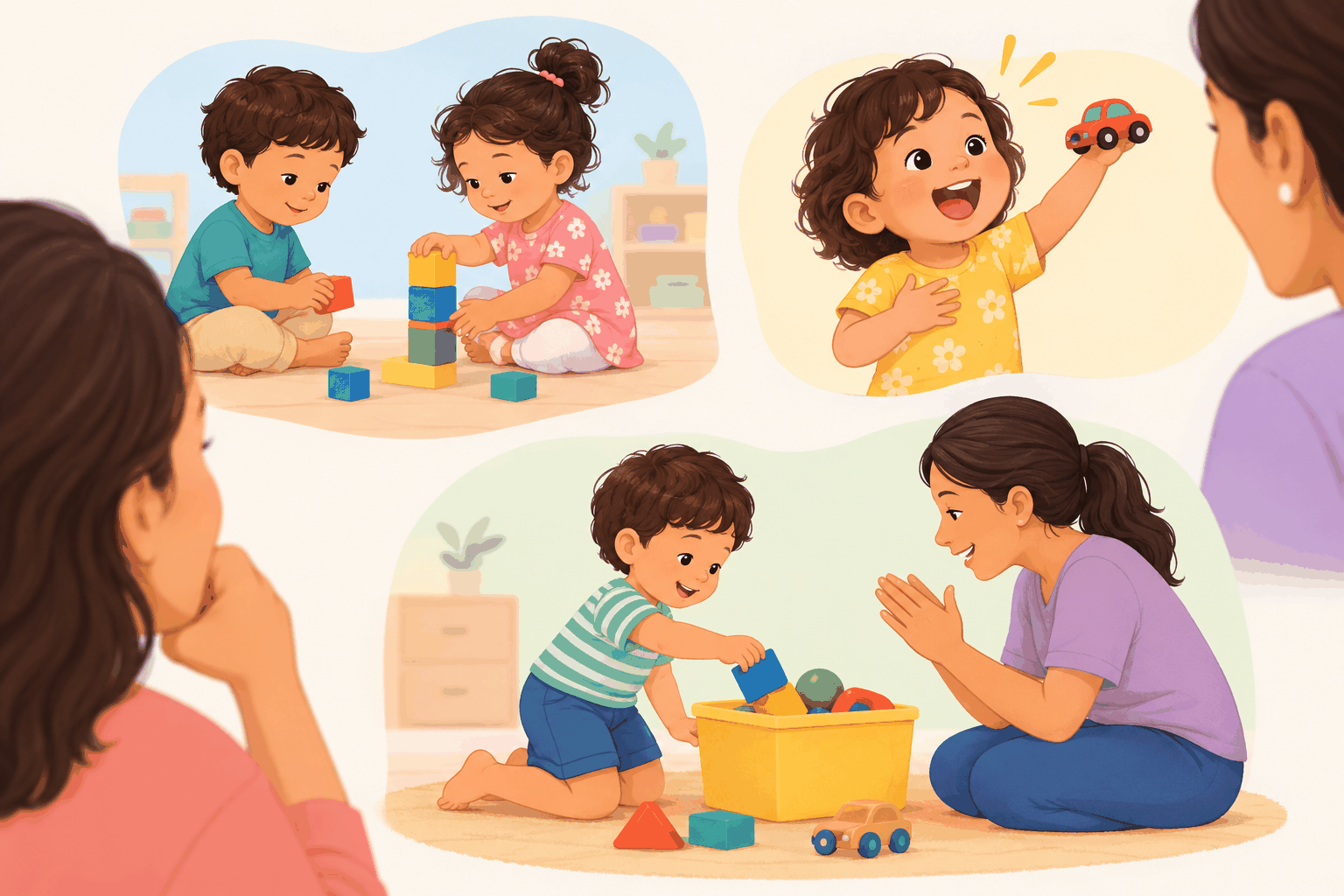
At 30 months, the three big social milestones are playing next to other children and sometimes with them, showing you what they can do by saying "Look at me!", and following simple routines like helping pick up toys at clean-up time. Most children — 75% or more — reach all three by this age.
Your 2.5-year-old plays happily beside another child without ever speaking to them. They shout "Look at me!" every few seconds. And at clean-up time they either help or run.
If you're wondering whether this is typical, it usually is. Here is what research and guidelines say about these three social milestones, how to support them, and when to ask for help.
What social skills should a 30-month-old have?
CDC milestones for 30 months include playing next to other children and sometimes with them, showing you what they can do by saying "Look at me!", and following simple routines when told, like helping pick up toys when you say, "It's clean-up time." A milestone means most children, 75% or more, can do it by that age.
The American Academy of Pediatrics recommends standardized developmental screening at 9, 18 and 30 months. The 30-month visit is a good moment to raise anything you've noticed.
Why your toddler keeps saying "Look at me!"
It's a milestone, not attention-seeking. Self-conscious emotions such as pride emerge by 24 months and are well established by 30 months. When your child shows you what they can do, they're sharing something and checking your reaction.
Research on two-year-olds found that toddlers who sought attention positively when a parent was busy collaborated more with the parent afterwards, while those who cried or threw things collaborated less. The takeaway is to answer the positive bid. A quick "I see you!" matters.
Showing also matters clinically. CDC lists not sharing interests with others by 15 months, such as showing you an object they like, among early signs of autism. It's the pattern across behaviours that counts, not one missed "Look at me."
Clean-up time: toddlers want to help
Many toddlers want to help, and research suggests it starts early. Infants as young as 14 months help in simple situations. Rewards seem to reduce later helping.
Cross-cultural research suggests that where toddlers are invited into family work, they keep helping. In one study, 74% of children in an Indigenous-heritage community regularly took initiative in household work, compared with none in a cosmopolitan community. Researchers describe this as "learning by observing and pitching in." Many Western parents brush off a toddler's offer to help because it slows them down.
A 2023 study of 105 mother-toddler pairs, with toddlers aged 17 to 30 months, found collaboration was the key to getting toddlers to tidy up.
How to make clean-up work
- Ask for one clear thing. "Put the blocks in the basket" works better than "tidy up"
- Give a warning and a signal. Use a timer or a 5-minute warning, and a clean-up song
- Do it together. Collaboration beats instructions
- Limit what's out. If clean-up is hard, reduce the toys available
- Acknowledge the big feelings. "It's hard to clean up this fort you worked so hard on" invites connection, not a fight
- Don't clean up for a tantrum. If tantrums mean you do it, you'll get more tantrums
If your toddler doesn't join other children
At 30 months, parallel play is on track. CDC's autism signs list not noticing other children and joining them in play by 36 months, not 30. If your child doesn't play near or with others, possible explanations include temperament, social experience, language skills, sensory processing and neurodivergence.
Ask childcare staff how your child does there. Keep playdates short so your child isn't overwhelmed.
When to talk to your doctor
Act early if your child isn't meeting milestones or has lost skills. If your instinct says something feels off, that alone is reason enough to ask — but look at the whole picture. Worth raising:
- little or no interest in other children, with no glancing or imitating
- rarely showing you things or sharing interests, or not pointing to show you something by 18 months
- not noticing when others are hurt or upset by 24 months
- not following simple routines or two-step instructions
- any loss of skills
Bring your example to a specialist: ParentQ
Social questions depend on what you see in context. ParentQ by Fairy Tales lets you ask a developmental paediatrician privately. Ask things like:
- "My 2.5-year-old plays beside other kids at nursery but never with them. Is that normal?"
- "He rarely says 'look at me' or shows me things. Should I be concerned?"
- "She ignores clean-up time unless I do it with her. Is it listening or defiance?"
Before you write, note where it happens, whether your child glances at or copies other children, what they show you, and how clean-up goes with one-step versus two-step requests. Ask childcare staff what they see. Attach a short video of your child playing near peers. You get preliminary guidance and can keep asking follow-ups in the same thread.
Ask a Specialist
Your first query is free. It isn't for emergencies.
Track social play over time with Hidden Hum
Social skills at 30 months sit between two checkpoints: parallel play and pretend play at 24 months, and noticing and joining other children by 36 months. Hidden Hum, Fairy Tales' parent-led early skills monitoring, takes under six minutes from home. Use it around 30 months to see how your child plays beside others, shows you things and follows routines, then repeat it as they grow to see the trend. It isn't a diagnosis, and it doesn't replace the standardized 30-month screening your paediatrician offers. It gives you structured observations to bring along.
Know Where Your Child Is Headed →Sources: CDC 30-month milestones · CDC milestones in action, 30 months · CDC 30-month checklist · KidsHealth: 30 months · CDC autism signs and symptoms · ZERO TO THREE: parallel play · Parallel play overview · Parten's stages of play · Play and peer relationships chapter · Pampers: parallel play · Lovevery: social play for toddlers · Gosselin & Forman 2012, attention-seeking · Toddlers' guilt, shame and prosocial behaviour, PMC · Self-conscious emotions review · Emotional development in toddlerhood · Toddlers want to help, Psychology Today · Raising helpful toddlers, Duncan et al. · NPR: chores without resentment · Child Helpers, Cambridge Element · Helping emerges in infancy, PMC · Harvard Health: put away toys · How to get your kid to clean up, Parenting Translator · Tidy-up guide, NJ Dept of Education · Emotion coaching and tidying, Univ. of Melbourne. This article is educational and does not replace assessment by a qualified clinician.
Frequently asked questions
Is it normal for a 2.5-year-old to play alone?
Yes. Playing near other children, not with them, is typical.
What is parallel play?
Children play side by side without trying to influence each other, often watching and imitating.
Why does my toddler say "Look at me!"?
They're sharing what they can do and checking your reaction. It's a 30-month milestone.
Should a 30-month-old help clean up?
Most can help pick up toys when told it's clean-up time.
How do I get my toddler to clean up?
Use one clear request, a warning, a song, and do it together.
When should I worry about social development at 30 months?
If your child shows no interest in other children, doesn't share or show things, can't follow simple routines, or has lost skills.



Playing alongside others: parallel play
Parallel play means children play near each other without trying to influence each other's behaviour. It typically begins around 24 to 30 months, though sources differ on exact ages, and stages overlap and shouldn't be treated as rigid deadlines.
Side by side doesn't mean disconnected. Children in parallel play glance at peers, imitate them, and choose similar toys, which is peer awareness without a shared plan.
Researchers also point out that Parten's classic stages can mislead, because they don't account for gestures and non-verbal interaction. Parallel play stays common through the preschool years and can be a bridge into more interactive play. Some children also use it as a coping style with unfamiliar peers.