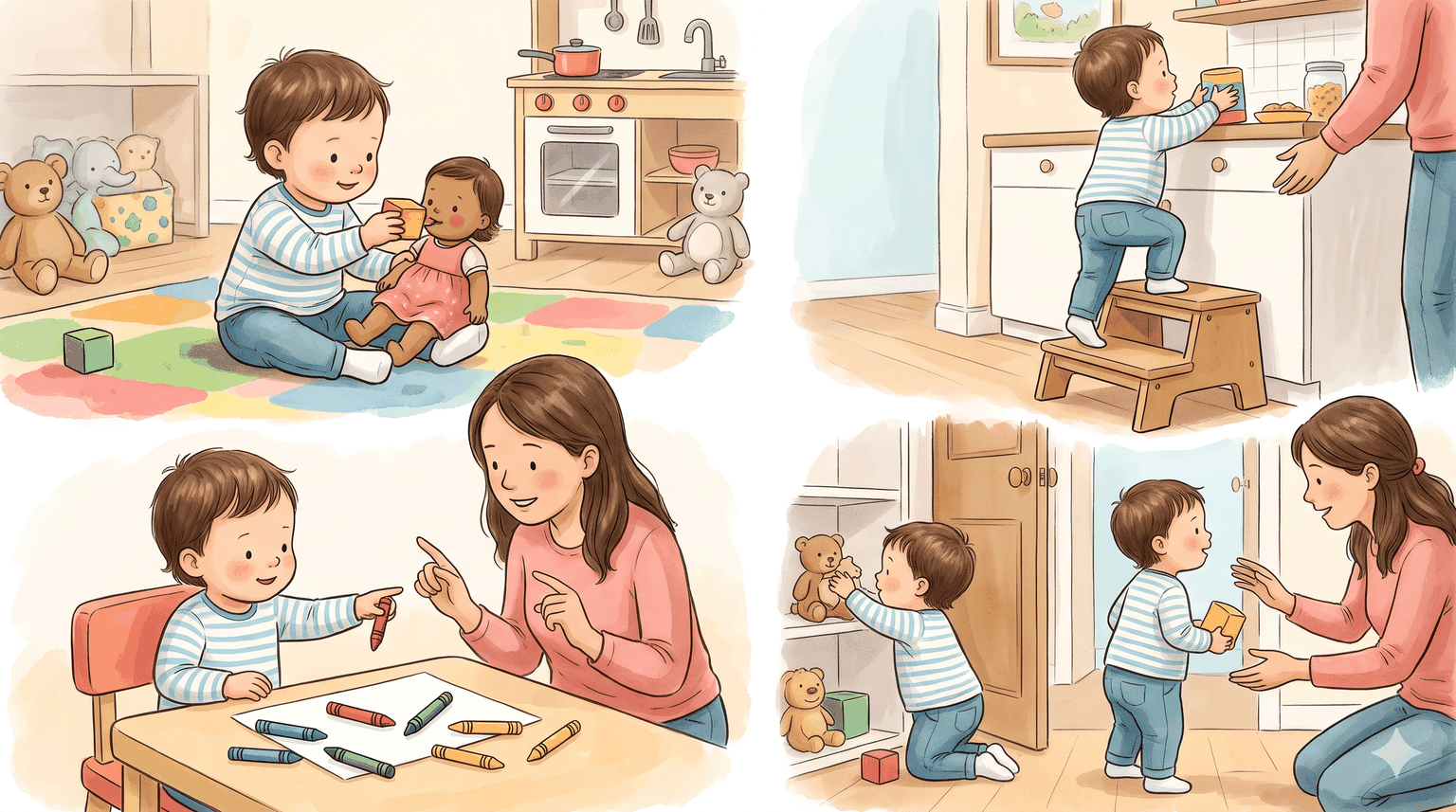
At 30 months, the four big thinking skills are using things to pretend (like feeding a block to a doll), showing simple problem-solving (like standing on a stool to reach something), knowing at least one colour, and following two-step instructions. Most children — 75% or more — reach all four by this age.
Your 2.5-year-old feeds a block to a doll, drags a stool to the counter, points to the red crayon, and sometimes follows "Put the toy down and close the door." If you're wondering whether that's typical, it very likely is.
At 30 months, four thinking skills stand out. Here is what research and guidelines say about each, how to support them, and when to ask a professional.
What thinking skills should a 30-month-old have?
CDC cognitive milestones for 30 months include using things to pretend, like feeding a block to a doll as if it were food; showing simple problem-solving, like standing on a small stool to reach something; following two-step instructions like "Put the toy down and close the door"; and showing they know at least one colour, like pointing to a red crayon when you ask "Which one is red?" A milestone means most children, 75% or more, can do it by that age. Children born prematurely may reach milestones later.
The American Academy of Pediatrics recommends general developmental screening at 30 months. Children born early may reach milestones later.
Pretend-feeding a doll
Pretend play begins to emerge around age 2 and peaks in the preschool years. It appears across cultures. Among the Yucatec Maya, early pretend play at about 18 months is rarely acknowledged or supported by adults, yet it increases steadily through childhood. Even in cultures where adults discourage pretending, children spontaneously pretend. Where adults take part varies by culture, so a child who pretends alone is not behind.
Parents often hear that pretend play builds intelligence and creativity. A review of more than 150 studies found no good evidence that pretend play contributes to creativity, intelligence or problem-solving, though it may contribute to language, storytelling, social development and self-regulation. Enjoy it for what it is.
Pretend play also matters as a signal. One of the review's authors noted that a complete absence of pretend play between 18 months and 2 years could point to autism and suggests an evaluation. Parents help by showing what pretend looks like: mothers who smiled after pretend actions helped toddlers understand them as play.
Simple problem-solving: the stool
Researchers use tool use as a window on how toddlers under 3 solve problems, because it shows planning. This builds on earlier skills like searching for a hidden object — now your toddler plans several steps ahead, not just one. Using one object to reach a goal is means-end thinking.
Between ages 2 and 4, children rapidly develop flexible tool-based problem-solving. At 30 months, don't expect flexibility. Two-year-olds often fail to carry a solution over to a similar problem, while many 3-year-olds can. In infants, combining objects in play was linked to better problem-solving.
Knowing a colour
The CDC milestone is pointing, not naming. Toddlers can usually understand basic colour words by about 30 months, while producing them keeps improving until 4 or 5. Children in the US typically acquire colour words at 2 to 3, and there is a long gap between first using a word and using it exactly. Researchers call this "slow mapping," and it has been shown in Japanese children as well.
Children aren't colour-blind and can tell colours apart within months of birth. Some babies show colour-word comprehension as early as 19 months.
Naming for a stranger is hard. Producing words in front of an experimenter can be daunting, so caregivers' observations may be more sensitive. If your toddler mixes up red and orange, that's normal.
Following two-step instructions
Following directions draws on listening, understanding, memory and attention. Two-step directions appear in different guides from 24 to 30 months, so timing varies. Most 30-month-olds can follow instructions like "Pick up the toy and put it on the shelf."
Hearing matters. Even mild or intermittent hearing loss can affect understanding, and some children need more time to process.
How to support these skills
- Pretend alongside them. Let them cook with safe kitchen things, and feed the doll with them
- Offer a gentle challenge. Let them work out how to reach a toy
- Name colours in daily life. "Which one is red?" at snack or dressing time
- Use short instructions. Start with one step, pair words with gestures, pause, and praise
- Limit choices to two or three
- Ask "who, what, where" questions in books
When to talk to your doctor
Tell your doctor if your child isn't meeting one or more milestones or has lost skills. If your instinct says something feels off, that alone is reason enough to ask — but look at the whole picture. Worth raising:
- no pretend play at all
- can't follow simple one-step instructions
- doesn't point to or show any colour knowledge
- little interest in solving simple problems, or no reaching for things with tools
- hearing concerns or frequent ear infections
By 3, a child who doesn't understand two-part instructions should be seen.
Bring what you observed to a specialist: ParentQ
Thinking skills are easiest to judge in context. ParentQ by Fairy Tales lets you ask a developmental paediatrician privately. Ask things like:
- "My 2.5-year-old lines up his toys but never pretends. Should I worry?"
- "She knows colours in a song but points to the wrong crayon. Is that normal?"
- "He follows one step but loses the second. Is it listening or understanding?"
Before you write, note exactly what you said and what your child did, whether you repeated it, hearing and ear-infection history, and what they do with a doll or a block. Attach a short video of play and of a calm two-step request. You get preliminary guidance and can keep asking follow-ups in the same thread.
Ask a Specialist
Your first query is free. It isn't for emergencies.
Watch these skills grow with Hidden Hum
Thinking skills build in steps. At 24 months, many children use two toys together, like toy food on a toy plate. At 30, they feed a doll. By 4, they pretend to be something else, like a teacher or a superhero. Hidden Hum, Fairy Tales' parent-led early skills monitoring, takes under six minutes from home. Use it around 30 months and again at 36 to see how pretend play, problem-solving, colour knowledge and directions are growing. It isn't a diagnosis, and it doesn't replace the 30-month screening your paediatrician offers. It gives you structured observations and a trend.
Know Where Your Child Is Headed →Sources: CDC 30-month milestones · CDC milestones in action, 30 months · CDC 30-month checklist · KidsHealth: 30 months · Univ. of Michigan 30-month milestones · Understood: milestones for 2-year-olds · Lillard et al. 2013, impact of pretend play · UVA news: pretend play review · Child Mind Institute: pretend play · Pretend play across cultures, Museum of Play · Pretend play and counterfactual reasoning across cultures · Universal and variable aspects of play, Haight et al. · Maternal cues and toddlers' understanding of pretense · Keen 2011, development of problem solving · Tool-use problem solving in 2-4.5-year-olds, PMC · Analogical transfer in toddlers, Front Psychol · Object play and problem solving in infancy, Oxford · Colour word learning in toddlers, UEA · Slow mapping in Japanese children, Front Dev Psychol 2025 · Early comprehension of colour words, Forbes & Plunkett · Scientific American: color words · Raising Children Network: language 2-3 years · Raising Children Network: development 2-3 years · Following directions guide, Beaming Health · Lovevery: cognitive development at age 2. This article is educational and does not replace assessment by a qualified clinician.
Frequently asked questions
What cognitive milestones should a 30-month-old have?
Pretend play, simple problem-solving, knowing at least one colour, and following two-step instructions.
Should a 2.5-year-old pretend play?
Yes. Using a block as food for a doll is a 30-month milestone.
What is simple problem-solving at 30 months?
Using a stool to reach something.
When do toddlers know colours?
Most understand basic colours by about 30 months and name them more reliably by 4 or 5.
Should a 30-month-old follow two-step instructions?
Most can follow simple ones like "Pick up the toy and put it on the shelf."
When should I worry?
If your toddler doesn't pretend, can't follow simple instructions, or has lost skills.