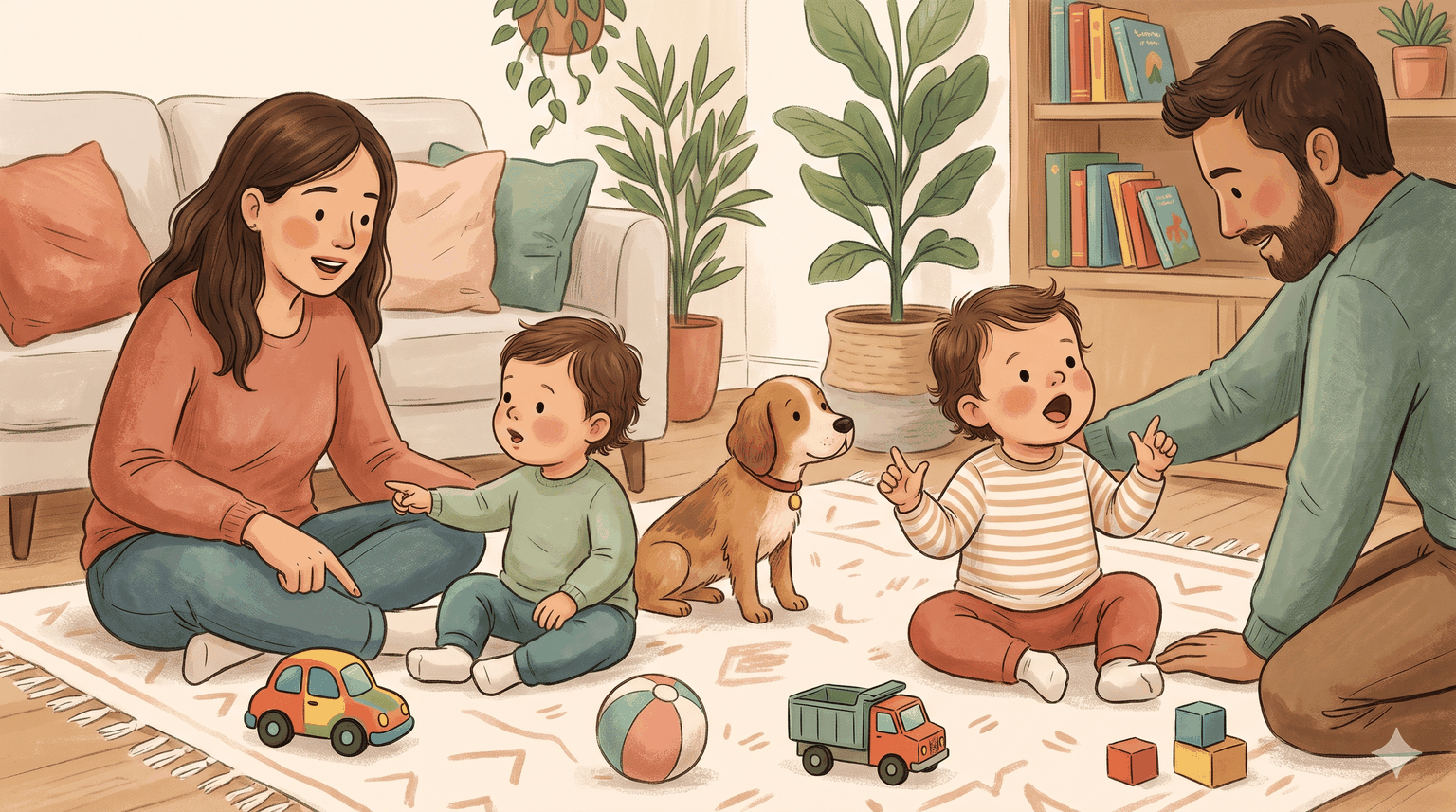
At 15 months, the two core speech milestones are trying to say one or two words beyond mama or dada, and looking at a familiar object when you name it. Most children — 75% or more — reach both by this age, alongside the waving, clapping and copying most toddlers are also practising socially at this stage.
Your 15-month-old babbles all day, says "dada" to everyone, and perhaps "brum" when a car goes by. You wonder whether that counts, and whether you should be hearing more.
At 15 months, CDC lists two core speech milestones: trying to say one or two words beyond mama or dada (or baba, whichever your family uses), and looking at a familiar object when you name it. Here is what research says about each, how to help, and when to ask.
What speech should a 15-month-old have?
CDC language milestones for 15 months include trying to say one or two words besides "mama" or "dada," like "ba" for ball or "da" for dog; looking at a familiar object when you name it; following directions given with both a gesture and words; and pointing to ask for something or to get help. A milestone means most children, 75% or more, can do it by that age. Children born early may reach milestones later.
First words beyond mama and dada
The wording matters: "tries to say." A child who says "ba" for ball is on track. This is the natural next step after the babbling most babies build through their first year. CDC's advice is to repeat and add to what they say: if they say "ba," you say "Ball, yes, that's a ball."
Early vocabularies look similar across languages. Children's first 10 words were predominantly words for people in English, Mandarin and Cantonese. Sound words such as animal and vehicle noises were the second largest category in a Mandarin study, so "woof" and "brum" are normal early words. Mandarin-speaking children used relatively fewer nouns and more verbs than English-speaking children, so first words differ across languages too.
The range is wide. Researchers describe tremendous individual variation in vocabulary, with growth slow at first and accelerating in the second year. Many 15-month-olds have only a few words. Some have none and then say many.
Looking at what you name
Understanding comes first. Babies as young as 6 to 9 months look at the picture of a named food or body part, which shows they know word meanings, and this has been replicated. Comprehension stays fairly stable until about 13 months and then improves robustly around 14 months. Parents' checklists show comprehension vocabulary growing steadily from 8 to 18 months.
The words babies understand early are common across settings: foods, body parts, caregivers. Researchers describe a lag between understanding and speaking.
So try this: ask "Where's your cup?" and watch where your child looks. Looking, pointing or fetching all count.
Bilingual families
Bilingual babies reach early milestones at the same pace. They produce first words around the same age as monolingual children. In a study of 302 bilingual and 302 monolingual Polish children, milestones came at similar ages.
Bilingual toddlers often know fewer words in each language, but their total vocabulary is comparable. Count words across both languages, and count "dog" and "chien" as two words for one idea. Measuring one language alone can make a bilingual child look behind.
How to help
- Name and wait. When your child points, name the object, then pause a few seconds. If they make any sound, say "Yes! Cup."
- Repeat and add. Turn "ba" into "Ball, yes, a ball."
- Respond to babble. Toddlers whose mothers responded promptly to their vocalizations and play reached language milestones earlier, though that study didn't control for total language input
- Make a picture book of people and pets in your child's life and name them
- Use gestures and songs. Gesture at 14 months predicted vocabulary at 42 months, and show and give gestures precede pointing
- Limit screens. A meta-analysis of 42 studies linked more screen time to weaker language, while co-viewing and quality were associated with better language. These are associations, not proof of cause. CDC recommends no screen time under 2 apart from video calls
If your child has few words
Roughly half of late talkers catch up by age 3, but up to 25% have language difficulties into school, and it's hard to tell which. Diagnosing delay before 24 months is difficult because variability is high. Late talkers may be more at risk if their understanding, symbolic gestures or functional communication is weaker, so understanding and gesture matter more than word count at 15 months.
"Many experts now say 'wait and see' is outdated, since a slow start is more likely temporary if it appears in isolation and is identified before 18 months. Asking early costs nothing."
If this continues closer to 18 months, our guide on the 18-month-old not talking covers the next set of signs to watch for.
When to talk to your doctor
Tell your doctor if your child isn't meeting one or more milestones or has lost skills. If your instinct says something feels off, that alone is reason enough to ask — but here's what's specifically worth raising:
- doesn't look toward objects or people you name
- no pointing, or few or no gestures by 12 months
- doesn't show you things they like by 15 months
- doesn't respond to their name, or you worry about hearing. Even mild or intermittent hearing loss can affect understanding
The AAP recommends general developmental screening at 9, 18 and 30 months and autism screening at 18 and 24 months.
Bring what you hear to a specialist: ParentQ
Early speech is hard to judge in your head. ParentQ by Fairy Tales lets you ask a developmental paediatrician privately. Ask things like:
- "My 15-month-old says 'dada' to everyone and 'brum' for cars. Does that count?"
- "He looks at the right picture when I name it but says nothing. Should I worry?"
- "We speak two languages at home. She says one word in each. Is she on track?"
Before you write, list every word-like sound, the language and the situation, whether your child looks at or points to what you name, hearing or ear-infection history, and any gestures. Attach a short video of a "Where's the…?" game or a voice note of their babble. You get preliminary guidance and can keep asking follow-ups in the same thread.
Ask a Specialist
Your first query is free. It isn't for emergencies.
Watch speech grow with Hidden Hum
Speech builds in steps. At 12 months, children call a parent "mama," "dada" or another name and wave bye-bye. At 15, they try one or two more words and look at what you name. By 18, they follow directions without gestures. Hidden Hum, Fairy Tales' parent-led early skills monitoring, takes under six minutes from home. Use it at 12, 15 and 18 months to see whether words, understanding and gestures are growing. It isn't a diagnosis, and it doesn't replace the screenings your paediatrician offers at 18 months. It gives you structured observations and a trend.
Know Where Your Child Is Headed →Sources: CDC 15-month milestones · CDC milestones in action, 15 months · CDC 15-month checklist · Univ. of Michigan 15-month milestones · KidsHealth: 15 months · CDC autism signs and symptoms · Bergelson & Swingley 2012, PNAS · Bergelson & Swingley 2015, replication · The comprehension boost in early word learning, Bergelson · Early word comprehension, Duke · Wordbank: open repository of vocabulary data · Wordbank book: consistency in early vocabulary · Baby's first 10 words, Tardif et al. · Mandarin and English early vocabulary, Tardif 1999 · Mandarin early vocabulary, 928 children · Bilingual milestones, Polish study 2024 · Keeping up with the monolinguals, Dutch infants · Bilingual vocabulary measurement, PMC · Bilingual and monolingual toddlers, PMC · Show, give and point gestures predict language, PMC · Late talkers: outcomes and predictors, Rescorla · Late talkers: social communication and vocabulary, PMC · Late language emergence review, PMC · Late talkers: why wait-and-see is outdated · Late talkers: what we know, Hanen · Late talkers critical review, Western Ontario · Screen use and child language, JAMA Pediatrics 2020 · Screen use and language, PMC. This article is educational and does not replace assessment by a qualified clinician.
Frequently asked questions
How many words should a 15-month-old say?
CDC looks for one or two beyond mama or dada, and word-like approximations count.
Is it normal for a 15-month-old to say only mama and dada?
Many do. Look at understanding and gestures too.
Why isn't my 15-month-old talking?
Variation is wide. Understanding comes first, and many catch up.
What does looking at a named object mean?
Your child understands the word, even if they can't say it yet.
Do bilingual babies talk later?
No. Bilingual babies reach early milestones at the same pace, and total vocabulary across both languages is comparable.
When should I worry about my 15-month-old's speech?
If they don't look at what you name, use few gestures, or have lost skills.