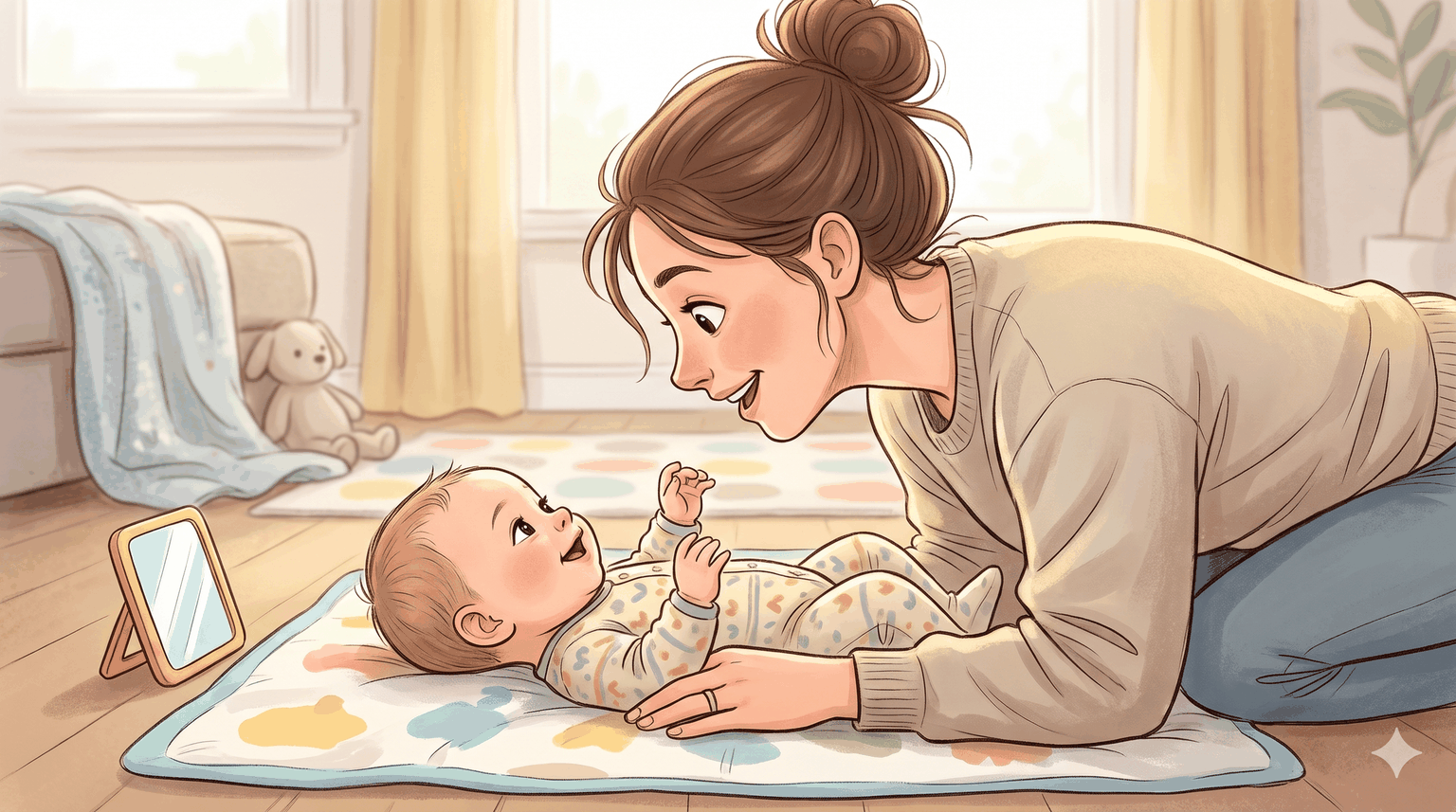
At 4 months, a baby smiling on their own to get your attention, and chuckling when you try to make them laugh, are two of the social milestones alongside the head control and tummy time milestones at this same age. Most babies — 75% or more — reach these by 4 months.
You lean in, make a silly noise, and your baby's whole face lights up. Then they do something new: they smile first, just to get you to look at them.
That's one of the social milestones at 4 months, and it's a lovely one.
What the milestone looks like
The CDC's 4-month checklist lists three social and emotional milestones:
- Smiles on their own to get your attention
- Chuckles (not yet a full laugh) when you try to make them laugh
- Looks at you, moves, or makes sounds to get or keep your attention
The key word is "on their own." Your baby isn't only smiling back at you any more. They're starting the conversation. A chuckle at this age is small, a breathy little giggle-sound, not a belly laugh. That's expected.
CDC defines a milestone as something 75% or more of children can do by that age. So some babies get there a little earlier and some a little later.
What's happening in your baby's mind
At this age, your face and voice are the most interesting things in the world. A study of 60 babies followed at 4, 6 and 8 months found that 4-month-olds didn't yet laugh at absurd events like a parent wearing a ball as a nose. Their heart rate slowed, though, which suggests they were paying close attention. When a parent laughed, it captured their attention.
By 5 months, babies in the same research laughed at those silly events even when the parent kept a neutral face (Mireault et al., 2018).
For your 4-month-old, then, the fun is mostly you: your voice, your face, your rhythm. They don't need a joke. They need you.
Families express this differently
Smiling back and forth, face to face, isn't the only way babies and parents connect. A study compared mother-infant pairs in Münster, Germany and in a rural Nso community in Cameroon at 6 and 12 weeks. Münster pairs spent more of their eye contact time smiling and imitating each other's smiles. The Nso mothers weren't less attuned. The researchers noted they responded in other ways, such as to the baby's sounds and through body contact (Wörmann et al., 2012).
Those babies were younger than 4 months, and the study was small. Still, it's a useful reminder that warmth doesn't have one look. If your family shows love through holding, carrying, humming or singing more than through long gazes, that counts.
Ideas to give your baby the chance
CDC suggests offering your baby the chance to show a milestone, then watching for a week or two. These are ideas, not research-proven recipes:
- Hold your face about an arm's length away and smile. Then wait. Give them time to smile back or start it themselves
- Try silly sounds — raspberries on a palm, or a gentle "I'm gonna get you" voice
- Notice when they look at you, wriggle or coo to keep you there. That counts as a milestone too
- Stop when they look away or fuss. That's their way of saying "enough"
If your baby was born early
Use your baby's corrected age. One Brazilian study of 105 preterm babies found a social smile in 71% when judged by age since birth, and in 94% when judged by corrected age (Albuquerque et al., 2013). It's a single, modest study, but it fits what paediatricians generally advise.
Not there yet?
If you aren't sure, CDC suggests watching over the next week or two and trying the ideas above. If your instinct says something feels off, that alone is reason enough to ask — talk with your child's doctor if the milestone still doesn't show up, or you have other concerns.
CDC also says developmental screening is recommended for all children, so it's fine to ask about it. You don't need to wait for a scheduled visit.
ParentQ: a question you can ask
"My 4-month-old smiles at me but hasn't really chuckled yet. Is that okay?"
That's the kind of question parents bring to ParentQ. A good answer starts with what CDC lists at this age, gives a couple of things to try, and says when a doctor is worth a call.
Ask a Specialist
Your first query is free. It isn't for emergencies.
Hidden Hum: the small moments
Hidden Hum is the quiet, everyday pattern of development. At 4 months, it's the smile you got while changing a nappy, the chuckle at the mirror, the cooing while you cooked. Noticing these small moments over a week or two is the kind of monitoring that gives you something clear to share with your child's doctor.
Know Where Your Child Is Headed →Sources: CDC: 4-month milestone checklist · CDC: Milestones in Action, by 4 months · Mireault et al. (2018), British Journal of Developmental Psychology, 36, 98–109 · Wörmann et al. (2012), Infant Behavior & Development, 35, 335–347 · Albuquerque et al. (2013), Journal of Human Growth and Development, 23(3), 318–321 · Scientific American: Laughing matters, and helps to explain how babies bond. This article is educational and does not replace assessment by a qualified clinician.
Frequently asked questions
When do babies start laughing?
CDC lists chuckling at 4 months. A popular-science summary of the research puts first laughs at around 14 to 18 weeks. A milestone means 75% or more can do it, so some babies chuckle later.
My baby smiles but isn't chuckling yet. Should I worry?
Watch over the next week or two and try the ideas above. If the chuckle still hasn't come, or you have other concerns, talk to your child's doctor.
Do I need to tell jokes?
No. At 4 months, your voice, face and play are the fun. In one study, 5-month-olds laughed at absurd events themselves, while 4-month-olds were captured mainly by their parent's reaction.
My baby was born early. Which age do I use?
Corrected age. One study of 105 preterm babies found far more social smiles when judged by corrected age.
Do babies in different cultures smile at different times?
Patterns of interaction differ. A small comparison of two communities found different amounts of face-to-face smiling at 12 weeks, and the authors stressed that sensitivity takes different forms. It doesn't say any one pattern is better.